Synonyms for Alliteration: 10 Related Terms Explained
Finding synonyms for alliteration can help you describe literary techniques more precisely, improve academic writing, and expand your understanding of poetic language. Alliteration refers to the repetition of the same consonant sound at the beginning of nearby words. Although several terms can describe this technique, not every similar literary device means the same thing.
Some expressions are genuine alternatives, while others refer to broader patterns of sound repetition. Understanding these differences helps you choose the right terminology for poetry, creative writing, literary analysis, and everyday communication.
Quick Answer: What Are Synonyms for Alliteration?
The closest synonyms for alliteration are head rhyme, initial rhyme, beginning rhyme, and front rhyme. These terms describe the repetition of similar initial sounds in nearby words, although some are less commonly used than others.
Expressions such as initial consonant repetition and repeated beginning sounds are also useful descriptive alternatives. Assonance and consonance are related literary devices, not exact synonyms.
10 Synonyms and Related Terms for Alliteration
The following table separates established alternative names from descriptive expressions and related literary concepts.
| Word or Phrase | Relationship | Meaning | Strength | Best Context |
|---|---|---|---|---|
| Head rhyme | Direct synonym | Repetition of initial sounds in nearby words | Strong | Literary analysis |
| Initial rhyme | Direct synonym | Repetition of consonant sounds at the beginnings of words | Strong | Poetry and literary terminology |
| Beginning rhyme | Near synonym | Repetition of sounds at the beginning of words | Strong | Educational explanations |
| Front rhyme | Near synonym | Repetition of initial sounds in nearby words | Strong | Literary education |
| Initial consonant repetition | Descriptive alternative | Reusing consonant sounds at the beginnings of words | Strong | Academic writing |
| Repeated beginning sounds | Descriptive alternative | Using the same starting sounds in nearby words | Strong | General explanations |
| Consonant repetition | Contextual alternative | Repeating consonant sounds within a phrase or passage | Moderate | Phonetic analysis |
| Sound repetition | Contextual alternative | Reusing sounds to create a noticeable language pattern | Moderate | Creative writing |
| Consonance | Related literary device | Repetition of consonant sounds, often within or at the ends of words | Different technique | Poetry analysis |
| Assonance | Related literary device | Repetition of similar vowel sounds | Different technique | Poetry and sound analysis |
Important distinction: The first four entries are alternative labels associated with alliteration, although their frequency and technical precision differ. The next four describe the technique rather than serving as established one-word synonyms. Consonance and assonance are related concepts, not interchangeable terms. TTABVUE+4
What Does Alliteration Mean?
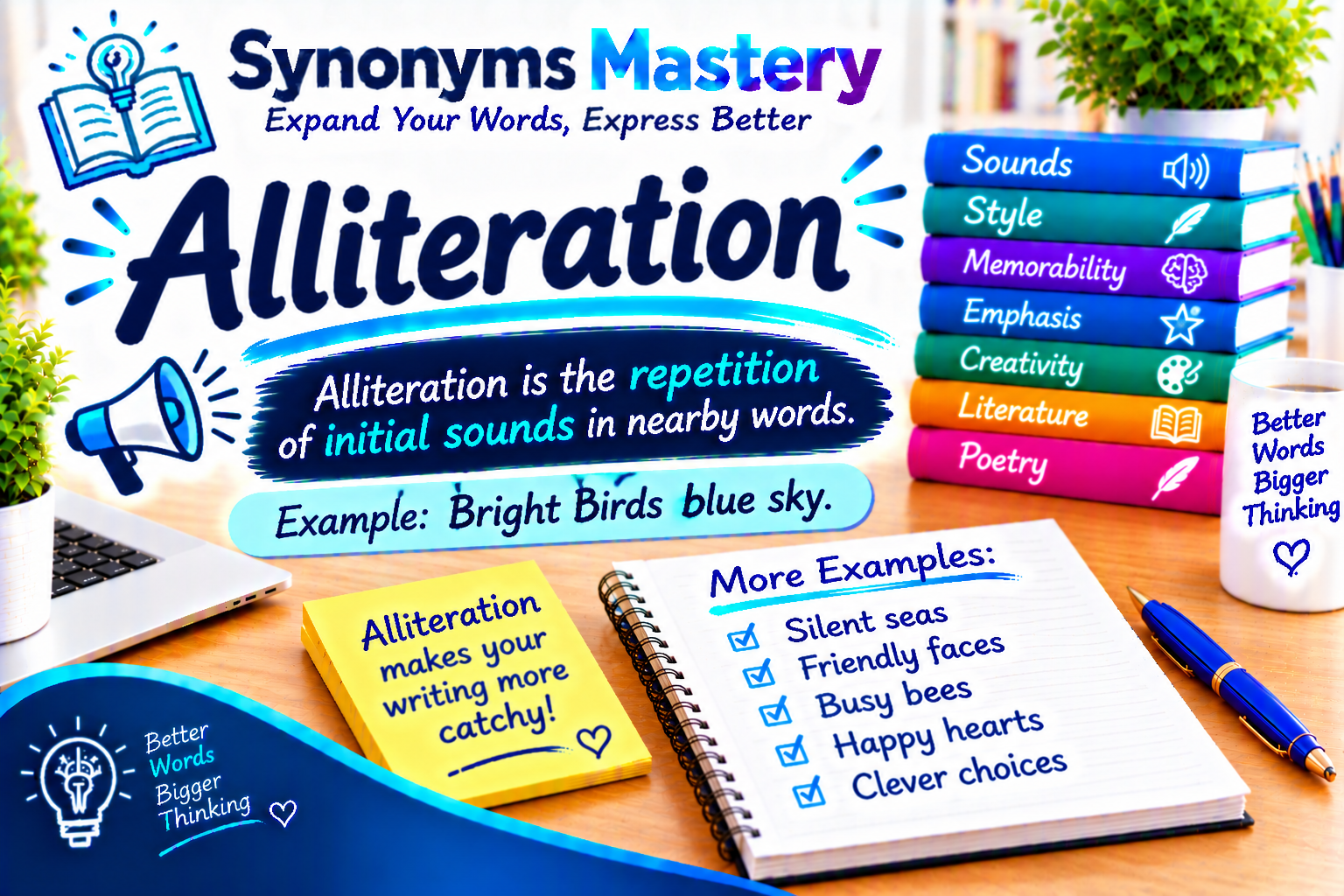
Alliteration is a literary and rhetorical device involving the repetition of the same or similar initial consonant sounds in nearby words or stressed syllables.
For example:
- Busy bees buzzed beside the blooming flowers.
- Peter picked a pile of purple plums.
- Wild winds whipped through the woods.
In these examples, the repeated beginning sounds create rhythm, emphasis, and a memorable effect.
Alliteration appears in poetry, advertising slogans, children’s literature, speeches, headlines, and everyday expressions. Writers use it to make phrases more engaging and give language a distinctive sound. The Poetry Foundation+2
Understanding the Closest Synonyms for Alliteration
Not every alternative expression has the same level of acceptance in literary terminology. Here are the most useful terms and how to use them.
1. Head Rhyme
Meaning: Head rhyme is another established name for alliteration, particularly the repetition of initial consonant sounds in neighboring words.
How it differs: It emphasizes the beginning or head of words rather than their ending sounds. Despite containing the word rhyme, it does not necessarily involve conventional end rhyme.
Best contexts: Poetry, literary criticism, academic discussions, and explanations of poetic sound patterns.
Example:
“The bright blue bird bounced between the branches.”
The repeated initial B sound creates head rhyme.
Register: Literary and technical.
2. Initial Rhyme
Meaning: Initial rhyme describes the repetition of consonant sounds at the beginnings of words or stressed syllables.
How it differs: It highlights the position where the repeated sound occurs. It is an established alternative label for alliteration.
Best contexts: Poetry instruction, literary terminology, and educational writing.
Example:
“Silent stars shone softly.”
The repeated S sound creates initial rhyme.
Register: Literary and academic.
3. Beginning Rhyme
Meaning: Beginning rhyme refers to the repetition of similar sounds at the start of nearby words.
How it differs: It is a straightforward descriptive label rather than the most standard technical term.
Best contexts: Classroom explanations, beginner-friendly writing, and introductory discussions of poetry.
Example:
“Funny frogs found fresh fruit.”
The repeated F sound creates a beginning-sound pattern.
Register: Informal to educational.
4. Front Rhyme
Meaning: Front rhyme is another expression used to describe repeated sounds at the beginnings of words.
How it differs: It emphasizes the front position of the repeated sounds. It is less familiar to general readers than alliteration or head rhyme.
Best contexts: Literary glossaries and educational explanations.
Example:
“Green grass grew gracefully.”
The repeated G sound produces front rhyme.
Register: Literary and educational.
5. Initial Consonant Repetition
Meaning: This phrase describes the repeated use of consonant sounds at the beginnings of nearby words.
How it differs: Unlike a traditional literary label, it explains exactly what the writer is doing.
Best contexts: Academic essays, grammar lessons, literary analysis, and writing instruction.
Example:
“Careful children crossed the crowded courtyard.”
The repeated C sound demonstrates initial consonant repetition.
Register: Formal and academic.
6. Repeated Beginning Sounds
Meaning: This expression refers to the recurrence of similar sounds at the start of multiple words.
How it differs: It is a plain-language explanation rather than a specialized literary term.
Best contexts: Beginner vocabulary lessons, elementary education, and simple writing explanations.
Example:
“Happy horses hurried home.”
The repeated H sound makes the phrase memorable.
Register: Neutral and conversational.
7. Consonant Repetition
Meaning: Consonant repetition describes the recurrence of consonant sounds within words or across a phrase.
How it differs: It is broader than alliteration because the repeated consonants do not have to appear at the beginnings of words.
Best contexts: Phonetic discussions, sound analysis, poetry, and creative writing.
Example:
“The thick black rock cracked.”
The repeated K sound contributes to the phrase’s sound pattern.
Register: Neutral to academic.
8. Sound Repetition
Meaning: Sound repetition refers generally to the reuse of particular sounds in spoken or written language.
How it differs: It covers several sound techniques, including alliteration, assonance, and consonance. It does not specifically identify initial consonant repetition.
Best contexts: Creative writing, poetry discussions, and general literary explanations.
Example:
“Soft silver sunlight slowly spread.”
The recurring sounds make the sentence more rhythmic.
Register: Neutral.
Register: Neutral and educational.
Related Literary Devices That Are Not Exact Synonyms
Some literary devices share features with alliteration but describe different sound patterns. Understanding these distinctions prevents inaccurate word choices.
9. Consonance
Meaning: Consonance is the repetition of consonant sounds in nearby words, often within words or at their endings.
How it differs from alliteration: Alliteration focuses particularly on initial sounds, whereas consonance can occur in different positions.
Best contexts: Poetry, phonetics, sound analysis, and literary criticism.
Example:
“The black rock cracked.”
The repeated K sound appears near the ends of words.
Register: Academic and literary.
10. Assonance
Meaning: Assonance is the repetition of similar vowel sounds in nearby words, especially in stressed syllables.
How it differs from alliteration: Alliteration generally emphasizes initial consonant sounds, while assonance emphasizes vowel sounds.
Best contexts: Poetry, songwriting, creative writing, and literary analysis.
Example:
“The rain in Spain stays mainly in the plain.”
The repeated long A sound creates assonance.
Register: Literary and academic.English meaning – Cambridge Dictionary+3
Alliteration vs. Similar Literary Terms
The following comparisons explain which expressions you can use interchangeably and which describe separate techniques.
Alliteration vs. Head Rhyme
| Feature | Alliteration | Head Rhyme |
|---|---|---|
| Meaning | Repetition of initial sounds | Alternative name for initial sound repetition |
| Usage | Standard literary term | Established alternative term |
| Context | General writing and poetry | Literary analysis |
| Example | Big brown bears | Big brown bears |
Which should you use? Choose alliteration for everyday explanations, school assignments, and general writing. Use head rhyme when discussing alternative literary terminology.
Alliteration vs. Consonance
| Feature | Alliteration | Consonance |
|---|---|---|
| Sound | Initial consonant sounds | Repeated consonant sounds |
| Position | Usually word beginnings | Beginning, middle, or end |
| Purpose | Creates emphasis and rhythm | Creates sound patterns |
| Example | Wild winds whistle | The black rock |
Which should you use? Use alliteration when the repeated consonant sounds occur at the beginnings of nearby words. Use consonance for broader consonant repetition.
Alliteration vs. Assonance
| Feature | Alliteration | Assonance |
|---|---|---|
| Repeated sound | Usually consonants | Vowels |
| Position | Usually word beginnings | Often stressed syllables |
| Purpose | Creates rhythm and emphasis | Creates musical sound patterns |
| Example | Pretty pink petals | The light of the fire |
Which should you use? Choose alliteration for repeated initial consonant sounds and assonance for repeated vowel sounds.
Alliteration vs. Rhyme
| Feature | Alliteration | Rhyme |
|---|---|---|
| Sound position | Usually beginnings | Usually endings |
| Main feature | Initial sound repetition | Matching final stressed vowel and following sounds |
| Example | Funny flying fish | Cat and hat |
Which should you use? Use alliteration when words share beginning sounds. Use rhyme when their ending sounds match.
Which Word Should You Use?
Your choice depends on the purpose of your writing.
- Choose alliteration when referring to the standard literary device.
- Choose head rhyme when you want an established alternative literary term.
- Choose initial rhyme when emphasizing repeated initial sounds.
- Choose beginning rhyme when explaining the concept to beginners.
- Choose front rhyme when discussing alternative terminology in a literary context.
- Choose initial consonant repetition when writing an academic explanation.
- Choose repeated beginning sounds when communicating with general readers.
- Choose consonance when describing repeated consonant sounds in different word positions.
- Choose assonance when discussing repeated vowel sounds.
- Choose sound repetition when referring broadly to recurring sounds in language.
For most readers, alliteration remains the clearest and most widely recognized term.
Common Mistakes When Choosing Alliteration Synonyms
Understanding related literary vocabulary is important, but using the wrong term can make an explanation inaccurate.
1. Treating Assonance as an Exact Synonym
Assonance involves repeated vowel sounds, not the initial consonant repetition generally associated with alliteration. Both are sound devices, but they describe different techniques.
2. Confusing Consonance With Alliteration
Consonance can occur anywhere within words. Alliteration specifically emphasizes repeated initial sounds in its conventional definition.
3. Assuming Every Repeated Sound Is Alliteration
Repeating sounds does not automatically create alliteration. The position and type of sound matter.
4. Using Head Rhyme to Describe Every Type of Rhyme
Head rhyme refers to initial sound repetition. It should not be confused with end rhyme or other conventional rhyming patterns.
5. Replacing Alliteration With an Unclear Expression
Phrases such as sound repetition can describe several literary techniques. Use a more specific term when the exact sound pattern matters.
Frequently Asked Questions
1. What is the closest synonym for alliteration?
Head rhyme and initial rhyme are two of the closest established alternatives for alliteration. Both describe repeated sounds at the beginnings of nearby words. Alliteration remains the more widely recognized term, particularly in general writing, education, and literary discussions.
2. Is head rhyme another word for alliteration?
Yes. Head rhyme is an established alternative name for alliteration. It refers to the repetition of initial consonant sounds in neighboring words or stressed syllables. The word rhyme in this expression does not mean that the words must have matching endings.
3. What is another word for alliteration in poetry?
Head rhyme and initial rhyme are suitable alternatives when discussing poetry. You can also use initial consonant repetition when explaining the technique to readers who may not recognize specialized literary terminology.
4. Are alliteration and consonance the same?
No. Alliteration focuses on repeated initial consonant sounds, while consonance describes repeated consonant sounds that may appear at the beginning, middle, or end of words. Alliteration is often discussed as a particular pattern of consonant repetition.
5. What is the difference between alliteration and assonance?
Alliteration generally repeats consonant sounds at the beginnings of nearby words, whereas assonance repeats vowel sounds in nearby words or stressed syllables. Both techniques contribute to rhythm, musicality, and emphasis in poetry and creative writing.
6. Can I use initial consonant repetition instead of alliteration?
Yes. Initial consonant repetition is a clear descriptive alternative when explaining how a phrase works. It is especially useful in academic writing and educational materials. However, alliteration is shorter, more established, and usually preferable when referring to the literary device itself.
7. Is sound repetition a synonym for alliteration?
Not exactly. Sound repetition is a broad expression covering several language techniques, including alliteration, consonance, and assonance. Alliteration is specifically concerned with repeated initial sounds, so the broader phrase may not communicate the intended meaning precisely.
8. Why do writers use alliteration?
Writers use alliteration to create rhythm, emphasize particular words, make phrases memorable, and improve the sound of their writing. It appears in poems, slogans, speeches, advertisements, headlines, and children’s stories because repeated sounds can make language more engaging.
Conclusion
Choosing the right synonyms for alliteration depends on the context and the level of precision your writing requires. Head rhyme and initial rhyme are the closest established alternatives, while beginning rhyme and front rhyme provide additional terminology. Descriptive expressions such as initial consonant repetition and repeated beginning sounds can make explanations easier to understand.
Consonance and assonance are related literary devices, but they should not be treated as exact replacements. For academic writing, poetry analysis, and everyday communication, alliteration remains the clearest choice. Understanding these distinctions helps you explain sound patterns accurately and use literary vocabulary with greater confidence.

Oliver Grant is a vocabulary researcher who focuses on uncovering the subtle differences between similar words. He specializes in synonyms, antonyms, and contextual usage, helping readers choose the most accurate word in any situation. His content is designed for writers, bloggers, and students who want to elevate their language skills and write with precision.