
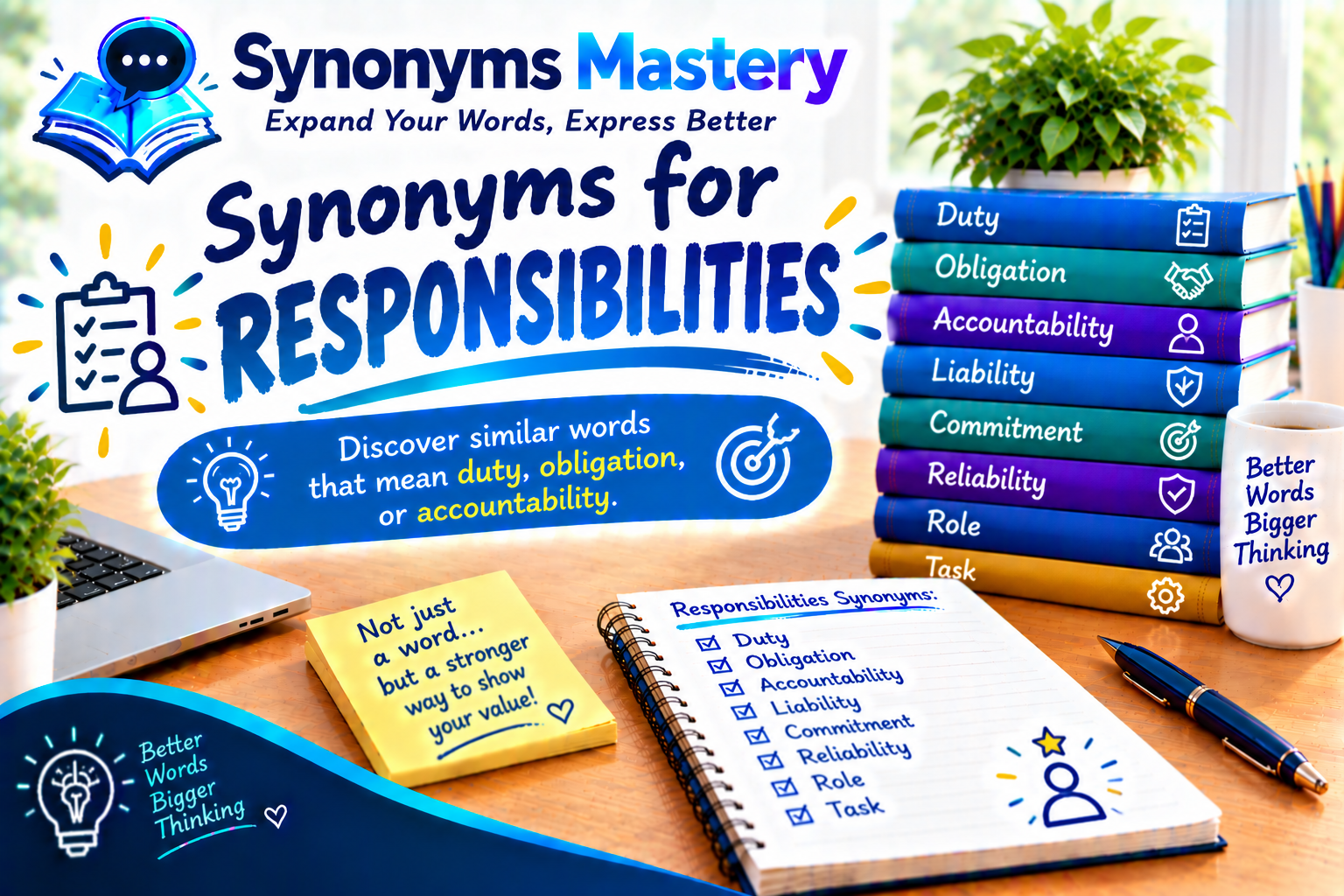
Synonyms for Responsibilities: Better Alternatives With Examples
Finding the right synonyms for responsibilities can help you make your writing more precise and avoid repeating the same word. Common alternatives include duties, obligations, tasks, assignments, commitments, roles, functions, and accountability, but these words are not interchangeable in every situation. Responsibilities can describe what someone is expected to do, what they are required to manage, or what they are answerable for. The best alternative depends on whether you are talking about a job, a specific task, a legal or personal obligation, a role, or accountability for results.
Quick Answer
The closest synonyms for responsibilities include duties, obligations, tasks, assignments, commitments, roles, functions, and accountability. Use duties for expected work, obligations for required commitments, tasks for specific pieces of work, and accountability when the focus is on being answerable for actions or results. The right choice depends on context and tone.
Core Synonym Resource
| Word | Relationship | Main Meaning | Best Context | Register |
|---|---|---|---|---|
| Duties | Direct/near synonym | Things someone is expected to do | Jobs, roles, regular work | Neutral/Formal |
| Obligations | Near synonym | Things someone is required to do | Rules, promises, serious commitments | Formal |
| Tasks | Contextual alternative | Specific pieces of work | Projects, jobs, school | Neutral |
| Assignments | Contextual alternative | Work given to someone to complete | School, projects, workplace | Neutral |
| Commitments | Near synonym | Things someone has agreed or promised to do | Work, personal life | Neutral/Formal |
| Accountability | Near synonym | Responsibility for actions or results | Management, leadership | Formal |
| Roles | Contextual alternative | Functions or positions someone performs | Work, organizations, groups | Neutral |
| Functions | Contextual alternative | Activities or purposes associated with a role | Professional/technical writing | Formal |
| Charges | Contextual alternative | People, duties, or matters placed in someone’s care | Care, authority, formal contexts | Formal |
| Burdens | Contextual alternative | Responsibilities experienced as difficult or heavy | Emotional, personal contexts | Neutral |
| Liabilities | Contextual alternative | Legal or financial responsibilities | Business, law, finance | Formal |
Not every word in this table can replace responsibilities in every sentence. Cambridge, for example, groups responsibility with words such as accountability, charge, function, task, burden, obligation, and duty, while also showing different senses involving blame and reliability.
What Does “Responsibilities” Mean?
Responsibilities is the plural form of responsibility. In one common sense, a responsibility is something that it is your job or duty to deal with. Cambridge gives examples involving a person’s responsibility for ensuring that something is completed and someone’s responsibilities in a professional role.
The word can therefore cover several related ideas:
- Things you are expected to do
- Duties connected with a job or role
- Matters you are responsible for managing
- Obligations you must fulfill
- Results or actions for which you are accountable
That broad meaning explains why no single synonym works in every context.
1. Duties
Duties is one of the closest and most useful alternatives to responsibilities.
A duty is something a person is expected or required to do, particularly because of a job, position, role, or obligation.
Best for: jobs, professional roles, regular responsibilities, formal writing
Example:
My duties include preparing reports and responding to customer inquiries.
Use “duties” when you mean the work someone is expected to perform as part of a role.
Responsibilities vs. Duties
Responsibilities is broader. Duties more strongly emphasizes the specific things a person is expected to do.
For example:
- My responsibilities include managing the team.
- My duties include reviewing reports and training new employees.
Both are natural, but duties can sound more specific and task-oriented.
2. Obligations
Obligations refers to things someone is required or expected to do because of a rule, agreement, promise, relationship, or circumstance.
Best for: formal writing, legal contexts, contracts, serious commitments
Example:
Employees must understand their obligations under the company policy.
The word often carries a stronger sense of requirement than responsibilities.
Compare:
I have several responsibilities at home.
with:
I have several family obligations.
The second sentence emphasizes things the speaker feels required to fulfill.
3. Tasks
Tasks are specific pieces of work that need to be completed.
Best for: workplace projects, schoolwork, daily work, instructions
Example:
The manager assigned several tasks to the new employee.
Tasks is useful when you are talking about individual activities rather than an entire area of responsibility.
For example, “managing customer accounts” may be a responsibility, while “responding to customer emails” may be a task within that responsibility.
4. Assignments
Assignments refers to work that has been given to someone to complete.
Best for: school, projects, workplace duties, delegated work
Example:
Her assignments included preparing the presentation and organizing the data.
The word is especially natural when someone else has given the work to you.
Because of that, assignment is usually narrower than responsibility.
5. Commitments
Commitments are things you have agreed or promised to do.
Best for: professional promises, personal obligations, scheduled work, long-term responsibilities
Example:
He has several work commitments this week.
This alternative emphasizes an agreement or promise rather than simply the duties associated with a role.
For instance, attending a scheduled meeting can be a commitment, while managing a department is more naturally a responsibility.
6. Accountability
Accountability focuses on being answerable for actions, decisions, or results.
Best for: leadership, management, professional writing, performance discussions
Example:
Managers have accountability for the performance of their teams.
This is an important distinction. Accountability does not simply mean having work to do. It emphasizes being answerable for what happens.
Cambridge lists responsibility and accountability as related terms, while distinguishing accountability as a concept connected with being held to account.
Use “accountability” when the sentence is about ownership of results rather than ordinary duties.
7. Roles
Roles can work as a contextual alternative when responsibilities refers to the functions or positions someone performs.
Example:
Her roles include team leader, mentor, and project coordinator.
However, roles is not an exact synonym in every context.
A role describes a position or function, while responsibilities describe what someone is expected to do within that role.
So:
My role is project manager.
but:
My responsibilities include managing deadlines and coordinating the team.
8. Functions
Functions can replace responsibilities in professional, organizational, or technical writing when the focus is on what a person, department, or system does.
Example:
The department’s main functions include recruitment and employee training.
The word sounds more formal and organizational than responsibilities.
It is especially useful when describing the duties or purposes associated with a department, position, institution, or system.
9. Charges
Charges is a more formal and context-specific alternative. It can refer to people or matters placed under someone’s care, control, or responsibility.
Example:
The counselor was responsible for the care of several young charges.
This word should not be used as a general replacement for responsibilities. Its appropriate use depends heavily on the context.
10. Burdens
Burdens describes responsibilities that feel heavy, difficult, stressful, or unwanted.
Example:
She struggled to balance the burdens of work and family life.
The word introduces a negative emotional meaning.
Compare:
He has many responsibilities.
with:
He carries many burdens.
The first statement is neutral. The second suggests that those responsibilities are difficult to manage.
11. Liabilities
Liabilities can refer to legal, financial, or other forms of responsibility, especially when someone may be responsible for a loss, debt, or obligation.
Example:
The company must understand its financial liabilities.
This is a specialized word and should not be used as a general synonym for responsibilities.
In everyday writing, duties or obligations will usually be more natural.
Which Synonym for Responsibilities Should You Use?
Choose the word based on what you actually mean:
- Use “duties” for regular work someone is expected to perform.
- Use “obligations” when something is required by a rule, promise, agreement, or relationship.
- Use “tasks” for individual pieces of work.
- Use “assignments” for work specifically given to someone.
- Use “commitments” when the emphasis is on promises or agreed activities.
- Use “accountability” when someone must answer for actions or results.
- Use “roles” when describing positions or functions rather than individual duties.
- Use “functions” in formal organizational or technical contexts.
- Use “burdens” when responsibilities feel difficult or emotionally heavy.
- Use “liabilities” for certain legal or financial responsibilities.
The safest general replacement is usually duties, but the best choice changes with the sentence.
Responsibilities vs. Duties vs. Obligations
| Word | Main Focus | Example |
|---|---|---|
| Responsibilities | What someone is expected to handle | My responsibilities include managing the team. |
| Duties | Specific work someone is expected to perform | My duties include preparing reports. |
| Obligations | What someone is required or committed to do | I have contractual obligations. |
A useful rule is simple: responsibilities are broad, duties are more specific, and obligations emphasize requirement.
Responsibilities vs. Tasks
These words overlap, but they are not interchangeable in every context.
A responsibility can describe an entire area of work, while a task usually refers to one specific activity.
For example:
Managing the company newsletter is one of my responsibilities.
Within that responsibility, you might have several tasks:
My tasks include writing articles, editing submissions, and scheduling publications.
Therefore, use tasks when you want to identify individual pieces of work.
Responsibilities vs. Accountability
The difference becomes especially important in professional writing.
Responsibility can mean having a duty or being assigned something to manage.
Accountability emphasizes being answerable for the outcome.
For example:
The manager has responsibility for the project.
This focuses on the manager’s assigned area.
The manager has accountability for the project’s results.
This places greater emphasis on the manager being answerable for the outcome.
In workplace communication, these distinctions can make your writing more precise.
Synonyms for Responsibilities on a Resume
If you are writing a resume, replacing repeated uses of responsibilities with more specific words can make your descriptions clearer.
Useful choices include:
Duties
Managed daily customer service duties.
Functions
Performed administrative functions across three departments.
Assignments
Completed time-sensitive assignments ahead of schedule.
Accountabilities
Managed key accountabilities related to project delivery.
Commitments
Coordinated client commitments and delivery schedules.
However, a strong resume usually benefits more from specific action verbs than from simply replacing responsibilities with another noun.
Instead of:
Responsibilities included managing a team.
Consider:
Managed a team of 12 employees and improved project coordination.
The second version tells the reader what you actually did.
Indeed’s current resume guidance similarly recommends choosing more specific alternatives based on the actual work being described, including duties, assignments, commitments, functions, and obligations.
Common Collocations With “Responsibilities”
These phrases are especially useful in natural English:
- accept responsibilities
- take on responsibilities
- assume responsibilities
- share responsibilities
- delegate responsibilities
- handle responsibilities
- manage responsibilities
- fulfill responsibilities
- meet responsibilities
- avoid responsibilities
- neglect responsibilities
- professional responsibilities
- job responsibilities
- work responsibilities
- family responsibilities
- legal responsibilities
- financial responsibilities
- primary responsibilities
- additional responsibilities
- core responsibilities
Examples
She is willing to take on additional responsibilities.
The team shares responsibility for the project’s success.
Employees should understand their professional responsibilities.
Parents often divide family responsibilities between them.
Common Mistakes When Using Synonyms for Responsibilities
1. Treating “tasks” and “responsibilities” as identical
A task is usually one specific piece of work. A responsibility can cover a much broader area.
2. Using “obligations” when you only mean ordinary duties
Obligations can imply that something is required or owed. It may sound too strong in a casual context.
3. Using “accountability” for every responsibility
Accountability focuses on being answerable for actions or outcomes. It is not simply another word for every duty someone performs.
4. Using “roles” to mean specific tasks
A role describes a position or function. It does not necessarily identify the individual duties within that position.
5. Using “burdens” without considering tone
Burdens suggests that responsibilities are difficult or unwanted. It is not a neutral replacement.
6. Using “liabilities” in ordinary workplace writing
Liabilities has specialized legal and financial meanings. Use it only when that meaning fits.
7. Replacing every occurrence of “responsibilities”
Sometimes responsibilities is already the most natural word. Synonyms should improve precision or variety, not create unnecessary variation.
Antonyms of Responsibilities
There is no single perfect antonym for responsibilities because the opposite depends on the intended meaning.
Possible contrasting concepts include:
- irresponsibility
- freedom from obligation
- exemption
- unaccountability
- neglect
- avoidance
For example, the opposite of accepting responsibility may be avoiding responsibility, while the opposite of accountability may be unaccountability.
FAQ
What are the most common synonyms for responsibilities?
Some of the most useful synonyms are duties, obligations, tasks, assignments, commitments, roles, functions, and accountability. The closest choice depends on context. Duties is especially natural for expected work, while obligations emphasizes requirements and tasks usually refers to individual pieces of work.
What is another word for responsibilities at work?
Duties is one of the most natural alternatives for responsibilities at work. Depending on the meaning, you can also use tasks, functions, assignments, accountabilities, or commitments. For example, “My duties include preparing reports” is natural when describing regular work expected as part of a position.
What is a formal synonym for responsibilities?
Obligations, duties, functions, and accountability can all work in formal writing, depending on the context. Obligations emphasizes requirements, functions focuses on organizational activities, and accountability emphasizes being answerable for actions or results.
Can “duties” replace “responsibilities”?
Yes, in many contexts. Duties is one of the closest alternatives to responsibilities, especially when discussing work or the things someone is expected to do. However, responsibilities can have a broader meaning and may include accountability or management of an area, not just individual duties.
Are responsibilities and obligations the same?
They overlap, but they are not identical. Responsibilities can describe duties someone has been given or is expected to handle. Obligations more strongly suggest something a person is required to do because of a rule, agreement, promise, or circumstance.
What is a good synonym for responsibilities on a resume?
For a resume, useful alternatives include duties, functions, assignments, accountabilities, and commitments, but the best choice depends on what you actually did. Specific action verbs such as managed, coordinated, supervised, and developed are often stronger than simply replacing the noun responsibilities.
Is “accountability” a synonym for responsibility?
It can be a close synonym in some contexts, but the words emphasize different ideas. Responsibility can mean having a duty or area to manage. Accountability focuses more specifically on being answerable for actions, decisions, or results.
What is the difference between responsibilities and tasks?
A task is generally a specific piece of work, while a responsibility can cover a larger area of work or an ongoing duty. For example, answering customer emails may be a task, while managing customer communication may be a responsibility.
Conclusion
The best synonyms for responsibilities depend on the meaning you want to emphasize. Duties works well for expected work, obligations highlights requirements, tasks refers to specific pieces of work, and accountability focuses on being answerable for results.
For professional writing, choose the word that describes the situation most precisely rather than replacing responsibilities simply to avoid repetition. That approach produces clearer resumes, workplace communication, essays, and everyday English.

Ava Thompson is a linguistic analyst who studies word meanings, origins, and usage patterns. She focuses on semantic relationships between words, helping readers understand how synonyms differ in tone, context, and application. Her content is ideal for advanced learners and writers who want deeper language insights.