Synonyms for Predict: 10 Better Alternatives
Finding the right synonyms for predict can make your writing more precise and natural. Words such as forecast, foresee, anticipate, project, and estimate overlap with “predict,” but each has a slightly different meaning or best use. Some work better for data-based forecasts, while others suit expectations, calculations, risks, or possible future events. This guide explains the most useful alternatives, shows how they differ, and provides practical examples to help you choose the right word for each context.
Quick Answer
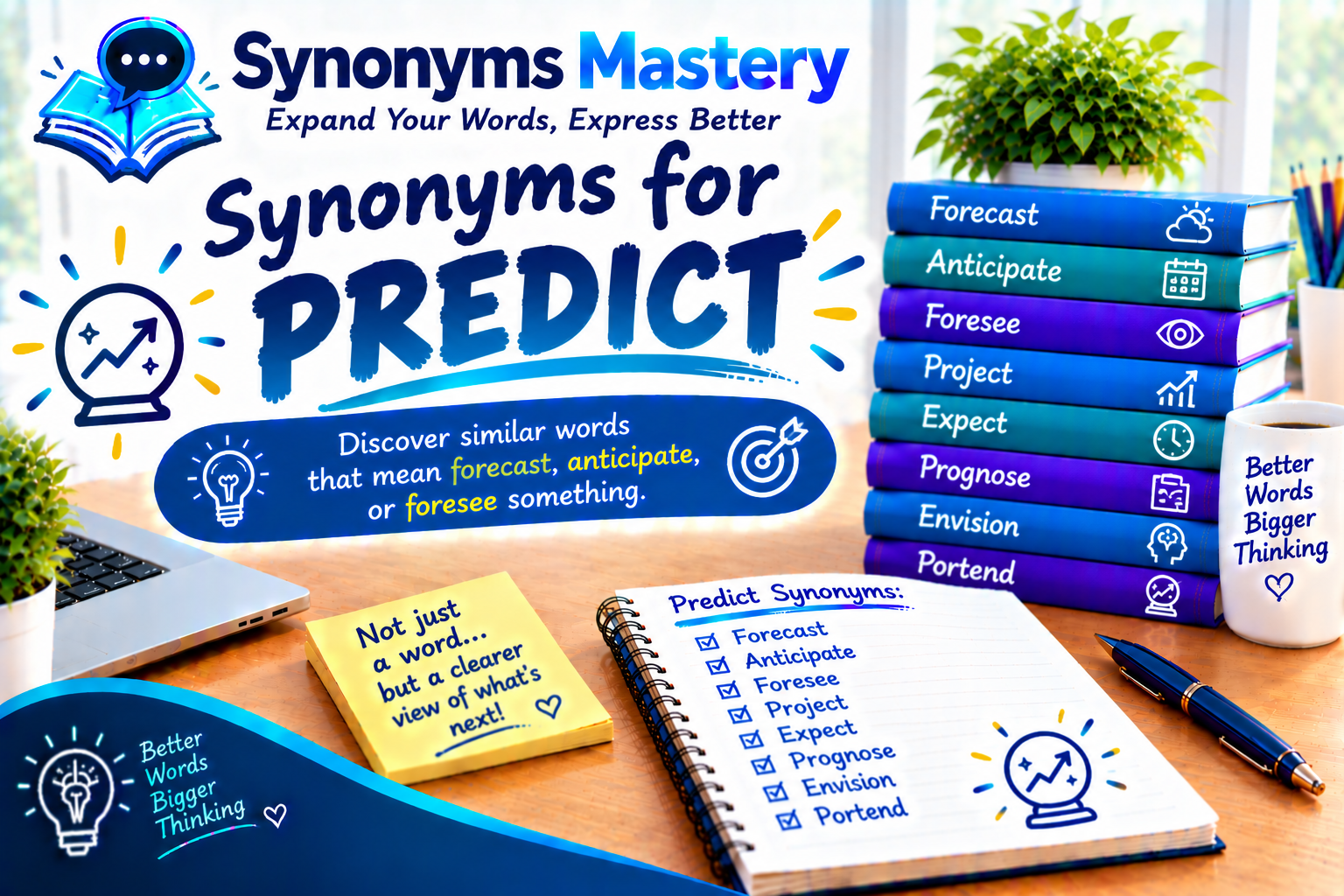
The closest synonyms for predict include forecast, foresee, anticipate, project, estimate, expect, envision, prophesy, foretell, and speculate. These words overlap with predict, but they are not interchangeable in every context. Use forecast for evidence-based future events, foresee for what someone believes will happen, and project for calculated future figures or trends.
10 Synonyms for Predict
| Word | Relationship | Meaning | Strength | Formality | Best Context |
|---|---|---|---|---|---|
| Forecast | Near synonym | Say what is likely to happen based on information or trends | Similar | Neutral/Formal | Weather, business, trends |
| Foresee | Near synonym | Recognize or expect something before it happens | Similar | Neutral | Consequences, events |
| Anticipate | Near synonym | Expect something before it happens | Similar | Neutral/Formal | Events, problems, needs |
| Project | Contextual alternative | Calculate or estimate a future result | Similar | Formal | Finance, business, data |
| Estimate | Contextual alternative | Calculate an approximate future amount or result | Weaker/Specific | Neutral/Formal | Costs, numbers, results |
| Expect | Near synonym | Believe something will probably happen | Similar | Neutral | Everyday and professional use |
| Envision | Contextual alternative | Imagine a possible future situation | Different | Neutral/Formal | Plans, goals, possibilities |
| Foretell | Near synonym | Say or indicate what will happen in the future | Strong | Literary/Formal | Stories, historical or dramatic contexts |
| Prophesy | Contextual alternative | Predict a future event, often with a prophetic or religious sense | Strong | Formal/Literary | Prophecy, religion |
| Speculate | Contextual alternative | Suggest what might happen without certainty | Weaker | Neutral/Formal | Uncertain outcomes |
What Does “Predict” Mean?
Predict means to say or estimate what is likely to happen in the future based on knowledge, evidence, experience, or judgment.
For example:
Scientists predict that temperatures will continue to rise.
The verb can describe both informed judgments and less certain statements about the future. The amount of evidence behind the prediction depends on the context.
Predict is a broad term. That is why its alternatives differ in subtle ways.
The Closest Synonyms for Predict
1. Forecast
Forecast is one of the closest alternatives to predict, particularly when the statement is based on data, trends, or observable conditions.
Example:
Economists forecast slower growth next year.
It is especially natural with:
- weather
- sales
- economic trends
- demand
- business performance
- population changes
Best choice: Use forecast when you are making a reasoned statement about a future trend or condition.
2. Foresee
Foresee means to recognize or expect that something will happen before it occurs.
Example:
We did not foresee the problems caused by the new system.
Unlike forecast, foresee often focuses on a person’s ability to recognize future consequences.
It works naturally with phrases such as:
- foresee problems
- foresee difficulties
- foresee consequences
- foresee changes
- foresee a future
Best choice: Use foresee when emphasizing someone’s awareness or understanding of what may happen.
3. Anticipate
Anticipate means to expect something before it happens. It can also suggest preparing for an expected event.
Example:
The company anticipates strong demand during the holiday season.
Compared with predict, anticipate often sounds more like an expectation than a detached prediction.
Best choice: Use anticipate when someone expects an event and may be preparing for it.
4. Project
Project is commonly used when future figures or outcomes are calculated from existing information.
Example:
Analysts project revenue to increase by 8% next year.
It is particularly common in:
- business
- finance
- economics
- statistics
- planning
- research
Best choice: Use project when a future number, trend, or outcome comes from analysis or calculation.
5. Estimate
Estimate means to make an approximate calculation or judgment.
Example:
The company estimates that the project will cost $2 million.
The word does not always mean a prediction. An estimate may concern a current or past quantity as well as a future one.
Best choice: Use estimate when the emphasis is on an approximate amount, value, cost, time, or result.
6. Expect
Expect is a common everyday alternative to predict.
Example:
We expect the package to arrive tomorrow.
It usually expresses a belief that something will happen.
Compared with predict, expect often sounds more natural in ordinary conversation.
Best choice: Use expect when expressing a personal or general belief about what is likely to happen.
7. Envision
Envision means to imagine or picture a possible future situation.
Example:
The founders envision the company becoming a global brand.
This is not an exact synonym for predict. It focuses more on imagining a desired or possible future than stating what is objectively likely to occur.
Best choice: Use envision for plans, goals, possibilities, and imagined futures.
8. Foretell
Foretell means to say or indicate what will happen in the future.
Example:
The ancient text was believed to foretell a major change.
It is less common in everyday American English than predict or forecast. It can sound literary, dramatic, or old-fashioned depending on context.
Best choice: Use foretell when the prediction has a literary, historical, or dramatic tone.
9. Prophesy
Prophesy means to make a prediction about the future, especially one presented as a prophecy.
Example:
The prophet was said to prophesy major changes in the kingdom.
This word carries a distinctive religious, spiritual, or prophetic association.
Best choice: Use prophesy only when that prophetic sense is appropriate.
Important: Prophesy is a verb. Prophecy is the corresponding noun.
10. Speculate
Speculate means to consider or suggest what might happen without enough certainty to call it a firm prediction.
Example:
Analysts speculate that interest rates may fall later this year.
It signals uncertainty more strongly than predict.
Best choice: Use speculate when the future outcome is uncertain and the speaker is offering a possibility rather than a confident prediction.
Which Word Should I Use Instead of “Predict”?
The best alternative depends on your meaning.
Forecast is the best choice when you are using data or trends to describe a likely future outcome.
Foresee works when you mean recognizing something before it happens.
When you expect something and may prepare for it, anticipate is a natural option.
For calculated future numbers, trends, or results, project is more precise.
Estimate fits situations where you are giving an approximate amount or figure.
In everyday communication, expect is useful when you believe something will happen.
If you are imagining a possible or desired future, envision is more appropriate.
To emphasize uncertainty, speculate is the better choice.
Predict vs. Forecast vs. Foresee
These three words are closely related, but their emphasis differs.
| Word | Main Idea | Example |
|---|---|---|
| Predict | State what you think will happen | Experts predict higher demand. |
| Forecast | Predict using trends, data, or conditions | Experts forecast higher demand. |
| Foresee | Recognize something before it happens | Experts foresee problems ahead. |
Predict is the broadest choice. Forecast sounds more analytical, while foresee focuses more on awareness of future events or consequences.
Predict vs. Anticipate
Both words can describe expecting something before it happens, but they are not always interchangeable.
We predict that sales will increase.
This sounds like a statement about a future outcome.
We anticipate higher demand.
This emphasizes expectation and may also imply preparation.
For business writing, anticipate is often useful when discussing expected needs, challenges, or demand.
Predict vs. Estimate
These words overlap when discussing future results, but estimate has a stronger connection to approximate measurement.
Analysts predict that the project will succeed.
Analysts estimate that the project will cost $5 million.
The first sentence concerns a future outcome. The second gives an approximate figure.
Predict vs. Project
Project is particularly useful for numerical or analytical predictions.
The company predicts higher sales next year.
The company projects $50 million in sales next year.
The second version sounds more specific and data-driven because project commonly introduces calculated future figures.
Common Collocations With “Predict”
Some combinations sound much more natural than others.
Predict + Future Outcomes
- predict the outcome
- predict the result
- predict future events
- predict what will happen
- predict changes
- predict trends
Example:
It is difficult to predict the outcome of the election.
Predict + Performance
- predict performance
- predict future performance
- predict customer behavior
- predict market demand
Example:
The model helps predict customer behavior.
Predict + Problems
- predict problems
- predict risks
- predict potential challenges
- predict consequences
Example:
Good planning can help teams predict potential problems.
Common Mistakes With Synonyms for Predict
1. Treating every alternative as an exact synonym
Words such as envision and estimate overlap with predict, but they do not have exactly the same meaning.
2. Using “forecast” for every prediction
Forecast is especially natural when evidence, trends, or measurable conditions support the prediction. It may sound awkward when discussing a purely personal expectation.
3. Using “prophesy” in ordinary business writing
Prophesy has a strong prophetic or religious association. In most professional contexts, predict, forecast, or project will sound more natural.
4. Confusing “estimate” with “predict”
An estimate usually gives an approximate quantity or value. A prediction can concern almost any future event or outcome.
5. Using “speculate” when certainty is intended
Speculate explicitly introduces uncertainty. Avoid it when you want to communicate a confident, evidence-based forecast.
Formal and Professional Alternatives to Predict
For professional writing, the strongest choices depend on context:
- Forecast — trends, demand, sales, economic conditions
- Project — financial figures and measurable outcomes
- Anticipate — expected events, needs, or challenges
- Estimate — approximate costs, quantities, or time frames
- Expect — general professional expectations
- Assess the likelihood of — formal risk-oriented writing
For example:
Analysts forecast continued growth.
The finance team projects higher revenue.
Management anticipates increased demand.
Engineers estimate that repairs will take three weeks.
Antonyms of Predict
There is no single perfect antonym for predict in every context. Depending on the intended meaning, useful opposites include:
- ignore — fail to consider something
- overlook — fail to notice something
- doubt — lack confidence that something will happen
- be surprised by — experience something unexpected
- react to — respond after an event rather than anticipating it
The most useful opposite depends on whether predict means anticipating, forecasting, or recognizing something in advance.
FAQ
What is the best synonym for predict?
Forecast is one of the closest synonyms for predict, especially when discussing future events, trends, weather, or business conditions. However, foresee, anticipate, project, estimate, and expect may be better depending on the context.
What is a formal word for predict?
Forecast, project, anticipate, and foresee can all work in formal writing. Project is especially useful for financial or numerical predictions, while forecast is common in analytical and professional contexts.
What is another word for predict the future?
Natural alternatives include foresee, forecast, anticipate, foretell, and expect. The best choice depends on the context. Foretell has a more literary or prophetic tone, while forecast usually suggests evidence or analysis.
Is “forecast” a synonym for “predict”?
Yes, in many contexts. Forecast means to predict a future event or condition, usually based on information, trends, or current conditions. It is particularly common for weather, economics, sales, demand, and other measurable trends.
Is “anticipate” the same as “predict”?
Not exactly. Both can refer to something expected to happen in the future, but anticipate often emphasizes expectation or preparation. Predict is broader and focuses more directly on stating what is likely to happen.
What is the difference between predict and estimate?
Predict generally means saying what is likely to happen in the future. Estimate means calculating or judging an approximate amount, value, cost, time, or result. An estimate can concern the present or past as well as the future.
What is the difference between predict and speculate?
Predict can communicate a reasoned expectation about the future, while speculate emphasizes uncertainty. If someone has limited evidence and is simply considering what might happen, speculate is usually the more accurate choice.
What is the difference between predict and foresee?
Predict means stating what is likely to happen, while foresee emphasizes recognizing or anticipating something before it happens. Foresee is particularly natural when discussing future problems, consequences, risks, or developments.
Conclusion
The best synonyms for predict depend on the type of future statement you want to make. Forecast works well for data-based trends, foresee emphasizes recognition, anticipate expresses expectation, and project suits calculated future figures. Estimate is better for approximate amounts, while speculate signals uncertainty. Choosing the right alternative makes your writing more precise and natural.

Chloe Mitchell is a professional content writer with expertise in building clear and engaging vocabulary resources. She focuses on creating easy-to-read synonym guides, helping users understand word meanings quickly. Her writing style is simple, user-friendly, and optimized for search engines.