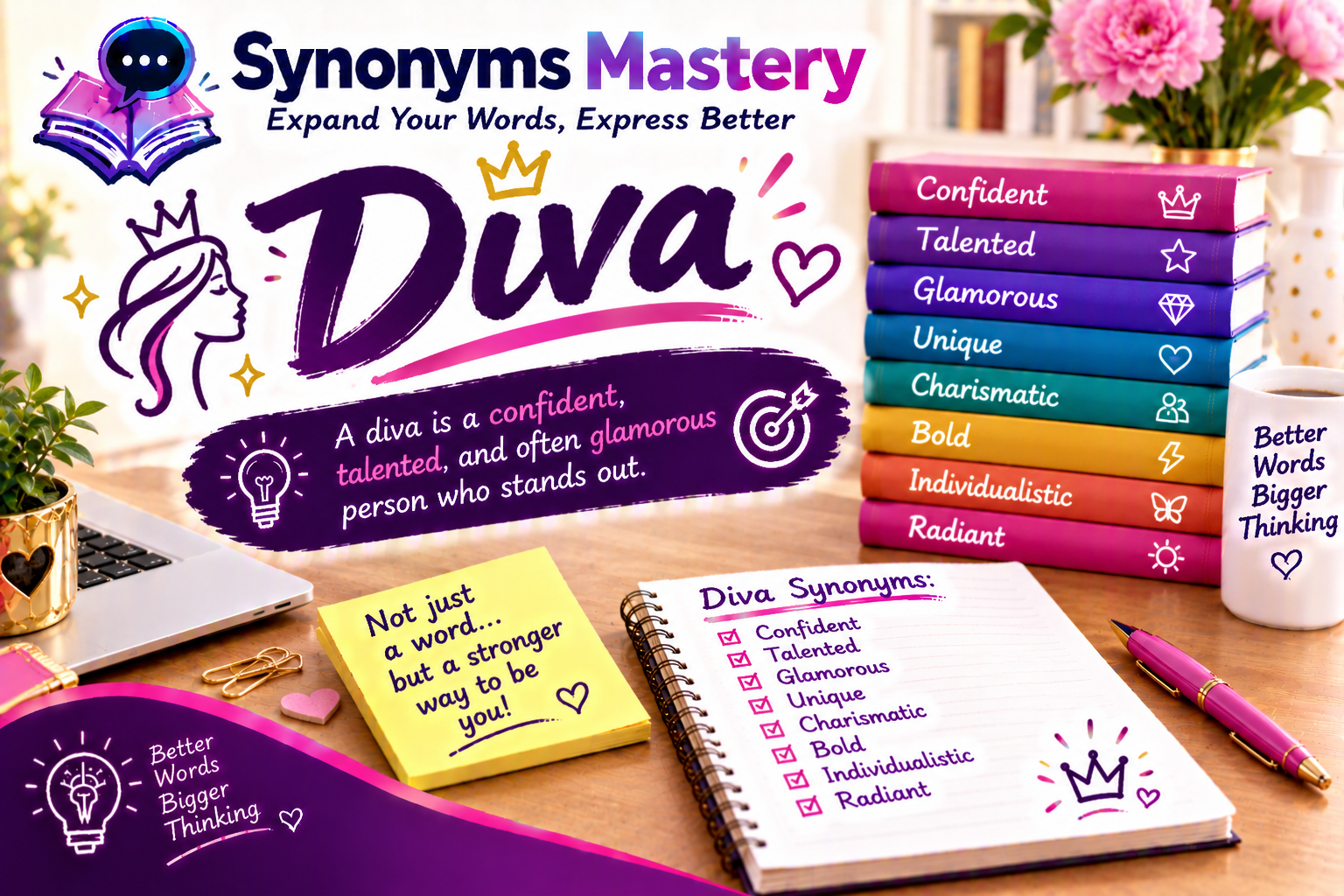
Synonyms for Diva: 20 Alternatives With Meanings and Examples
Finding the right synonym for diva depends on what you want to express. The word can describe a famous and talented female performer, particularly a singer, or someone who expects special treatment and behaves in a demanding way. Words such as star, superstar, and songstress emphasize fame or musical talent,
while prima donna and drama queen can suggest difficult or exaggerated behavior. Some alternatives emphasize glamour, influence, or confidence instead. Understanding these differences helps you choose a word that communicates the intended meaning without accidentally making a compliment sound like criticism.
Quick Answer: What Are the Best Synonyms for Diva?
The best synonyms for diva include prima donna, star, superstar, leading lady, and songstress, depending on the context. Use superstar for an exceptionally famous performer, songstress for a female singer, and leading lady for a prominent female performer. When diva describes someone who behaves in a demanding or self-important way, prima donna is often the closest alternative.
20 Synonyms for Diva and Their Meanings
The following table distinguishes close synonyms from contextual alternatives. Not every word can replace diva in every sentence.
| Word or Phrase | Relationship | Meaning | Tone | Best Context |
|---|---|---|---|---|
| Prima donna | Close synonym | A celebrated performer or a demanding, self-important person | Positive or negative | Performing arts, demanding behavior |
| Star | Contextual alternative | A famous or successful performer | Positive | Entertainment and fame |
| Superstar | Contextual alternative | An exceptionally famous performer | Positive | Major celebrities |
| Songstress | Contextual alternative | A female singer | Positive, sometimes literary | Music and singing |
| Leading lady | Contextual alternative | A prominent female performer, especially in theater or film | Positive | Acting and theater |
| Icon | Near-synonym | A highly influential or admired person | Positive | Cultural influence and legacy |
| Celebrity | Near-synonym | A widely known public figure | Neutral | Fame and public recognition |
| Drama queen | Contextual alternative | Someone who reacts in an exaggerated or dramatic way | Negative or teasing | Dramatic behavior |
| High-maintenance person | Contextual alternative | Someone who requires considerable attention or special treatment | Often negative | Demanding behavior |
| Glamorous woman | Contextual alternative | A woman with an attractive, sophisticated appearance | Positive | Fashion and appearance |
Important: Prima donna is the closest alternative when diva refers to someone who is difficult to please or expects special treatment. When diva describes a celebrated singer, star, songstress, or superstar may be more appropriate.
What Does Diva Mean?
A diva is traditionally a celebrated female singer, particularly an opera singer. In modern English, the word can also describe a highly successful female entertainer or, informally, someone who behaves as though they deserve special treatment.
The word has two important meanings:
- A celebrated performer: A talented and famous singer or entertainer who attracts admiration.
- A demanding personality: Someone who expects considerable attention, makes excessive demands, or behaves as though they are more important than others.
The tone depends on context. Calling someone a pop diva may be a compliment about her fame and talent. Calling someone a diva because she refuses reasonable requests may be criticism.
According to the Cambridge Dictionary, these two meanings are established in contemporary English usage.
Pronunciation
- US IPA: /ˈdiː.və/
- UK IPA: /ˈdiː.və/
- Part of speech: Noun
- Plural: Divas
The word comes through Italian from Latin and originally relates to the idea of a goddess. This origin helps explain its association with exceptional status and admiration. Collins Dictionary
Best Synonyms for Diva by Meaning
The most useful way to choose a synonym is to identify which aspect of diva you want to emphasize.
1. Synonyms for a Famous and Talented Performer
When diva refers to a celebrated entertainer, choose a word that communicates fame, musical talent, or performance ability.
Star
A star is a famous or successful performer. Unlike diva, the word does not inherently suggest a demanding personality.
Example: She became a star after the success of her debut album.
Superstar
A superstar is exceptionally famous and successful. It generally emphasizes a higher level of recognition than star.
Example: The singer became an international superstar after her world tour.
Songstress
A songstress is a female singer. The word often sounds more literary or traditional than singer.
Example: The celebrated songstress captivated the audience with her performance.
Leading lady
A leading lady is a prominent female performer, particularly an actress playing a major role in a production.
Example: She established herself as the leading lady in several successful stage productions.
Icon
An icon is someone widely admired for their influence, achievements, or cultural significance. An icon does not necessarily have to be a singer or entertainer.
Example: Her distinctive voice and decades of influence made her a music icon.
Which should you choose?
- Choose star for general fame.
- Choose superstar for exceptional fame.
- Choose songstress when emphasizing female singing.
- Choose leading lady for a prominent female acting role.
- Choose icon when emphasizing lasting influence.
2. Synonyms for a Demanding or Dramatic Diva
When diva describes someone’s difficult behavior, positive words such as superstar and songstress do not preserve the intended meaning.
Consider these alternatives instead.
Prima donna
A prima donna can be a celebrated performer, but the phrase also describes someone who is temperamental, self-important, or difficult to please.
Example: The director struggled to work with the prima donna, who rejected every reasonable suggestion.
Drama queen
A drama queen is someone who reacts to situations in an exaggerated or unnecessarily dramatic way.
Example: He called himself a drama queen after realizing how much he had overreacted to a minor inconvenience.
The expression is informal and can sound insulting. It emphasizes dramatic reactions rather than the broader sense of entitlement associated with diva.
High-maintenance person
A high-maintenance person requires considerable attention, effort, or special treatment.
Example: The manager found it difficult to accommodate a high-maintenance client who repeatedly changed her demands.
This phrase is more descriptive than drama queen, but it can still sound critical.
Self-important person
A self-important person behaves as though their position, opinions, or needs are more important than those of other people.
Example: His self-important attitude made collaboration difficult.
This is useful in professional writing when you want to criticize someone’s attitude without using a slang expression.
Which should you choose?
- Choose prima donna for a demanding or temperamental person, especially in an artistic or professional setting.
- Choose drama queen for exaggerated emotional reactions.
- Choose high-maintenance person for someone who requires excessive attention or accommodation.
- Choose self-important person when the main issue is an inflated sense of importance.
Important Differences Between Diva and Similar Words
Some words overlap with diva but emphasize different qualities. These distinctions matter when writing descriptions, reviews, biographies, or professional messages.
Diva vs. Prima Donna
Both words can describe a celebrated performer or someone who is difficult to please.
The difference lies in emphasis. Diva often has a strong association with a famous female singer or entertainer. Prima donna can describe a leading performer, but it is also commonly used critically for someone who behaves as though they deserve special treatment.
Examples:
- Diva: The opera diva received a standing ovation.
- Prima donna: The actor behaved like a prima donna during rehearsals.
Best choice: Use diva when the emphasis is on celebrated performance. Use prima donna when you want to highlight demanding behavior.
Diva vs. Superstar
A superstar is an exceptionally famous or successful person, especially an entertainer or athlete. It does not inherently suggest arrogance or difficult behavior.
Examples:
- The superstar performed to a sold-out audience.
- The diva delivered a powerful performance.
Best choice: Use superstar when you want to emphasize fame and success without implying a particular personality.
Diva vs. Songstress
A songstress is a female singer. A diva typically suggests greater prominence, distinction, or star status when used in the musical sense.
Examples:
- The songstress released a new album.
- The opera diva performed the leading role.
Best choice: Use songstress when the person’s identity as a female singer matters more than celebrity status.
Diva vs. Icon
An icon is someone whose influence or symbolic importance extends beyond a single performance. A diva can become an icon, but the terms are not interchangeable in every context.
Examples:
- She is a diva known for her extraordinary live performances.
- She became a fashion icon because of her lasting influence on style.
Best choice: Use icon when emphasizing cultural influence, historical significance, or an enduring legacy.
Diva vs. Drama Queen
A diva may be demanding, but a drama queen specifically exaggerates reactions or makes situations seem more dramatic than they are.
Examples:
- The singer developed a reputation as a demanding diva.
- He was being a drama queen about a minor scheduling change.
Best choice: Use drama queen for exaggerated reactions, not simply for fame, confidence, or high standards.
Diva vs. Glamorous Woman
A glamorous woman is admired for her striking appearance, style, or sophisticated presentation. The expression does not imply that she is a famous performer or has a demanding personality.
Examples:
- The glamorous woman wore an elegant evening gown.
- The diva received a warm welcome from her fans.
Best choice: Use glamorous woman when appearance and style are the main focus.
Which Synonym for Diva Should You Use?
Use this quick guide to select a word based on your intended meaning.
| If You Mean… | Best Word | Why It Fits |
|---|---|---|
| A famous entertainer | Star | Emphasizes public recognition |
| An exceptionally famous performer | Superstar | Emphasizes extraordinary fame |
| A celebrated female singer | Songstress | Focuses on singing |
| A prominent female actor | Leading lady | Focuses on an important acting role |
| A highly influential person | Icon | Emphasizes influence and lasting recognition |
| A demanding performer | Prima donna | Captures self-important or temperamental behavior |
| Someone who exaggerates problems | Drama queen | Emphasizes dramatic reactions |
| Someone who expects excessive attention | High-maintenance person | Describes demanding needs |
| A woman with striking style | Glamorous woman | Emphasizes appearance and elegance |
| An outstanding performance | Showstopper | Describes something that attracts exceptional attention |
Synonyms for Diva in Different Writing Contexts
The most natural alternative also depends on where the word appears.
In an entertainment article
Instead of repeatedly describing a singer as a diva, consider star, superstar, vocalist, or music icon. Each emphasizes a different aspect of the performer’s public identity.
In a professional review
If you need to describe demanding behavior, prima donna, self-important, or difficult to work with may communicate the point more precisely.
In creative writing
Words such as songstress, showstopper, and icon can create a more descriptive tone, provided their meanings fit the character or performer.
In casual conversation
Drama queen may work when discussing exaggerated reactions, while queen can serve as an informal expression of admiration in some social contexts.
Remember that tone matters. A phrase intended as playful praise can sound dismissive or insulting in a formal review.
Common Mistakes When Choosing Synonyms for Diva
1. Treating every synonym as interchangeable
Songstress refers to a female singer, while drama queen describes exaggerated behavior. Neither preserves every meaning of diva.
Better approach: Identify whether you mean talent, fame, glamour, or personality before choosing an alternative.
2. Assuming diva is always an insult
Although diva can describe someone demanding or self-important, it can also express admiration for a celebrated performer.
Better approach: Examine the surrounding sentence and intended tone.
3. Using superstar to describe difficult behavior
Superstar communicates exceptional fame. It does not normally imply that someone is difficult to please.
Better approach: Use prima donna or a more precise description of the behavior when criticism is intended.
4. Confusing glamour with celebrity
A glamorous person may be unknown to the public, while a celebrity may not be particularly glamorous.
Better approach: Use glamorous woman for appearance and celebrity for public recognition.
5. Using informal expressions in formal writing
Drama queen can sound dismissive in professional communication.
Better approach: Consider more specific wording, such as overly dramatic, self-important, or difficult to accommodate, depending on the behavior.
Frequently Asked Questions
What is the closest synonym for diva?
Prima donna is often the closest synonym when diva describes someone who is demanding, temperamental, or difficult to please. When it refers to a celebrated female singer, star, superstar, or songstress may be more suitable. The best choice depends on whether the intended meaning is admiration or criticism.
What is a positive synonym for diva?
Positive alternatives include star, superstar, songstress, leading lady, and icon. Use superstar to emphasize fame, songstress to emphasize singing, and icon to highlight cultural influence. These words convey different qualities, so choose the one that best describes the person.
What is a negative synonym for diva?
Prima donna is a close alternative when describing someone who expects special treatment or behaves in a self-important way. Drama queen is appropriate for exaggerated reactions, while high-maintenance person describes someone who requires considerable attention or accommodation. Each expression has a slightly different meaning.
Is diva a compliment or an insult?
Diva can be either. In music and entertainment, it often describes a celebrated and talented female performer. In informal conversation, it can criticize someone who is demanding or behaves as though they deserve special treatment. The surrounding words and the speaker’s intention determine whether it sounds complimentary or disapproving.
What is another word for a female singer or diva?
Songstress, singer, vocalist, and opera singer can describe female singers, although they are not identical in meaning. Songstress specifically refers to a female singer, while vocalist is a more general musical term. Opera singer identifies a particular type of performer.
What is the difference between a diva and a drama queen?
A diva can be a celebrated performer or a demanding person. A drama queen is someone who exaggerates emotional reactions or makes situations unnecessarily dramatic. The terms overlap when describing behavior, but drama queen focuses more specifically on exaggerated reactions.
Can diva describe someone who is not a singer?
Yes. Modern English sometimes uses diva for a famous female entertainer or, informally, anyone who behaves in a demanding or self-important way. However, the word’s traditional association with celebrated female singers remains important, especially in discussions of opera and popular music.
What is the plural of diva?
The standard English plural is divas. For example: “The festival brought together several international divas.” The singular diva refers to one person, while divas refers to more than one.
Conclusion
The best synonyms for diva depend on the meaning and tone you want to communicate. Star, superstar, songstress, and icon work well when describing fame, singing talent, or influence. Prima donna is a strong alternative when the emphasis is on demanding behavior, while drama queen describes exaggerated reactions.
For accurate writing, avoid replacing diva with a word merely because it sounds similar. Consider the person’s qualities, the context, and the tone you want to convey. Choosing the right synonym makes your writing clearer, more natural, and more precise.

Ethan Walker is a language tutor who helps learners improve their English through practical examples and real-life usage. He specializes in teaching synonyms, sentence formation, and writing clarity. His goal is to make complex vocabulary simple and usable for everyday communication.