Synonyms for Helper: 15 Better Alternatives With Examples
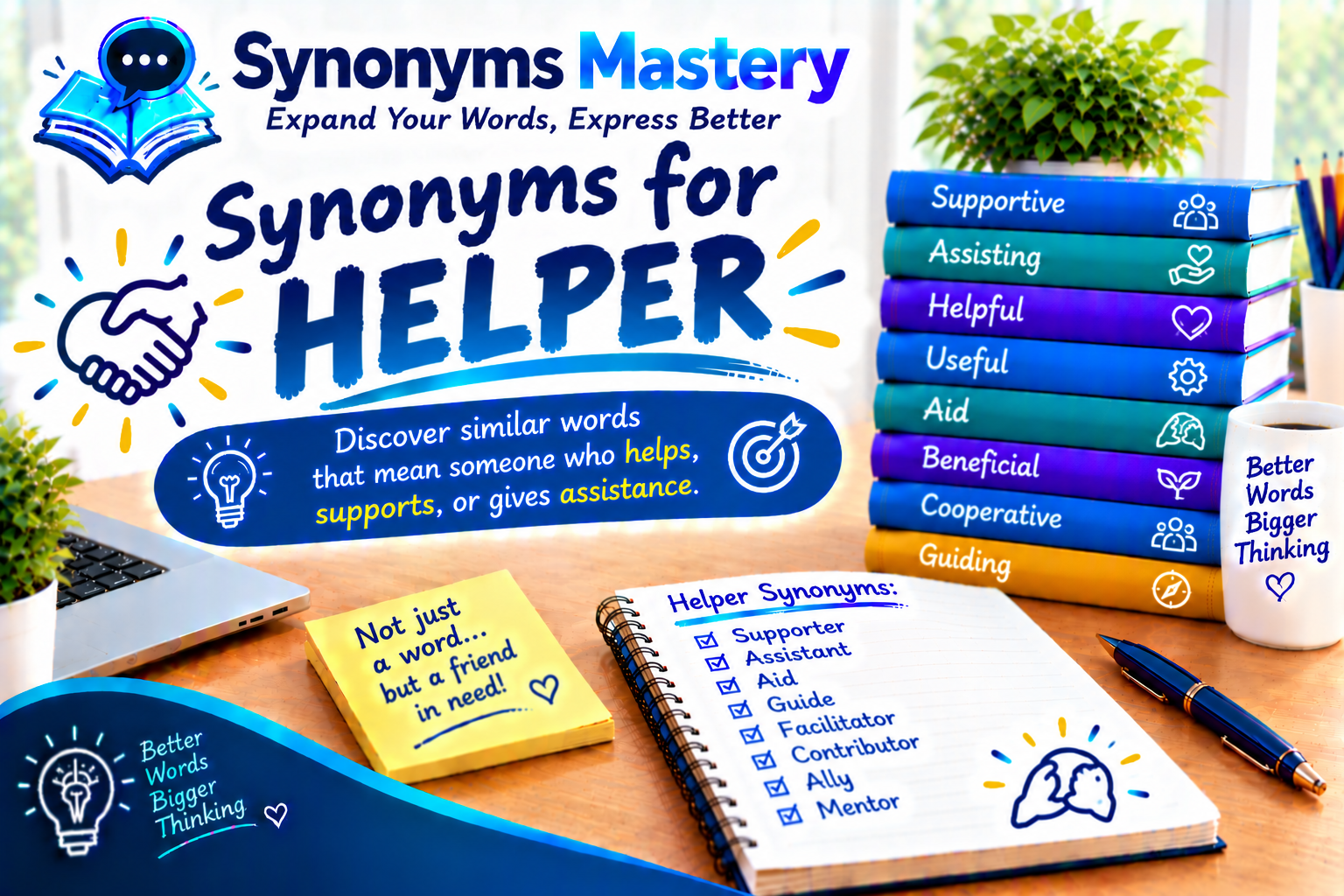
Finding the right synonym for helper depends on what kind of help you mean. A helper is generally a person who assists someone with an activity, task, or job. However, words such as assistant, aide, supporter, ally, collaborator, colleague, and facilitator emphasize different types of help.
Some alternatives describe a person’s job or role, while others highlight teamwork, emotional support, cooperation, or professional assistance. Choosing the right word can make your writing more precise, especially on a resume, in workplace communication, or when describing someone’s contribution to a project.
Quick Answer: What Are the Best Synonyms for “Helper”?
The closest synonyms for helper include assistant, aide, and supporter. Other alternatives work better in specific contexts: collaborator emphasizes working together, ally emphasizes support, facilitator emphasizes making something easier, and volunteer describes someone who offers help willingly, often without pay. The best choice depends on the person’s role and the type of assistance provided.
Core Synonym Resource
| Word | Relationship | Main Meaning | Best Context | Formality |
|---|---|---|---|---|
| Assistant | Direct/near synonym | Person who helps with tasks or duties | Work, administration | Neutral |
| Aide | Near synonym | Person who assists someone in a specific role | Government, education, healthcare | Formal |
| Supporter | Near synonym | Person who provides support | Causes, people, teams | Neutral |
| Ally | Contextual alternative | Person who supports another person or group | Relationships, causes, teamwork | Neutral |
| Collaborator | Contextual alternative | Person who works jointly with others | Projects, research, business | Neutral/Formal |
| Colleague | Contextual alternative | Fellow worker | Workplace | Neutral |
| Partner | Contextual alternative | Person who works with another | Business, projects, activities | Neutral |
| Facilitator | Contextual alternative | Person who makes a process easier | Meetings, training, projects | Formal |
| Volunteer | Contextual alternative | Person who offers help willingly | Community, charities, events | Neutral |
| Attendant | Contextual alternative | Person who provides service or assistance | Events, facilities, customer service | Neutral |
| Caregiver | Contextual alternative | Person who provides care | Health, family, support | Neutral |
| Apprentice | Contextual alternative | Learner who works under guidance | Skilled trades | Neutral |
| Auxiliary | Contextual alternative | Person or thing providing additional support | Organizations, services | Formal |
| Deputy | Contextual alternative | Person authorized to act for another | Government, management | Formal |
| Right-hand person | Contextual alternative | Trusted and important assistant | Leadership, informal professional use | Neutral |
Important: These words are not interchangeable in every sentence. Colleague, for example, means a fellow worker rather than simply anyone who helps. Volunteer identifies how someone provides help, while facilitator describes a specific function.
What Does “Helper” Mean?
Helper is a countable noun referring to a person who helps another person, group, or activity. The word is broad and can apply to many situations, from volunteer work and household tasks to jobs and organized activities.
For example:
We need another helper for the community event.
The word does not necessarily tell the reader exactly what the person does. That is why a more specific term can sometimes improve your writing.
For example:
We need another volunteer for the community event.
This version tells the reader that the person is offering their time voluntarily.
1. Assistant
Assistant is probably the closest general alternative to helper. It usually describes someone whose role involves helping another person with tasks, duties, or responsibilities.
She works as an assistant to the department manager.
Compared with helper, assistant often sounds more like an established job or professional role.
Best for: workplaces, administration, personal assistance, and professional descriptions.
2. Aide
Aide is a more specialized term for someone who assists another person, particularly someone with an important position or someone receiving care or instruction.
The senator’s aide prepared the briefing documents.
It is also common in expressions such as teacher’s aide and nurse’s aide.
Best for: government, education, healthcare, and formal roles.
3. Supporter
Supporter emphasizes providing support rather than performing specific tasks.
She has always been a strong supporter of the organization.
This word is especially useful when someone helps a person, cause, organization, or team through encouragement, resources, or advocacy.
Best for: causes, organizations, teams, public figures, and personal support.
4. Ally
An ally is someone who supports another person or group, often because they share an interest, goal, or commitment.
The organization found a strong ally in the local community.
Unlike helper, ally often suggests a relationship of mutual support rather than a simple assistance role.
Best for: teamwork, relationships, organizations, causes, and strategic support.
5. Collaborator
A collaborator works with others toward a shared goal.
Maria was a key collaborator on the research project.
This is different from helper because collaboration usually suggests active participation rather than simply assisting someone else’s work.
Best for: research, business, creative projects, academic work, and team projects.
6. Colleague
A colleague is someone you work with. The word does not automatically mean that the person is helping you.
I discussed the project with a colleague.
Therefore, colleague is only a good alternative to helper when the assistance comes from someone you work with.
Best for: professional and workplace communication.
7. Partner
Partner can describe someone who works with another person toward a shared goal.
James was my partner on the project.
Unlike helper, the word usually suggests a more equal relationship. It should not be used when the person simply provides subordinate assistance.
Best for: business, projects, activities, and collaborative work.
8. Facilitator
A facilitator helps a process happen more easily or effectively.
The workshop facilitator guided the discussion.
This word is more specialized than helper. A facilitator may organize a meeting, guide a discussion, remove obstacles, or help participants reach an outcome.
Best for: meetings, workshops, training, discussions, and organizational work.
9. Volunteer
A volunteer is someone who willingly offers their time or services, usually without being paid.
Several volunteers helped organize the event.
Not every helper is a volunteer. A paid employee can be a helper, while the defining feature of a volunteer is the voluntary nature of the service.
Best for: charities, community projects, schools, events, and nonprofit organizations.
10. Attendant
Attendant can refer to someone whose role includes providing assistance, service, or supervision.
A parking attendant helped direct the vehicles.
The word is more appropriate for specific service roles than for general help.
Best for: facilities, events, transportation, customer service, and similar roles.
11. Caregiver
Caregiver specifically describes someone who provides care for another person who needs assistance.
Her mother has a full-time caregiver.
This is not a general synonym for helper. It should be used when the person’s role involves providing care.
Best for: healthcare, family care, disability support, and personal assistance.
12. Apprentice
An apprentice is a learner who gains practical experience while working under the guidance of someone more experienced.
The electrician’s apprentice helped prepare the equipment.
An apprentice may help with tasks, but the word focuses on learning a trade or profession.
Best for: skilled trades, vocational training, and supervised work.
13. Auxiliary
Auxiliary can describe someone or something that provides additional support.
The hospital has an auxiliary staff to support its main operations.
The term is more formal and is often used in organizational, institutional, or technical contexts.
Best for: organizations, services, healthcare, and formal writing.
14. Deputy
A deputy is someone who has authority to act for another person, especially a manager, official, or leader.
The director’s deputy handled the meeting.
This is not a general synonym for helper. It is appropriate only when the person has a delegated position or authority.
Best for: government, management, administration, and official roles.
15. Right-Hand Person
Right-hand person describes a trusted and important assistant or close collaborator.
She is the CEO’s right-hand person.
It is more expressive and informal than assistant. The phrase suggests trust, importance, and close involvement.
Best for: leadership, business, informal professional writing, and descriptions of trusted support.
Which Word Should You Use?
The best choice depends on what the person actually does.
Use “assistant” for general professional help
She is the manager’s assistant.
Choose this when the person regularly helps with another person’s work or responsibilities.
Use “aide” for a specialized assisting role
The senator’s aide arranged the meeting.
Choose this for government, education, healthcare, and similar settings.
Use “collaborator” when both people work together
He was a valuable collaborator on the project.
This is better than helper when the person actively contributes to shared work.
Use “supporter” when the person provides backing
She has been a longtime supporter of the organization.
This works for causes, people, teams, and organizations.
Use “volunteer” when the help is offered voluntarily
Twenty volunteers helped at the event.
This identifies the person’s status rather than simply their function.
Use “facilitator” when the person makes a process easier
The facilitator guided the team through the exercise.
This is particularly useful in professional and educational contexts.
Use “caregiver” when the person provides personal care
His caregiver helps him with daily activities.
Do not use this term for ordinary workplace assistance.
Helper vs. Assistant
Helper and assistant have substantial overlap, but assistant often sounds more specific and professional.
| Helper | Assistant |
|---|---|
| Broad term | More role-specific |
| Can describe casual help | Often describes an established role |
| Common in everyday contexts | Common in workplaces |
| Does not imply a formal position | Can imply a job or assigned position |
For a resume or job description, assistant is usually more precise when the person had an official assisting role.
Helper vs. Aide
Both words describe someone who assists another person, but aide tends to be more specialized.
The classroom helper organized the materials.
The teacher’s aide worked with students.
Aide commonly appears in specific professional or institutional roles, while helper is broader.
Helper vs. Supporter
A helper assists with an activity or task. A supporter provides backing, encouragement, advocacy, or other forms of support.
The event needed more helpers.
She is a strong supporter of the event.
The first emphasizes practical assistance. The second emphasizes backing or commitment.
Helper vs. Collaborator
A helper may assist another person’s work. A collaborator generally participates in the work as a contributor.
I need a helper to organize the files.
I need a collaborator to develop the project.
Use collaborator when the relationship involves shared responsibility or contribution.
Common Mistakes When Choosing a Synonym for “Helper”
1. Using “colleague” as a direct replacement
A colleague is a fellow worker, not necessarily someone who helps you.
2. Using “volunteer” for every unpaid helper
A volunteer willingly provides services, but helper does not necessarily indicate whether the person is paid.
3. Using “aide” in every situation
Aide often suggests a defined assisting role. For casual help, helper or assistant may sound more natural.
4. Using “partner” when the relationship is unequal
Partner can imply shared responsibility or a relatively equal relationship. It may not accurately describe someone who simply assists another person.
5. Using “caregiver” for general assistance
A caregiver provides care to someone who needs it. The word is too specific for ordinary workplace or event assistance.
6. Using “facilitator” for every kind of helper
A facilitator specifically helps a process, activity, or group function effectively. It is not a universal replacement for helper.
Antonyms of “Helper”
The most useful opposites depend on the context.
- Hindrance — something that makes progress harder
- Obstacle — something that blocks progress
- Opponent — someone who works against another person or group
- Adversary — a person or group in opposition
- Obstruction — something that prevents or delays progress
For a person, opponent or adversary may be appropriate when the opposite idea is someone who actively works against you. For a situation or object, obstacle or hindrance is usually more natural.
Frequently Asked Questions
What is the best synonym for helper?
Assistant is usually the closest general synonym for helper, especially when describing someone who regularly assists another person with tasks or duties. However, aide, supporter, collaborator, volunteer, and facilitator may be more accurate when the person’s specific role calls for one of those terms.
What is a professional word for helper?
Assistant is one of the most natural professional alternatives. Depending on the role, aide, coordinator, facilitator, collaborator, or support specialist may be more precise. The best term should describe the person’s actual responsibilities rather than simply sounding more formal.
What is another word for someone who helps?
Depending on the situation, you can use assistant, aide, supporter, ally, collaborator, volunteer, or facilitator. If the person works with you, colleague or partner may also fit, but these words describe a relationship rather than help itself.
Is “assistant” the same as “helper”?
They are closely related, but assistant often suggests a more defined role. A helper can be anyone who provides assistance, while an assistant commonly has assigned duties or responsibilities. For example, a person helping at an event can be a helper, while an employee supporting a manager may be an assistant.
What is a formal synonym for helper?
Aide, assistant, facilitator, auxiliary, and collaborator can work in formal contexts, depending on the meaning. However, formal does not automatically mean better. A precise everyday word is often stronger than an unnecessarily technical alternative.
What is a synonym for helper on a resume?
The best choice depends on the actual job. Assistant, aide, coordinator, facilitator, collaborator, or support specialist can be appropriate when they accurately describe the work performed. Avoid replacing helper with a more impressive-sounding title if it changes the actual meaning of the role.
Is “supporter” a synonym for helper?
Sometimes. Both words can describe someone who provides assistance, but supporter often emphasizes backing, encouragement, advocacy, or loyalty. A person can support a cause without helping with its daily tasks, so the words are not interchangeable in every context.
What is the difference between a helper and a volunteer?
A helper is anyone who provides assistance, while a volunteer is someone who willingly offers their time or services, commonly without pay. A volunteer can be a helper, but not every helper is a volunteer.
Conclusion
The best synonym for helper depends on the person’s role and the kind of assistance they provide. Assistant is the strongest general alternative, while aide suits specialized roles, supporter emphasizes backing, and collaborator highlights shared work.
For community activities, volunteer may be more precise, while facilitator works when someone helps a process run smoothly. Choosing a specific word instead of relying on helper can make your writing clearer, more professional, and more accurate.

Ethan Walker is a language tutor who helps learners improve their English through practical examples and real-life usage. He specializes in teaching synonyms, sentence formation, and writing clarity. His goal is to make complex vocabulary simple and usable for everyday communication.