Synonyms of Plain: 40+ Alternatives for Every Meaning
The word plain has several meanings, so the best synonym depends heavily on context. It can describe something simple or undecorated, something clear or obvious, a person who is frank or direct, something ordinary, or, in some contexts, an appearance that is not especially attractive. It can also function as a noun referring to a broad area of relatively level land.
That makes plain a particularly tricky word to replace. Simple may work when plain means uncomplicated, but obvious is better when it means easy to understand, while frank or straightforward can work when it describes direct speech. This guide separates those meanings so you can choose the most accurate alternative.
Quick Answer: What Are the Best Synonyms of Plain?
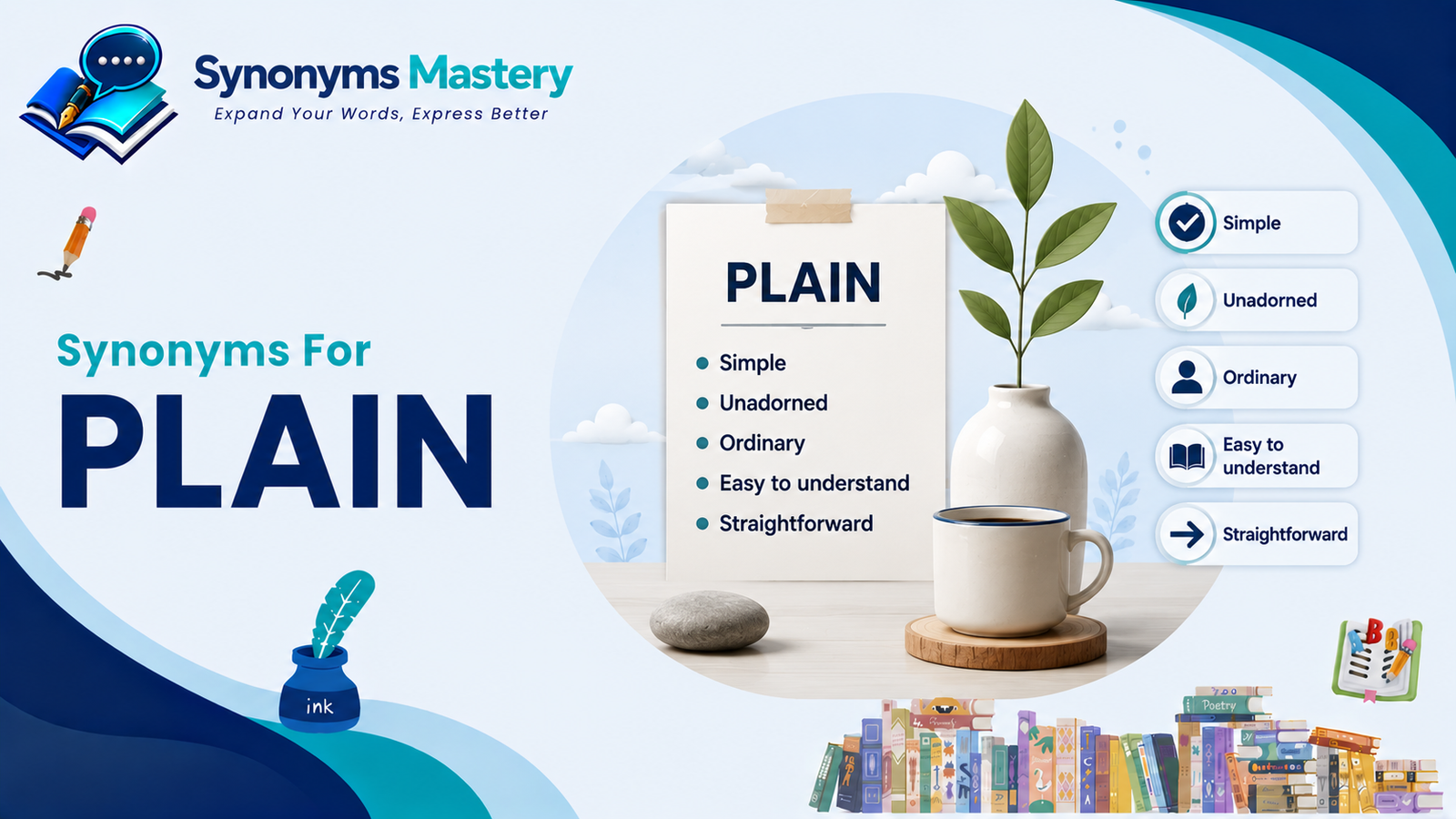
Some of the most useful synonyms of plain are simple, unadorned, clear, obvious, straightforward, frank, candid, direct, ordinary, commonplace, basic, unpretentious, and unembellished. However, there is no single synonym that replaces plain in every context because the word has several meanings. For example, plain clothing can mean unadorned, plain facts can mean clear or obvious, and plain speaking can mean frank or direct.
Synonyms of Plain at a Glance
| Synonym | Meaning of “plain” | Relationship | Best Context | Tone |
|---|---|---|---|---|
| Simple | Not complicated or elaborate | Very close | Ideas, objects, design | Neutral |
| Unadorned | Without decoration | Direct | Clothing, rooms, objects | Neutral |
| Basic | Simple and without extras | Near synonym | Products, services, designs | Neutral |
| Unembellished | Without added decoration or detail | Close | Writing, design, description | Neutral/formal |
| Bare | Lacking additions or coverings | Near synonym | Rooms, surfaces, facts | Neutral |
| Clear | Easy to understand | Contextual | Meaning, explanations | Neutral |
| Obvious | Easy to see or understand | Close | Facts, truths, evidence | Neutral |
| Straightforward | Easy to understand or direct | Contextual | Instructions, communication | Neutral |
| Candid | Honest and open | Contextual | Opinions, criticism | Neutral |
| Frank | Direct and honest | Contextual | Conversations, opinions | Neutral |
| Direct | Straightforward and not indirect | Contextual | Communication | Neutral |
| Ordinary | Not special or unusual | Close | People, objects, situations | Neutral |
| Everyday | Ordinary or routine | Contextual | Life, objects, experiences | Neutral |
| Unpretentious | Simple and without affectation | Near synonym | People, places, style | Positive |
| Austere | Severely simple | Near synonym | Design, architecture, lifestyle | Formal |
The major dictionaries likewise separate plain according to meaning rather than treating all alternatives as interchangeable.
Merriam-Webster lists simple for one adjective sense and separately identifies synonyms such as outspoken and straightforward for other senses. Collins similarly organizes its synonyms under meanings such as clear, honest, unadorned, ugly, and ordinary.
What Does “Plain” Mean?
Plain is a versatile English word with several meanings.
It can mean:
- Simple or lacking decoration — a plain white shirt
- Clear or obvious — The answer is plain to see.
- Frank or direct — She gave him a plain warning.
- Ordinary or not distinctive — He lived a plain, ordinary life.
- Not attractive — She considered herself plain-looking.
- Level or open land when used as a noun — The cattle grazed across the plain.
Merriam-Webster lists these major adjective senses, including lacking ornament, being clear or evident, being outspoken, being ordinary, being uncomplicated, and lacking beauty. It also records plain as a noun for an extensive area of relatively level land.
Because the meanings are so different, context is essential when selecting a synonym.
Synonyms of Plain Meaning Simple or Unadorned
When plain means simple, undecorated, or without unnecessary additions, the strongest alternatives include simple, unadorned, undecorated, basic, unembellished, unornamented, bare, austere, and unfussy.
Simple
Simple is usually the safest alternative when plain means uncomplicated or lacking unnecessary decoration.
She wore a plain black dress.
Possible replacement:
She wore a simple black dress.
However, simple is broader than plain. It can describe something uncomplicated even when appearance is not involved.
Unadorned
Unadorned specifically emphasizes the absence of decoration.
The room had plain white walls.
The room had unadorned white walls.
This is an excellent choice for formal or descriptive writing.
Undecorated
Undecorated is very literal: something has not been decorated.
The plain room felt cold and empty.
The undecorated room felt cold and empty.
It is useful when the physical absence of decoration is the main point.
Basic
Basic emphasizes simplicity and the absence of extras.
The hotel provided plain accommodation.
The hotel provided basic accommodation.
It works particularly well for products, services, facilities, and features.
Unembellished
Unembellished means lacking decorative or additional elements.
He gave a plain account of what happened.
He gave an unembellished account of what happened.
It can describe both physical things and language, making it especially useful in formal writing.
Bare
Bare suggests that something has very little added to it.
The room contained plain wooden furniture.
The room contained bare wooden furniture.
However, bare can imply stronger deprivation than plain, so it should not always be treated as an exact replacement.
Unfussy
Unfussy describes something simple and not overly elaborate.
She prefers plain, practical clothing.
She prefers unfussy, practical clothing.
This is particularly natural when describing design, food, clothing, or personal taste.
Synonyms of Plain Meaning Clear or Obvious
When plain means easy to understand, recognize, or see, the best alternatives include:
- clear
- obvious
- evident
- apparent
- manifest
- unmistakable
- unambiguous
- understandable
- distinct
Clear
Clear is often the most natural replacement.
Something was plainly wrong.
It was clear that something was wrong.
Both plain and clear work naturally in everyday conversation and professional writing.
Obvious
Obvious is stronger than clear in many contexts. It suggests that something should be easy to recognize or understand.
The answer was plain to everyone.
The answer was obvious to everyone.
Evident
Evident is more formal and is particularly useful in academic or professional writing.
The benefits of the policy were plain.
The benefits of the policy were evident.
Apparent
Apparent often means readily visible or understandable.
The failure of the plan soon became plain.
It became apparent that the plan had failed.
Plain is a strong choice for formal prose when something is clearly evident.
Unmistakable
Unmistakable emphasizes that something cannot reasonably be confused with something else.
There was a plain change in his attitude.
There was an unmistakable change in his attitude.
It is stronger than plain in many contexts.
Synonyms of Plain Meaning Honest or Direct
When plain describes speech, communication, or a person’s manner, the meaning can shift toward being direct, frank, or outspoken.
Useful alternatives include:
- straightforward
- frank
- candid
- direct
- forthright
- outspoken
- open
- honest
- plain-spoken
Merriam-Webster specifically explains that plain can overlap with candid, frank, and open when describing willingness to express what one thinks or feels. It notes that plain emphasizes outspokenness and freedom from subtlety or affectation.
Straightforward
Straightforward suggests directness without unnecessary complexity or evasiveness.
She gave me a plain answer.
She gave me a straightforward answer.
This is especially useful in professional communication.
Candid
Candid emphasizes sincerity and openness, particularly when expressing an honest opinion.
He gave a plain assessment of the situation.
He gave a candid assessment of the situation.
Frank
Frank emphasizes directness and a lack of evasiveness.
Let me be plain about the problem.
Let me be frank about the problem.
Forthright
Forthright is a polished alternative for direct and honest communication.
Her plain response surprised the committee.
Her forthright response surprised the committee.
Outspoken
Outspoken is different because it describes a person’s willingness to express opinions openly.
He is known for his plain criticism of the policy.
He is known for his outspoken criticism of the policy.
It is therefore a contextual alternative rather than a universal synonym.
Synonyms of Plain Meaning Ordinary
When plain means ordinary, common, or not especially distinctive, consider:
- ordinary
- common
- everyday
- commonplace
- unremarkable
- unpretentious
- unaffected
- modest
Ordinary
Ordinary is one of the closest choices.
They lived a plain life.
They lived an ordinary life.
It emphasizes a lack of unusual or exceptional qualities.
Commonplace
Commonplace suggests something ordinary or frequently encountered.
The idea was once considered unusual but is now commonplace.
This word is generally stronger than plain when emphasizing how widespread something is.
Everyday
Everyday emphasizes something routine or normal.
She chose plain clothes for everyday use.
She chose everyday clothes for casual use.
It does not always preserve the idea of simplicity or lack of decoration.
Unpretentious
Unpretentious is often more positive than plain. It suggests simplicity without trying to appear impressive.
They stayed in a plain little hotel.
They stayed in an unpretentious little hotel.
This is an excellent choice when you want a positive or neutral tone.
Synonyms of Plain Meaning Not Attractive
In some contexts, plain can describe someone or something as lacking conventional beauty.
Possible alternatives include:
- unattractive
- unlovely
- homely — particularly in American English
- unprepossessing
- ill-favored
- ordinary-looking
- plain-looking
Use these carefully because descriptions of physical attractiveness can be sensitive and highly subjective.
For example:
The character is described as plain-looking.
This is generally more precise than automatically substituting a strongly negative adjective such as ugly.
Importantly, plain does not always mean ugly. Merriam-Webster defines one sense as “lacking beauty or ugliness,” while Collins groups plain with appearance-related alternatives under a separate sense.
Synonyms of Plain Meaning Flat or Level
When plain is used to describe land or a physical surface, the relevant vocabulary changes completely.
Possible alternatives include:
- flat
- level
- even
- grassland
- flatland
- prairie
- steppe
However, these are not interchangeable in every geographical context.
As a noun, a plain is a broad area of relatively level or rolling land. In this sense, simple or clear obviously cannot replace it. Merriam-Webster lists geographical terms such as prairie, steppe, and grassland among noun-related synonyms.
Which Synonym of Plain Should You Use?
A simple way to choose is to identify what plain means in your sentence.
| If “plain” means… | Best alternatives |
| Simple | simple, basic |
| Without decoration | unadorned, undecorated, unembellished |
| Easy to understand | clear, understandable |
| Obvious | obvious, evident, apparent |
| Honest/direct | frank, candid, straightforward |
| Openly expressive | outspoken, forthright |
| Ordinary | ordinary, commonplace, everyday |
| Unpretentious | modest, unpretentious, unaffected |
| Not attractive | unattractive, plain-looking, unprepossessing |
| Flat land | flatland, prairie, grassland |
| Level surface | flat, level, even |
Plain vs. Simple
Plain and simple overlap strongly when describing something without decoration or unnecessary complexity.
She wore a plain dress.
She wore a simple dress.
But simple is much broader. It can describe something that is easy to understand, operate, or accomplish.
The instructions are simple.
You generally would not replace simple with plain in that sentence unless you mean something slightly different.
Choose “plain” when the emphasis is often on lack of decoration or straightforward presentation.
Choose “simple” when the emphasis is on lack of complexity.
Plain vs. Clear
When plain means easy to understand, clear is usually the most natural everyday alternative.
I made my position plain.
I made my position clear.
Both work naturally.
However, clear has a much wider range of uses. It can also describe visibility, sound, organization, and physical space.
Plain vs. Straightforward
Straightforward is particularly useful when plain means direct, uncomplicated, or easy to understand.
The instructions were plain.
The instructions were straightforward.
For communication, straightforward often sounds polished and neutral, while plain can emphasize a deliberate lack of subtlety.
Plain vs. Ordinary
When plain means not special or distinctive, ordinary is often the closest alternative.
It was a plain little house.
It was an ordinary little house.
But plain can focus on appearance or lack of decoration, whereas ordinary primarily emphasizes a lack of unusual or exceptional qualities.
Common Mistakes When Choosing a Synonym for Plain
Mistake 1: Treating “simple” as a universal synonym
Simple works for some meanings of plain, but not for all.
The meaning was plain.
Here, clear or obvious is better than simple.
Mistake 2: Using “obvious” for plain clothing
She wore an obvious dress.
This changes the meaning completely.
For plain clothing, use simple, unadorned, undecorated, or unembellished.
Mistake 3: Assuming “plain” always means unattractive
Plain can describe something undecorated, uncomplicated, obvious, ordinary, or direct. Physical appearance is only one of its senses.
Mistake 4: Treating “frank” as a synonym in every context
Frank works when plain describes direct or honest speech, not when it describes a plain wall or plain food.
Mistake 5: Confusing the adjective with the noun
In:
The cattle crossed the plain.
Plain is a noun referring to land.
In:
She wore a plain dress.
Plain is an adjective.
The appropriate synonym depends on the grammatical meaning.
Related Words That Are Not Universal Synonyms
Some words are closely associated with plain but should not automatically be presented as interchangeable:
- Minimalist — emphasizes a deliberate design philosophy
- Bland — often suggests lack of interest, flavor, or excitement
- Dull — suggests lack of interest or stimulation
- Ugly — much stronger than plain when describing appearance
- Transparent — can mean easy to understand but has additional meanings
- Basic — can mean fundamental as well as simple
- Modest — can describe behavior, wealth, size, or appearance
- Spartan — suggests severe simplicity, often with very few comforts
These words may overlap with a particular sense of plain, but they carry additional meanings or connotations.
Antonyms of Plain
Because plain has multiple meanings, its antonyms also vary.
When plain means undecorated, possible opposites include:
- ornate
- decorated
- elaborate
- embellished
- ornamented
- fancy
In the sense of simple or uncomplicated, suitable opposites include:
- complex
- complicated
- elaborate
- intricate
For something ordinary or unremarkable, stronger opposites may be:
- exceptional
- remarkable
- unusual
- extraordinary
- distinctive
Merriam-Webster similarly lists words such as fancy, decorated, gaudy, showy, and embellished as opposites for the unadorned sense of plain.
Frequently Asked Questions
What is the closest synonym for plain?
There is no single closest synonym because plain has several meanings. Simple is especially close when it means uncomplicated or lacking ornament, clear or obvious when it means easy to understand, and frank or straightforward when it describes direct speech.
What is another word for plain and simple?
Depending on the sentence, alternatives include straightforward, uncomplicated, basic, simple, and unadorned. If plain and simple means “without complication,” straightforward is often a natural choice.
What is a synonym for plain meaning obvious?
The strongest alternatives include obvious, evident, apparent, manifest, unmistakable, and clear. Obvious is usually the most direct everyday replacement.
What is a synonym for plain meaning honest?
When plain means direct and honest, useful alternatives include frank, candid, straightforward, forthright, direct, and open. The best choice depends on whether you want to emphasize sincerity, directness, or openness.
What is a synonym for plain meaning simple?
Useful alternatives include simple, basic, uncomplicated, unadorned, and straightforward. The correct choice depends on whether the sentence concerns complexity, appearance, design, or communication.
Is plain the same as simple?
Not always. Simple commonly means uncomplicated or not complex, while plain has several additional meanings, including undecorated, obvious, frank, ordinary, and unattractive. The two words overlap most strongly when describing something uncomplicated or lacking ornament.
Is plain a negative word?
Not necessarily. Plain can be completely neutral or even positive, depending on context. Plain language can mean clear and easy to understand, while plain design can suggest simplicity. When used about physical attractiveness, however, it can imply that someone is not conventionally attractive.
What is the opposite of plain?
It depends on the intended meaning. With plain clothing, suitable opposites include ornate and decorated styles.
If plain means obvious or easy to understand, words such as unclear or ambiguous express the opposite idea.
In the sense of ordinary, however, plain can contrast with exceptional or remarkable.
Conclusion
The best synonym for plain depends on the meaning you intend. Use simple or basic for lack of complexity, unadorned or unembellished for lack of decoration, clear or obvious for something readily understood, and frank, candid, or straightforward for direct communication. For ordinary things, ordinary or commonplace may be more precise.
The most important lesson is that plain is a polysemous word. Instead of choosing a synonym from a long list, first determine which sense of plain you mean. That small distinction will make your writing more precise, natural, and effective

Oliver Grant is a vocabulary researcher who focuses on uncovering the subtle differences between similar words. He specializes in synonyms, antonyms, and contextual usage, helping readers choose the most accurate word in any situation. His content is designed for writers, bloggers, and students who want to elevate their language skills and write with precision.