Synonyms for Guidelines: 25 Better Alternatives With Examples
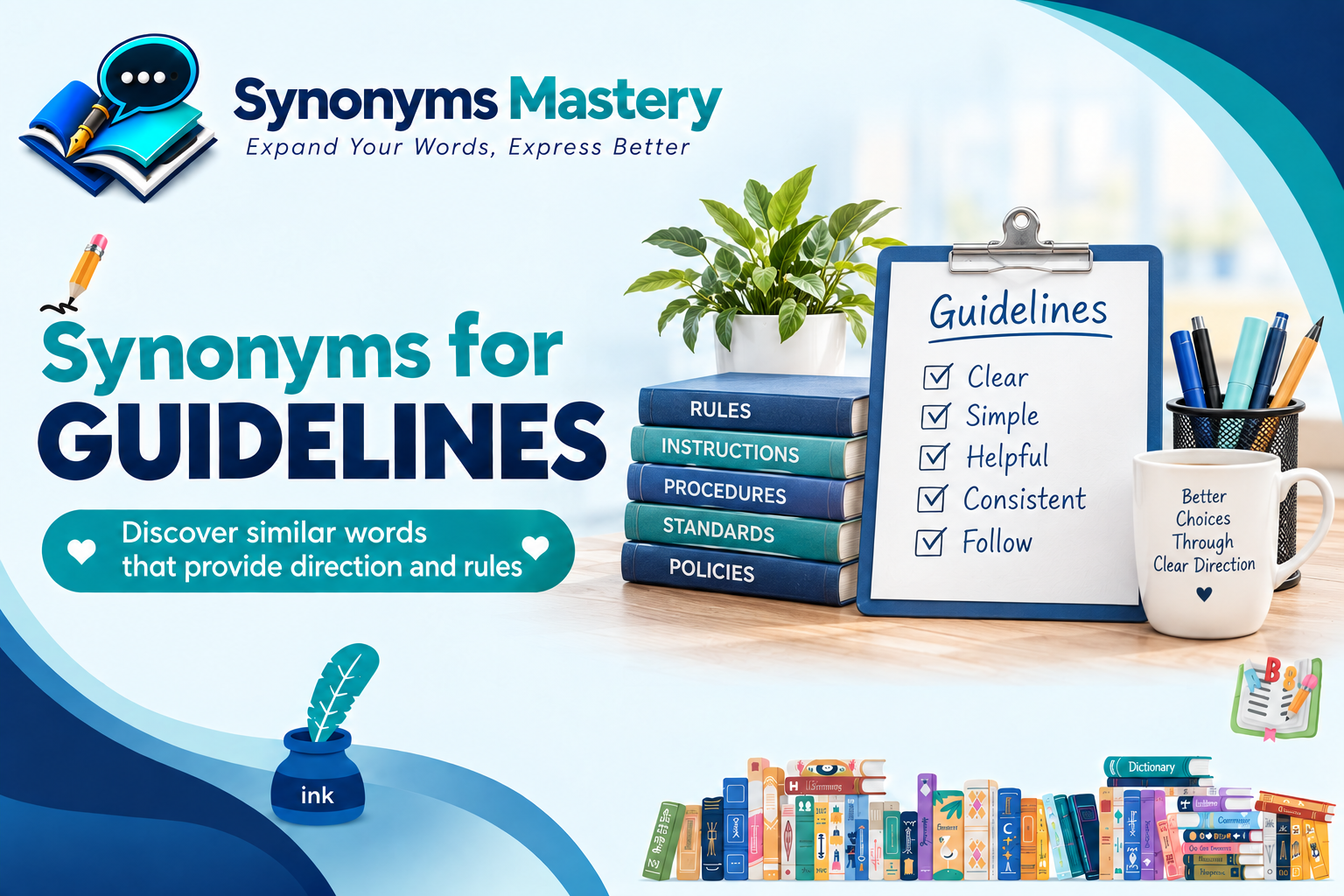
If you need synonyms for guidelines, the best choice depends on what you mean. Useful alternatives include rules, instructions, directions, standards, recommendations, advice, guidance, principles, policies, protocols, procedures, directives, and codes.
However, these words are not interchangeable in every sentence. Some suggest requirements, while others simply offer advice or establish an expected standard.
This guide explains the most useful alternatives to guidelines, shows how they differ, and provides natural examples so you can choose the right word for professional, academic, workplace, and everyday writing.
Quick Answer: What Are the Best Synonyms for Guidelines?
The closest alternatives to guidelines include rules, instructions, directions, standards, recommendations, guidance, principles, policies, protocols, and codes.
The best choice depends on context. Use instructions when you are telling someone how to do something, rules when compliance is expected, recommendations when the advice is optional,
standards when referring to an expected level of quality or performance, and policies when referring to an organization’s official position or requirements.
Core Synonyms for Guidelines
| Word | Relationship | Main Meaning | Best Context |
|---|---|---|---|
| Rules | Near synonym | Requirements governing behavior or action | Organizations, games, conduct |
| Instructions | Near synonym | Information explaining what to do | Tasks, products, procedures |
| Directions | Near synonym | Guidance about what action to take | Tasks, travel, processes |
| Standards | Near synonym | Expected level or benchmark | Quality, performance, industry |
| Recommendations | Contextual alternative | Suggestions about what is advisable | Advice, policy, professional guidance |
| Guidance | Close alternative | Advice or help about how to proceed | Professional and general contexts |
| Advice | Contextual alternative | An opinion about what someone should do | Personal and professional situations |
| Principles | Near synonym | Fundamental ideas guiding decisions | Ethics, policy, leadership |
| Policies | Related/near synonym | Official organizational positions or rules | Companies, institutions |
| Protocols | Contextual alternative | Established procedures for specific situations | Medicine, technology, safety |
| Procedures | Contextual alternative | Established way of carrying out a process | Workplaces, administration |
| Directives | Stronger alternative | Official instructions or orders | Government, organizations |
| Codes | Near synonym | Organized rules or principles | Conduct, professional practice |
| Requirements | Stronger alternative | Things that must be satisfied | Applications, compliance |
| Specifications | Contextual alternative | Detailed requirements or descriptions | Engineering, products, technical work |
Not every word above is a perfect synonym. Major dictionaries similarly group words such as rules, standards, regulations, instructions, codes, guides, directions, directives, and principles with guideline, while distinguishing their meanings through context.
What Does “Guidelines” Mean?
Guidelines are information, advice, rules, or principles intended to help people understand how something should be done or what should be done.
Cambridge defines guideline as information intended to advise people about how something should be done or what something should be.
Oxford also identifies two important uses: a set of rules or instructions from an official organization, and something used to help someone make a decision or form an opinion.
For example:
The company issued new guidelines for remote work.
Here, the guidelines provide a framework for employees without necessarily meaning that every point has the force of law.
Another example:
These figures should be used as a guideline, not an exact prediction.
Here, guideline means a useful point of reference rather than a strict rule.
The Most Useful Synonyms for Guidelines
1. Rules
Rules are established requirements that tell people what they should or should not do in a particular situation.
The coach explained the team rules before the match began.
More restrictive than guidance, these requirements set clear expectations that people are generally expected to follow. Use this term when the emphasis is on permitted and prohibited behavior.
Best for: conduct, organizations, games, workplaces, schools, and procedures.
2. Instructions
Instructions explain what someone needs to do and often provide a sequence of actions.
Please read the instructions before assembling the desk.
This is one of the best alternatives when guidelines refers to practical directions for completing a task.
Guidelines may provide general advice; instructions are usually more directly actionable.
3. Directions
Directions tell someone how to proceed.
Follow the directions on the package carefully.
They are particularly natural when referring to practical tasks, routes, processes, or specific actions.
Compare:
- Guidelines = general advice about how to proceed
- Directions = specific information about what to do or where to go
4. Standards
Standards describe an expected level of quality, performance, behavior, or achievement.
The company maintains high safety standards.
This is an especially useful alternative when guidelines establishes a benchmark rather than explaining a process.
Standards are not always instructions. They can define the level that something should meet.
5. Recommendations
Recommendations are suggestions about what is advisable or preferable.
The committee published several recommendations for improving workplace safety.
This word is useful when the guidance is persuasive rather than strictly mandatory.
Recommendation is often a better choice than rule when the proposed action is optional.
6. Guidance
Guidance refers to advice or help that directs someone toward an appropriate decision or course of action.
The manager provided guidance on how to handle customer complaints.
Unlike guidelines, which often refers to a written set of points or rules, guidance can describe the broader process of helping someone make a decision.
7. Advice
Advice refers to helpful suggestions or recommendations about what someone should do. It is generally more specific and practical than guidance, especially when addressing a particular decision, problem, or situation.
Her mentor gave her valuable advice about choosing the right career path.
The teacher offered practical advice to help students prepare for the exam.
8. Principles
Principles are fundamental ideas that guide decisions, behavior, or policy.
The organization operates according to several ethical principles.
Choose principles when you want to emphasize the underlying ideas behind a set of guidelines rather than the practical instructions themselves.
9. Policies
Policies are official principles or requirements that guide decisions and actions within an organization or institution.
The university has clear policies regarding academic integrity.
More formal and authoritative than guidance, they establish an organization’s official expectations, requirements, and approach. Unlike guidelines, which often offer recommended direction, policies can set clearer standards that members of an organization are expected to follow.
Policies can be stronger and more formal than guidelines. A policy normally represents an organization’s established position or requirements.
10. Protocols
Protocols are established procedures or systems for dealing with particular situations.
The hospital has strict infection-control protocols.
This is particularly natural in technical, medical, scientific, security, and professional contexts.
Do not automatically replace guidelines with protocols. A protocol usually implies a more defined procedure.
11. Procedures
Procedures describe established ways of carrying out a task or process.
Employees must follow the company’s emergency procedures.
A procedure tends to tell you how something is carried out, whereas a guideline may simply establish general direction.
12. Directives
Directives are official instructions, especially those issued by an authority or organization.
The department issued new directives regarding data security.
This word generally sounds more authoritative than guidelines.
Use directive when the emphasis is on an official instruction that people are expected to follow.
13. Codes
A code is an organized set of rules or principles.
All employees must comply with the company’s code of conduct.
Code works particularly well for professional ethics, conduct, standards, and organized rules.
Examples include:
- code of conduct
- building code
- professional code
- ethical code
14. Requirements
Requirements are conditions that must be met.
Applicants must satisfy all application requirements.
This is a stronger alternative to guidelines. A guideline can be flexible; a requirement generally describes something necessary.
15. Specifications
Specifications are detailed descriptions of requirements, characteristics, or technical standards.
The product must meet the manufacturer’s technical specifications.
This word is particularly appropriate for engineering, manufacturing, software, construction, and technical writing.
Which Synonym Should You Use?
Choosing the right alternative depends on what your sentence is trying to communicate.
| If you mean… | Best choice |
| General advice | Guidance |
| A suggestion | Recommendation |
| Something someone should consider | Advice |
| What someone must obey | Rule |
| How to complete a task | Instructions |
| Specific steps or actions | Directions |
| An expected level | Standard |
| An organization’s official position | Policy |
| A defined professional process | Protocol |
| An established way of doing something | Procedure |
| An authoritative instruction | Directive |
| Fundamental ideas | Principles |
| A formal set of rules | Code |
| Something that must be satisfied | Requirement |
| Technical details or criteria | Specifications |
Guidelines vs. Rules
Guidelines and rules are closely related, but they are not always interchangeable.
The former generally provides direction or advice about how something should be done, while the latter more strongly establishes what is permitted, prohibited, or required.
Compare:
The company published guidelines for using artificial intelligence.
This suggests a framework for responsible use.
The company introduced rules prohibiting employees from entering confidential information into public AI tools.
The second sentence communicates a specific restriction.
Choose “guidelines” when:
You want to emphasize flexibility, advice, or general direction.
Choose “rules” when:
You want to emphasize requirements or restrictions.
Guidelines vs. Instructions
Instructions are usually more direct and action-oriented.
The website provides guidelines for writing an effective application.
This suggests general advice.
The website provides instructions for submitting the application.
This suggests concrete steps the applicant should follow.
If the reader needs to know how to do something, instructions is often more natural.
Guidelines vs. Recommendations
A recommendation suggests a preferred action, while guidelines can encompass a broader framework of advice or standards.
The committee issued guidelines for responsible research.
The committee made several recommendations for improving research practices.
The first sounds like a structured framework. The second focuses on specific suggestions.
Guidelines vs. Standards
Standards generally establish an expected level or benchmark.
The laboratory follows strict safety guidelines.
The laboratory must meet national safety standards.
The first emphasizes guidance for conduct. The second emphasizes an established benchmark that must be met.
Guidelines vs. Policies
These terms are common in workplace and institutional writing, but they have different implications.
A policy normally represents an organization’s official position, rule, or approach.
A guideline usually provides direction within a broader policy or situation.
For example:
The company’s privacy policy explains how customer information is handled.
The company’s privacy guidelines explain recommended practices for employees handling customer information.
In some organizations, the distinction may be formalized differently, so always follow the organization’s own terminology.
Guidelines vs. Regulations
Regulations are formal rules established by an authority, often a government or regulatory body.
The agency issued new environmental regulations.
The agency published guidelines to help businesses comply with the regulations.
This illustrates an important distinction: regulations can create binding requirements, while guidelines may explain or recommend ways to meet them.
Formal Synonyms for Guidelines
If you’re writing a professional, academic, or institutional document, these alternatives can work well:
- standards
- recommendations
- principles
- policies
- protocols
- procedures
- directives
- specifications
- criteria
- requirements
However, formality alone does not make these words interchangeable. Choose based on meaning first.
For example, criteria means standards or conditions used to judge something, while requirements describe conditions that must be met. Neither should automatically replace guidelines.
Best Synonyms for Guidelines in Professional Writing
For professional writing, the most useful choices are often:
guidance — when providing general professional direction
recommendations — when suggesting preferred actions
standards — when establishing expected quality or performance
policies — when describing an organization’s official approach
procedures — when describing an established process
protocols — when describing a formal process for a specialized situation
directives — when emphasizing authoritative instructions
For example:
The report provides guidance on effective project management.
The report contains recommendations for improving project management.
The report establishes standards for project performance.
Each sentence is natural, but each communicates something slightly different.
Common Mistakes When Replacing “Guidelines”
Mistake 1: Treating every related word as an exact synonym
Words such as law, regulation, requirement, instruction, and recommendation can overlap with guidelines, but their meanings and levels of authority differ.
Mistake 2: Using “rules” when the guidance is optional
If compliance is encouraged rather than required, recommendations or guidance may be more accurate.
Mistake 3: Using “instructions” for broad principles
If a document gives general direction rather than step-by-step actions, guidelines may be better than instructions.
Mistake 4: Using “regulations” for internal advice
Regulations usually suggest formally established requirements, especially those created by an authority. They should not be used simply because a document contains guidelines.
Mistake 5: Assuming “standards” means “guidelines”
Standards usually establish an expected level, benchmark, or criterion. Guidelines can explain how to approach something without defining a measurable standard.
Natural Collocations With “Guidelines”
Some common phrases include:
- general guidelines
- clear guidelines
- strict guidelines
- official guidelines
- safety guidelines
- professional guidelines
- ethical guidelines
- design guidelines
- dietary guidelines
- follow guidelines
- issue guidelines
- develop guidelines
- provide guidelines
- establish guidelines
- update guidelines
- guidelines for employees
These combinations are useful because the most natural synonym can change with the collocation.
For example:
safety guidelines
safety regulations
safety standards
safety procedures
All are possible, but they do not mean exactly the same thing.
Related Words That Are Not Always Synonyms
Several words may appear beside guidelines in a thesaurus but should not automatically be treated as interchangeable.
Laws
Laws are legally established rules. They are generally much stronger than guidelines.
Criteria
Criteria are standards or conditions used to evaluate something.
Requirements
Requirements specify what must be satisfied.
Blueprint
A blueprint can mean a detailed plan or model, but it is not a general synonym for guidelines.
Formula
A formula provides a specific method or established way of achieving a result. It is too specific to replace guidelines in most contexts.
This distinction matters because thesaurus lists can contain related terms as well as close substitutes. Merriam-Webster, for example, lists words including law, blueprint, formula, statute, constitution, ordinance, and command among related words for guideline, rather than implying that all are interchangeable in every sentence.
FAQ About Synonyms for Guidelines
What is the closest synonym for “guidelines”?
There is no single perfect synonym for every context. Guidance, directions, instructions, standards, rules, and recommendations can all be close alternatives depending on meaning. Guidance is often appropriate when the emphasis is on general advice, while rules are better when compliance is expected.
What is a formal word for guidelines?
Formal alternatives include standards, recommendations, principles, policies, protocols, directives, procedures, and specifications.
The best choice depends on the document’s purpose. For example, protocols suits specialized procedures, while standards suits expected levels of performance or quality.
What is another word for guidelines in professional writing?
Useful professional alternatives include guidance, recommendations, standards, policies, procedures, protocols, and directives. Choose guidance for general direction, recommendations for suggested actions, and policies for an organization’s official position.
Are “guidelines” and “rules” the same?
No. They overlap, but rules usually imply stronger requirements about what people must or must not do. Guidelines generally provide direction or advice and may allow greater flexibility.
What is another word for guidelines and instructions?
Depending on context, you could use directions, guidance, procedures, protocols, or directives. Directions works for practical steps, guidance for broader advice, procedures for established processes, and directives for authoritative instructions.
What is another word for guidelines in a workplace?
Common choices include policies, procedures, standards, protocols, recommendations, rules, and guidance. The correct term depends on whether the document describes official company policy, a required process, a quality benchmark, or general advice.
Can “recommendations” replace “guidelines”?
Sometimes. Recommendations are suitable when the guidelines primarily suggest preferred actions. However, guidelines can also include standards, principles, or requirements, so recommendations may be narrower in meaning.
What is the difference between guidelines and standards?
Guidelines generally provide direction about how something should be approached or done. Standards establish an expected level, benchmark, or criterion. A document can contain guidelines for achieving a particular standard.
Conclusion
The best synonym for guidelines depends on the meaning you want to communicate. Use guidance for broad advice, instructions for practical steps, rules for requirements, recommendations for suggestions, standards for benchmarks, policies for organizational positions, and protocols or procedures for established processes.
The key is not to choose the most formal or sophisticated word. Choose the word that accurately communicates the level of authority, purpose, and context of the guidance you are describing.

Ethan Walker is a language tutor who helps learners improve their English through practical examples and real-life usage. He specializes in teaching synonyms, sentence formation, and writing clarity. His goal is to make complex vocabulary simple and usable for everyday communication.