Synonyms for Mimic: 15 Alternatives With Examples
Finding the right synonyms for mimic can help you describe imitation more precisely. The word commonly refers to copying someone’s speech, movements, behavior, or distinctive characteristics. However, the best alternative depends on the situation.
Imitate works in many everyday contexts, impersonate emphasizes portraying another person, and parody describes imitation intended to create humor or satire. Understanding these differences helps you choose natural vocabulary for conversations, academic writing,
storytelling, and professional communication. Below, you’ll find useful alternatives, their meanings, example sentences, and practical guidance on when to use each word.
Quick Answer: What Are the Best Synonyms for Mimic?
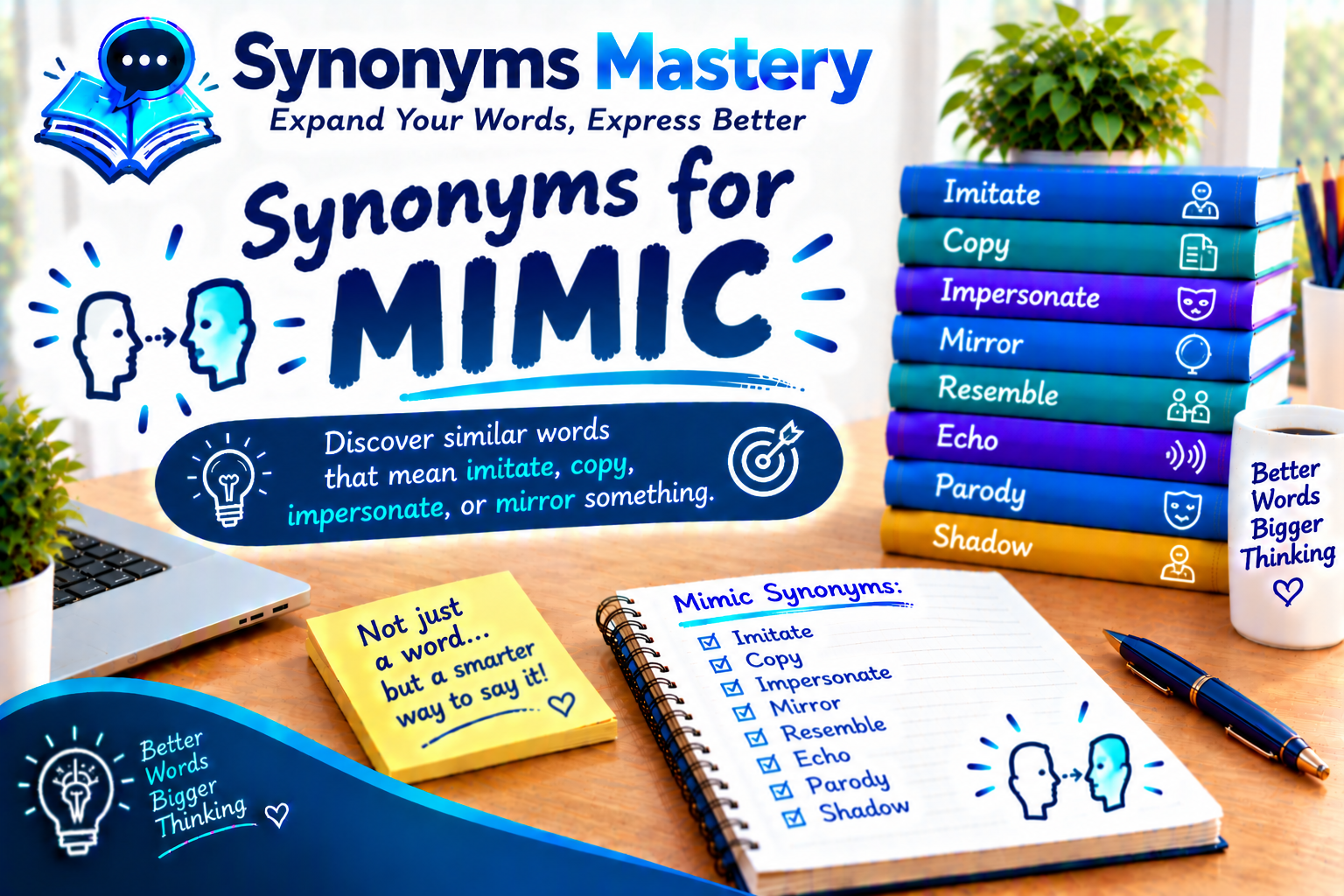
The closest synonyms for mimic are imitate, copy, and ape. Depending on the context, mirror, impersonate, parody, mock, and simulate can also work. Use imitate for general copying, impersonate for portraying a person, parody for humorous imitation, and simulate for reproducing a process or set of conditions.
15 Synonyms for Mimic
| Word | Relationship | Meaning | Best Context |
|---|---|---|---|
| Imitate | Direct synonym | Copy someone’s actions, speech, or style | General use |
| Copy | Direct synonym | Reproduce another person’s actions or something’s characteristics | Everyday situations |
| Ape | Near synonym | Imitate someone’s behavior, often uncritically | Critical or literary writing |
| Mirror | Contextual alternative | Reflect or reproduce similar behavior or characteristics | Behavior and responses |
| Impersonate | Contextual alternative | Act or speak as though you are another person | Acting and performance |
| Parody | Contextual alternative | Imitate a style for humorous or satirical effect | Comedy and writing |
| Mock | Near synonym | Imitate someone to ridicule them | Negative situations |
| Simulate | Contextual alternative | Reproduce the behavior or conditions of something | Science and technology |
| Emulate | Near synonym | Follow someone’s example, often to achieve similar success | Learning and professional development |
| Reproduce | Contextual alternative | Create a copy or repeat an effect | Sounds, images, and results |
| Echo | Contextual alternative | Repeat or reflect words, sounds, or ideas | Speech and writing |
| Take off | Contextual alternative | Imitate someone’s manner or voice, often humorously | Informal conversation |
| Parrot | Near synonym | Repeat words, sometimes without understanding them | Speech and memorized information |
| Caricature | Contextual alternative | Exaggerate recognizable features for comic or critical effect | Art and satire |
| Resemble | Contextual alternative | Have similar characteristics or appearance | Appearance and characteristics |
Usage note: These words are not interchangeable in every sentence. Imitate and copy are generally the most versatile alternatives. The remaining words introduce specific meanings or work best in particular contexts.
What Does Mimic Mean?
Mimic means to copy or imitate someone’s speech, movements, behavior, or characteristics. It can also describe reproducing the appearance or effects of something.
The word functions as both a verb and a noun.
As a verb:
- The comedian can mimic several famous actors.
- The software mimics certain aspects of human behavior.
As a noun:
- The performer is a talented mimic.
In the first example, mimic describes copying recognizable characteristics. In the second, it describes reproducing aspects of a system’s behavior.
Pronunciation: /ˈmɪmɪk/
Part of speech: Verb and noun
Verb forms: Mimic, mimics, mimicked, mimicking
Best Synonyms for Mimic by Context
1. Synonyms for Mimicking Someone’s Behavior
When describing gestures, actions, or mannerisms, the following alternatives are useful.
Imitate: Copy someone’s behavior, speech, or actions.
Example: The student imitated the instructor’s hand movements.
Copy: Reproduce someone’s actions or behavior.
Example: The younger child copied his brother’s gestures.
Ape: Imitate someone’s behavior, often with a suggestion of unoriginality.
Example: The writer was criticized for aping another author’s style.
Mirror: Reflect or reproduce similar behavior, expressions, or responses.
Example: Children sometimes mirror the behavior of adults around them.
Which word should you choose? Use imitate for general imitation, copy for straightforward reproduction, ape for critical commentary, and mirror when emphasizing corresponding behavior.
2. Synonyms for Mimicking Someone’s Voice
When describing voices, accents, or speech patterns, choose an alternative that reflects the intended meaning.
- Imitate: Copy someone’s voice or accent.
- Impersonate: Reproduce someone’s voice and mannerisms while portraying that person.
- Take off: Informally imitate someone’s distinctive voice or manner, often for entertainment.
- Parrot: Repeat another person’s words, sometimes without understanding them.
- Mock: Imitate someone’s speech to ridicule them.
Examples:
- The actor imitated the singer’s accent.
- The performer impersonated a famous television host.
- My friend did a funny takeoff of the character’s dramatic voice.
- The child parroted the phrase he had heard on television.
Usage tip: Imitate is the most versatile option for copying a voice. Use impersonate when someone portrays a particular person, and parrot when the emphasis is on repeating words.
3. Synonyms for Mimicking a Style
When someone copies an artistic, literary, or creative style, the intention determines the best word.
Imitate: Follow another person’s recognizable style.
Example: The young writer imitated the structure of classic mystery novels.
Emulate: Follow a successful example, often to achieve a similar standard.
Example: She hopes to emulate the discipline of her favorite author.
Parody: Imitate recognizable features of a style for humorous or satirical effect.
Example: The sketch parodied the exaggerated dialogue of action movies.
Caricature: Exaggerate distinctive features to create a comic or critical portrayal.
Example: The cartoon caricatured the politician’s dramatic gestures.
These words communicate different intentions. Emulate often suggests admiration or aspiration, while parody and caricature involve exaggeration.
4. Synonyms for Mimicking a Process or Effect
In scientific and technical contexts, mimic may describe reproducing a process, characteristic, or effect.
- Simulate: Reproduce the behavior or conditions of a system.
- Reproduce: Create a similar result or repeat an effect.
- Mirror: Reflect a corresponding pattern or behavior.
- Resemble: Have similar characteristics without necessarily copying deliberately.
- Copy: Reproduce an existing design or model.
Examples:
- The training program simulates real-world driving conditions.
- Researchers reproduced the results under controlled conditions.
- The new design resembles the original model.
- The computer model mirrors several patterns observed in nature.
Usage tip: Choose simulate when describing a system that reproduces another system’s behavior or conditions. Choose resemble when you mean that two things are similar, regardless of whether copying occurred.
Mimic vs. Imitate vs. Copy
Mimic, imitate, and copy overlap in meaning, but they can emphasize different aspects of imitation.
| Word | Main Emphasis | Example |
|---|---|---|
| Mimic | Reproducing recognizable behavior, speech, or characteristics | The bird mimicked the sound. |
| Imitate | Following another person’s actions, style, or example | The student imitated the instructor. |
| Copy | Reproducing something from an existing model | The artist copied the original sketch. |
When Should You Use Mimic?
Use mimic when recognizable behavior or characteristics are central to the sentence.
Example: The actor mimicked the character’s unusual walk.
When Should You Use Imitate?
Use imitate when describing the act of following another person’s example or reproducing their behavior.
Example: Young children often imitate the speech patterns of adults.
When Should You Use Copy?
Use copy when emphasizing straightforward reproduction, especially when an existing object, design, or action serves as the model.
Example: The designer copied the layout of the original document.
The words frequently overlap. Choose the one that communicates your intended meaning most naturally.
Mimic vs. Impersonate
Mimic and impersonate can both describe copying someone’s voice or mannerisms. However, impersonate more specifically means pretending to be another person.
- Mimic: The comedian mimicked the actor’s distinctive laugh.
- Impersonate: The performer impersonated the actor during a comedy show.
In the first sentence, the comedian copies one characteristic. In the second, the performer portrays the person.
Use mimic when a particular feature is being copied and impersonate when portraying the person is central to the action.
Mimic vs. Mock
The key difference is that mock usually introduces ridicule, whereas mimic can be neutral.
| Feature | Mimic | Mock |
|---|---|---|
| Core meaning | Copy or imitate | Ridicule or imitate disrespectfully |
| Tone | Neutral, playful, or critical | Usually negative |
| Main emphasis | Imitation | Ridicule |
| Example | She mimicked his accent. | They mocked his accent. |
Someone can mimic another person without intending to insult them. Mocking generally involves making someone or something appear foolish or deserving of ridicule.
If you simply mean copying someone’s speech or behavior, imitate may be the more appropriate choice.
Common Mistakes When Using Mimic Synonyms
1. Using Mock When You Mean Imitate
Mock often suggests ridicule, while imitate can be neutral.
- Neutral: The student imitated the instructor’s movements.
- Negative: The student mocked the instructor’s movements.
Choose imitate when the intention is simply to copy.
2. Using Impersonate for Every Type of Imitation
Impersonate generally means acting as a particular person. It is not the best general substitute for reproducing an object or process.
- Natural: The actor impersonated the singer.
- More precise: The software mimicked the behavior of the original system.
3. Confusing Similarity With Copying
Resemble describes similarity without necessarily implying imitation.
- The child resembles her mother.
- The child imitates her mother’s gestures.
The first sentence describes similar characteristics; the second describes copied actions.
4. Using Parody Without a Humorous or Satirical Meaning
Parody generally involves imitating recognizable features for comic or satirical effect.
If someone copies a style without this intention, imitate may be more accurate.
5. Confusing Mimic With Mimicry
Mimic can function as a verb or noun, while mimicry is a noun referring to imitation or the practice of imitating.
- Verb: The bird can mimic other sounds.
- Noun: The bird’s mimicry is remarkable.
Choose the grammatical form that fits your sentence.
Frequently Asked Questions
1. What is the closest synonym for mimic?
Imitate is generally the closest synonym for mimic. Both words describe copying someone’s behavior, speech, movements, or characteristics. However, mimic often emphasizes recognizable mannerisms, while imitate also commonly describes following someone’s example or style.
2. What is another word for mimic someone?
Use imitate or copy when describing someone’s behavior or speech. Choose impersonate when a person acts as someone else, parody when the imitation is humorous or satirical, and mock when the intention is ridicule.
3. Is mimic the same as imitate?
The words are very similar and can often replace each other. However, mimic frequently emphasizes reproducing recognizable characteristics, speech, or behavior. Imitate has a broader range and can describe copying actions, styles, or examples as part of learning.
4. What is a formal synonym for mimic?
Imitate is suitable for both formal and everyday writing. Depending on the context, simulate works well in technical writing, while emulate is appropriate when describing an effort to follow a successful example. These alternatives are not interchangeable in every sentence.
5. What is a synonym for mimicking someone’s voice?
Imitate is the most versatile choice for describing the copying of a person’s voice. Impersonate is suitable when someone portrays another person, parrot emphasizes repetition of words, and mock suggests ridicule.
6. What is the difference between mimic and mirror?
Mimic generally means to copy recognizable characteristics or behavior. Mirror emphasizes reflecting or reproducing a similar action, expression, pattern, or response. For example, a comedian might mimic a celebrity’s voice, while a person’s expression might mirror another person’s surprise.
7. Can mimic be used as a noun?
Yes. As a noun, mimic refers to someone skilled at imitating other people, animals, or sounds. For example, “The performer is a talented mimic.” The word can also appear in specialized contexts involving imitation.
Conclusion
The best synonym for mimic depends on what is being copied and why. Imitate is the most versatile alternative, while copy emphasizes reproduction, impersonate describes portraying another person, and parody conveys humorous or satirical imitation. In technical writing, simulate may be more precise, whereas mirror describes corresponding behavior or patterns.
Choosing the right word requires more than finding a similar dictionary definition. Consider the context, tone, and intended meaning to make your writing more accurate and natural.

Chloe Mitchell is a professional content writer with expertise in building clear and engaging vocabulary resources. She focuses on creating easy-to-read synonym guides, helping users understand word meanings quickly. Her writing style is simple, user-friendly, and optimized for search engines.