Synonyms for Tedious: 25 Alternatives With Examples
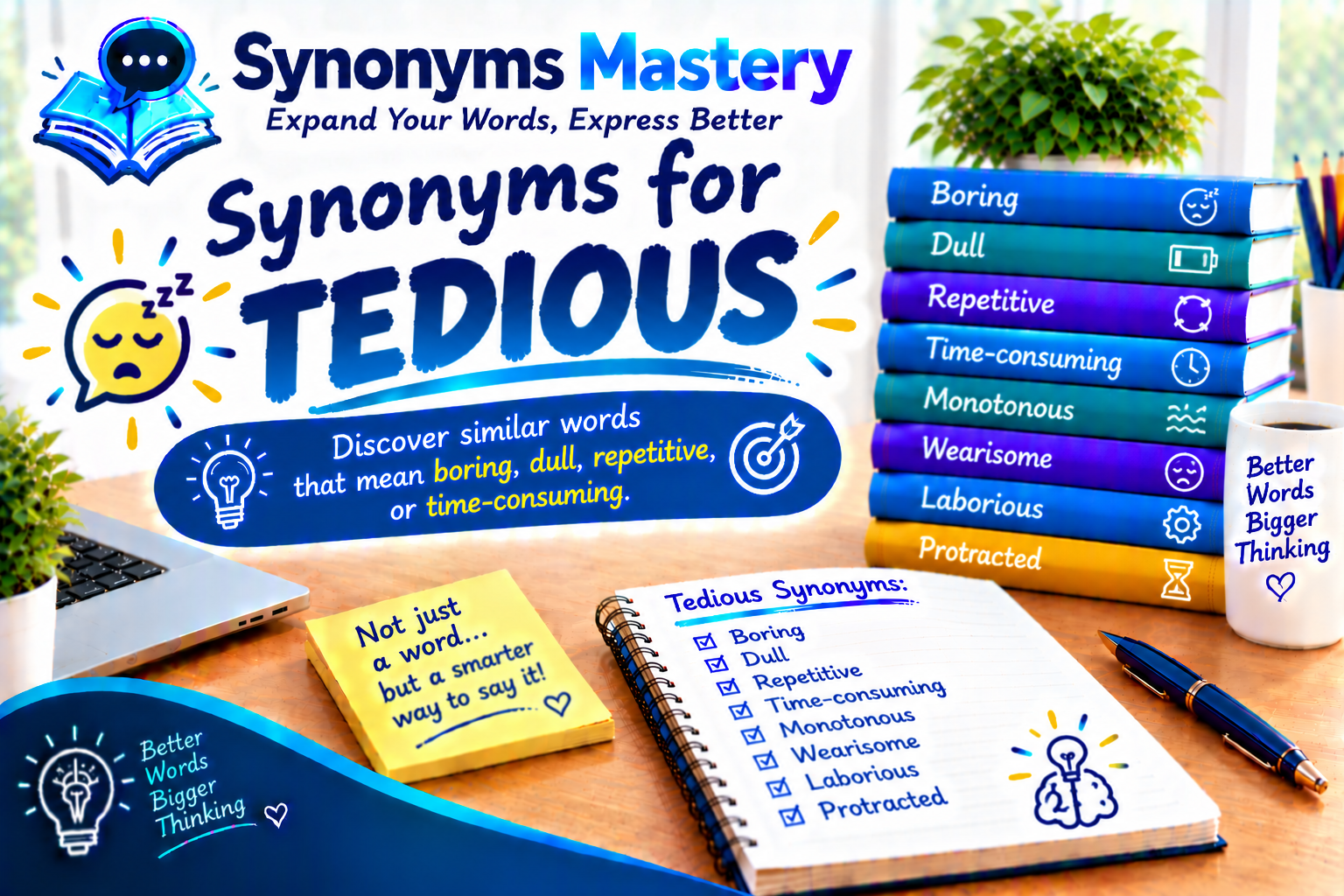
Finding the right synonym for tedious depends on why something feels boring or exhausting. A repetitive assignment may be monotonous, a dull presentation may be uninteresting, and a lengthy administrative process may be time-consuming.
Although these expressions overlap, they emphasize different aspects of an experience. Choosing the right word makes your writing more precise and natural.
This guide explores useful synonyms for tedious, explains their meanings and differences, and provides practical examples for academic writing, everyday conversations, and professional communication.
Quick Answer: What Are the Best Synonyms for Tedious?
The closest synonyms for tedious include boring, tiresome, wearisome, monotonous, dull, dreary, and wearing. Use monotonous when something is repetitive, time-consuming when it takes a long time, laborious when it requires considerable effort, and mind-numbing when it is extremely boring or mentally unstimulating. The best alternative depends on whether the main problem is boredom, repetition, duration, or effort.
25 Synonyms for Tedious
The following words and expressions are grouped by how closely they match tedious and what they emphasize.
| Synonym | Relationship | Meaning and best use |
|---|---|---|
| Boring | Direct | Not interesting or engaging |
| Tiresome | Direct | Boring or tiring, often because something continues too long |
| Wearisome | Direct | Causing boredom, fatigue, or impatience; somewhat formal |
| Monotonous | Direct/near | Repetitive and lacking variety |
| Dull | Direct | Not interesting, lively, or stimulating |
| Dreary | Near | Gloomy, monotonous, or depressing |
| Uninteresting | Direct | Failing to attract attention or interest |
| Drab | Near | Lacking variety, liveliness, or appeal |
| Wear-ing (wearing) | Near | Gradually causing fatigue or strain |
| Irksome | Near | Annoying or irritating because of its demands |
| Mind-numbing | Contextual | So boring or repetitive that it feels mentally numbing |
| Humdrum | Near | Ordinary, routine, and lacking excitement |
| Dry | Contextual | Dull or difficult to engage with, especially a subject or presentation |
| Lifeless | Contextual | Lacking energy, animation, or interest |
| Banal | Near | Unoriginal, predictable, or lacking freshness |
| Prosaic | Contextual | Ordinary or unimaginative; often literary or formal |
| Unstimulating | Near | Failing to engage the mind or encourage interest |
| Fatiguing | Contextual | Causing physical or mental tiredness |
| Tiring | Near | Making someone feel tired |
| Exhausting | Contextual | Requiring so much energy that it leaves someone very tired |
| Laborious | Contextual | Requiring considerable effort or painstaking work |
| Arduous | Contextual | Difficult and demanding, not necessarily boring |
| Time-consuming | Contextual | Taking a substantial amount of time |
| Drawn-out | Contextual | Lasting longer than necessary or desirable |
| Tedious and repetitive | Phrase-level | Useful when both boredom and repeated actions matter |
Note: These alternatives are not interchangeable in every sentence. Words such as arduous and time-consuming describe particular aspects of a tedious experience rather than necessarily expressing boredom themselves.
What Does Tedious Mean?
Tedious is an adjective describing something that becomes boring, tiring, or frustrating because it lasts a long time, involves repetition, or lacks variety and interest.
For example:
- The tedious paperwork delayed the application process.
- Listening to the same explanation repeatedly became tedious.
- The journey was tedious because of the long delays.
According to the tedious describes something boring, particularly work or activities. also highlights the connection between excessive duration and lack of interest.
English meaning – Cambridge Dictionary
+1
Pronunciation: /ˈtiː.di.əs/ in both American and British English.
Part of speech: Adjective.
Related forms: Tediously (adverb), tediousness (noun), and tedium (noun).
Best Synonyms for Tedious by Context
Different situations call for different alternatives. These distinctions are especially useful when writing essays, describing work, or choosing more precise vocabulary.
1. Synonyms for Tedious Work
When describing repetitive office duties, paperwork, data entry, or routine assignments, these words are often useful:
- Monotonous: The employee spent the afternoon doing monotonous data-entry work.
- Laborious: Preparing the records manually was a laborious process.
- Time-consuming: Checking every document individually was time-consuming.
- Mind-numbing: Sorting thousands of nearly identical records was mind-numbing.
- Repetitive: The job involved repetitive administrative tasks.
Choose monotonous when repetition is the main problem, laborious when effort is the issue, and time-consuming when duration matters most.
2. Synonyms for a Tedious Task
For chores, assignments, or processes that require patience, consider:
- Tiresome: Completing the same form for each department became tiresome.
- Wearisome: The wearisome process required several rounds of corrections.
- Irksome: Re-entering information after every minor error was irksome.
- Arduous: Completing the project under difficult conditions was arduous.
- Drawn-out: The approval process became unnecessarily drawn-out.
Arduous emphasizes difficulty rather than boredom, so it is most appropriate when the task is genuinely demanding.
3. Synonyms for a Tedious Speech, Book, or Presentation
When describing content that fails to hold attention, try:
- Dull: The presentation was dull and lacked clear examples.
- Uninteresting: The article was uninteresting because it offered little new information.
- Dry: The speaker made a dry technical subject difficult to follow.
- Banal: The essay relied on banal observations instead of original ideas.
- Lifeless: The performance felt lifeless despite the talented cast.
Banal suggests that ideas are unoriginal or predictable, while dry often describes material presented in a way that lacks liveliness.
4. Synonyms for a Tedious Journey or Experience
When something feels long, monotonous, or draining, consider:
- Tiresome: The repeated delays made the journey tiresome.
- Dreary: It was a dreary afternoon of waiting indoors.
- Wearisome: The endless sequence of announcements became wearisome.
- Drawn-out: The ceremony felt drawn-out because several sections repeated the same information.
- Exhausting: Traveling overnight without enough rest was exhausting.
Remember that exhausting describes a strong effect on energy. A journey can be tedious without being physically exhausting.
Important Synonym Comparisons
Understanding the differences between similar words helps you choose alternatives that preserve the intended meaning.
Tedious vs. Boring
Both words describe something that fails to hold interest, but tedious often emphasizes excessive duration, repetition, or the resulting impatience. Boring is broader and works in almost any everyday context.
- Tedious: The tedious registration process required us to enter the same details repeatedly.
- Boring: The movie was boring because the story lacked suspense.
Choose tedious when the length or repetitive nature contributes to the problem. Choose boring when you simply mean something is not interesting.
Tedious vs. Monotonous
Monotonous emphasizes sameness and a lack of variation. Tedious emphasizes the boredom or impatience an activity causes, often because it is long or repetitive.
- Tedious: Reviewing hundreds of applications took hours and became tedious.
- Monotonous: Repeating the same task every morning made the job monotonous.
A monotonous activity is often tedious, but something can be tedious without being repetitive.
Tedious vs. Tiresome
These words overlap considerably. Tiresome can describe something boring, tiring, or irritating, while tedious frequently highlights a long or repetitive experience.
- Tedious: The tedious report took an entire afternoon to complete.
- Tiresome: His tiresome complaints continued throughout the meeting.
Tiresome can also describe a person’s behavior more naturally when that behavior annoys others.
Tedious vs. Laborious
Laborious describes work that requires considerable effort, patience, or careful attention. It does not necessarily mean the work is boring.
- Tedious: Checking each entry manually was tedious.
- Laborious: Restoring the damaged manuscript was laborious because every page required careful work.
Use laborious when effort is central to the meaning and tedious when boredom or impatience is central.
Tedious vs. Arduous
Arduous emphasizes difficulty, strain, or the demands of a task. Tedious emphasizes boredom, duration, or repetition.
- Tedious: The lengthy procedure was tedious but relatively easy.
- Arduous: Climbing the steep mountain trail was arduous.
A task can be both arduous and tedious, but neither word automatically implies the other.
Tedious vs. Time-Consuming
Time-consuming refers specifically to the amount of time something requires. It does not necessarily suggest boredom.
- Tedious: The repetitive verification process was tedious.
- Time-consuming: Reviewing every application individually was time-consuming.
A task may be time-consuming and enjoyable, or quick but tedious.
Which Word Should You Use Instead of Tedious?
Use this quick guide to select a natural alternative.
| If you mean… | Choose… | Example |
|---|---|---|
| Not interesting | Boring | The lecture was boring. |
| Repetitive and unvaried | Monotonous | The work became monotonous. |
| Boring and tiring | Tiresome | The repeated interruptions were tiresome. |
| Long and frustrating | Wearisome | The negotiations became wearisome. |
| Requiring much effort | Laborious | Compiling the records was laborious. |
| Difficult and demanding | Arduous | The recovery process was arduous. |
| Taking a long time | Time-consuming | The review was time-consuming. |
| Extremely unstimulating | Mind-numbing | The repetitive sorting was mind-numbing. |
| Unoriginal or predictable | Banal | The article contained banal observations. |
| Excessively prolonged | Drawn-out | The meeting was drawn-out. |
Professional Alternatives to Tedious
In workplace communication, the most effective replacement often describes the specific problem without sounding unnecessarily negative.
| Instead of… | Consider… | Why it works |
|---|---|---|
| Tedious paperwork | Extensive paperwork | Neutral and professional |
| Tedious process | Lengthy process | Emphasizes duration |
| Tedious manual work | Repetitive manual work | Identifies the repetition |
| Tedious procedure | Time-consuming procedure | Highlights the time required |
| Tedious review | Detailed review | Emphasizes thoroughness, if accurate |
| Tedious task | Routine task | Neutral and suitable for regular duties |
These alternatives are not all exact synonyms. For example, detailed can describe a useful and engaging review, whereas tedious expresses a negative judgment. Choose a neutral phrase when communicating with colleagues or clients and the negative judgment is not necessary.
Common Mistakes When Using Tedious Synonyms
1. Treating every difficult task as tedious
A difficult task is not necessarily boring. Use arduous for difficulty and tedious for boredom or impatience.
2. Using monotonous when repetition is absent
A long, complicated discussion may be tedious without being monotonous. Reserve monotonous for experiences that lack variation or follow the same pattern repeatedly.
3. Assuming time-consuming always means boring
A rewarding project can be time-consuming. This expression describes duration, not a person’s level of interest.
4. Using exhausting for every tiring activity
Exhausting is stronger than tiring and suggests substantial fatigue. Use it when the intensity of the experience justifies that meaning.
5. Confusing tedious with tediously
Tedious is an adjective, while tediously is an adverb.
- Correct: The process was tedious.
- Correct: The instructions were explained tediously.
- Incorrect: The process was tediously.
6. Using formal vocabulary when a simple word is clearer
Words such as wearisome and irksome can be useful, but boring may sound more natural in casual conversation. Match the word to your audience and purpose.
Antonyms of Tedious
Antonyms help express the opposite of a tedious experience. The best choice depends on whether you want to emphasize interest, excitement, or variety.
- Engaging: Holds attention and encourages interest.
- Interesting: Attracts attention or curiosity.
- Exciting: Creates enthusiasm or anticipation.
- Stimulating: Encourages thought, curiosity, or mental activity.
- Varied: Includes different activities, experiences, or elements.
- Entertaining: Provides enjoyment or amusement.
For example, instead of saying, “The workshop was not tedious,” you could write, “The workshop was engaging and stimulating.”
Frequently Asked Questions
1. What is the closest synonym for tedious?
Boring is one of the closest and most versatile synonyms for tedious. However, tiresome and wearisome are also strong alternatives. If repetition is the main problem, monotonous may be more precise.
2. What is a more professional word for tedious?
The best professional alternative depends on the context. Use time-consuming when a task takes too long, repetitive when the same actions recur, and laborious when the work requires substantial effort. These terms communicate specific problems without automatically labeling the work boring.
3. What is another word for tedious work?
Monotonous, repetitive, tiresome, and laborious are useful alternatives. Choose monotonous for work lacking variety, repetitive for recurring actions, and laborious for tasks that demand sustained effort.
4. Is tedious the same as monotonous?
No. Tedious describes something boring or tiring, often because it takes too long. Monotonous describes something repetitive or lacking variation. Repetitive work can be both tedious and monotonous, but the words emphasize different qualities.
5. Is tedious a negative word?
Yes. Tedious generally expresses a negative judgment because it suggests boredom, impatience, or weariness. In professional writing, a neutral alternative such as lengthy, repetitive, or time-consuming may be more appropriate when you want to describe the situation without criticizing it.
6. What is the difference between tedious and laborious?
Tedious emphasizes boredom or impatience, while laborious emphasizes effort and difficulty. A simple task that involves entering the same information repeatedly may be tedious. Repairing a complex machine by hand may be laborious, even if the work is interesting.
7. What are some formal synonyms for tedious?
Wearisome, irksome, and laborious can work in formal contexts, depending on meaning. Prosaic is appropriate when something is ordinary or unimaginative, while time-consuming is a clear, professional choice when duration is the main concern.
8. What is the opposite of tedious?
Common antonyms include interesting, engaging, exciting, and stimulating. Use engaging for something that holds attention, exciting for something that generates enthusiasm, and stimulating for something that encourages thought or curiosity.
Conclusion
The best synonym for tedious depends on what makes an experience unpleasant. Choose boring for a lack of interest, monotonous for repetition, tiresome for something that wears on your patience, laborious for demanding work, and time-consuming for tasks that take too long. By understanding these distinctions, you can write more precisely and select vocabulary that fits your intended meaning, tone, and audience.

Ethan Walker is a language tutor who helps learners improve their English through practical examples and real-life usage. He specializes in teaching synonyms, sentence formation, and writing clarity. His goal is to make complex vocabulary simple and usable for everyday communication.