Synonyms for Jobs: 20 Better Alternatives With Examples
Looking for synonyms for jobs can be tricky because the word has more than one common meaning. It can refer to paid positions, types of employment, or individual pieces of work that need to be completed. That is why words such as positions, occupations, work, tasks, assignments, and duties are not always interchangeable. Cambridge and Collins group the meanings of job around employment, position, and task-related uses.
The best alternative depends on what you mean by jobs in your sentence. This guide separates the major meanings and shows which words sound most natural in everyday, professional, and formal English.
Quick Answer: What Are the Best Synonyms for Jobs?
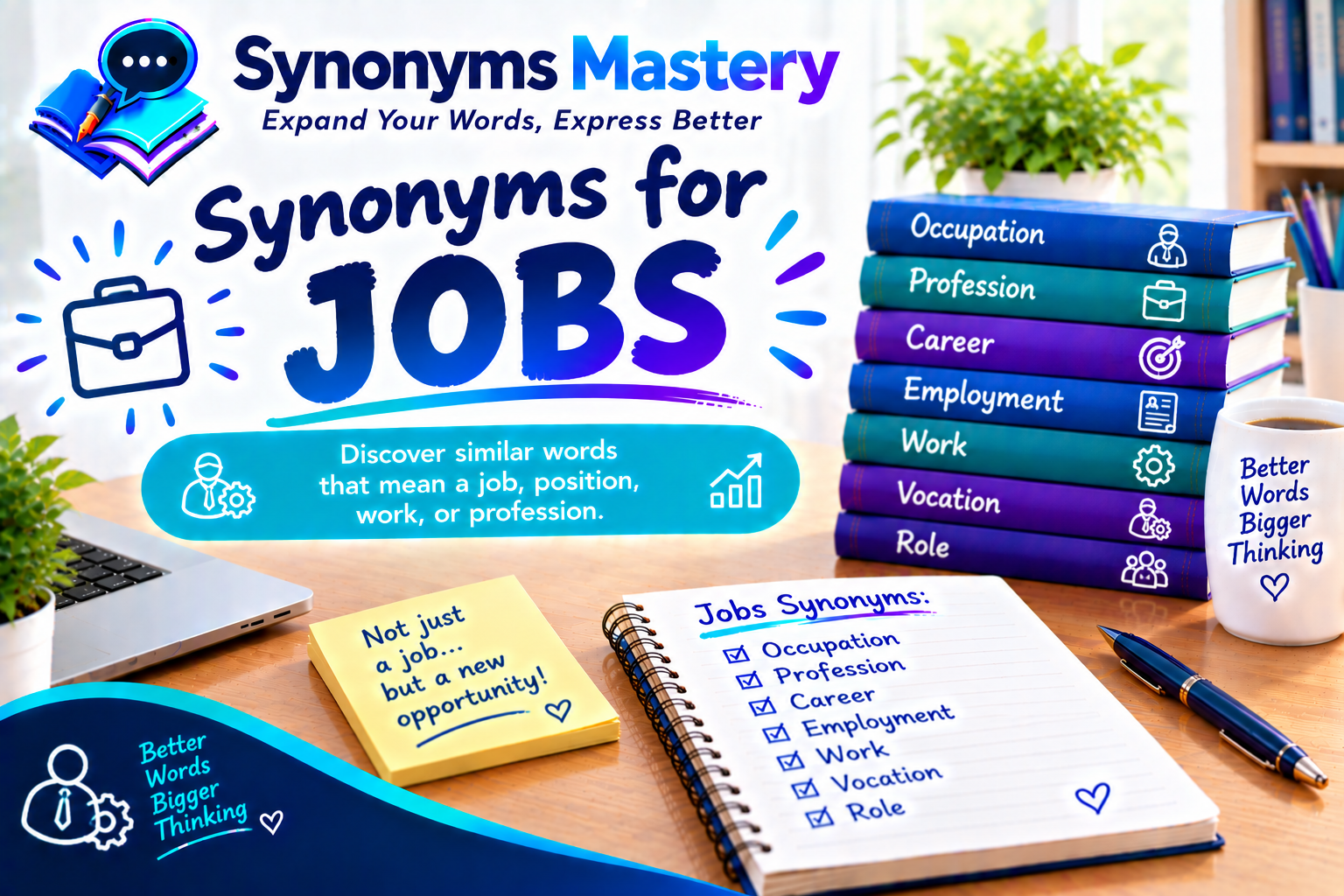
Common synonyms for jobs include work, positions, occupations, employment, roles, professions, posts, tasks, assignments, duties, and responsibilities. However, these words have different meanings. Use positions for specific employment opportunities, occupations for types of work, tasks for pieces of work to complete, and employment for the general state of having paid work.
Core Synonyms for Jobs
| Word | Relationship | Meaning | Strength | Formality | Best Context |
| Work | Near synonym | Activity done as a job or livelihood | Broad | Neutral | General employment |
| Positions | Close synonym | Specific employment opportunities or roles | Similar | Neutral/Formal | Hiring and workplaces |
| Occupations | Close synonym | A person’s regular type of work | Similar | Formal | Forms, surveys, writing |
| Employment | Close synonym | Paid work or the state of being employed | Broad | Formal | Business and labor contexts |
| Roles | Near synonym | A person’s function or responsibilities | Contextual | Neutral/Professional | Organizations and teams |
| Professions | Contextual | Skilled occupations requiring specialized training | Narrower | Formal | Law, medicine, teaching |
| Posts | Contextual | Official positions within an organization | Narrower | Formal | Government and institutions |
| Careers | Related | A person’s longer-term working path | Broader | Neutral | Professional development |
| Tasks | Contextual | Individual pieces of work to complete | Different sense | Neutral | Projects and daily work |
| Assignments | Contextual | Work given to someone to complete | Different sense | Neutral/Formal | School and workplaces |
| Duties | Contextual | Work someone is expected or required to perform | Different sense | Formal | Job descriptions |
| Responsibilities | Contextual | Areas of work or obligations assigned to someone | Different sense | Professional | Workplace communication |
| Chores | Contextual | Routine or unpleasant pieces of work | Narrower | Informal/Neutral | Household or routine work |
| Undertakings | Contextual | Tasks or projects requiring effort | Broader | Formal | Projects and formal writing |
| Appointments | Contextual | Positions to which people are appointed | Narrower | Formal | Institutions |
| Trades | Contextual | Skilled occupations, especially practical ones | Narrower | Neutral | Construction and skilled work |
| Vocations | Near synonym | Occupations viewed as a calling | More specific | Formal | Careers and personal purpose |
| Gigs | Contextual | Short-term or flexible paid work | Informal | Informal | Freelance work |
| Openings | Contextual | Available employment opportunities | Narrower | Neutral | Job searches |
| Positions available | Phrase alternative | Specific jobs currently open | Contextual | Professional | Recruiting |
The major distinction is important: positions, occupations, and employment relate to work as a form of livelihood, while tasks, assignments, duties, and responsibilities relate to work that someone must do.
What Does “Jobs” Mean?
Jobs is the plural of job, but job has several common senses.
1. Jobs as paid employment
In this sense, a job is regular work that someone does for money. For example:
She applied for three jobs this week.
Here, positions, occupations, or employment opportunities may work depending on the context.
2. Jobs as specific positions
A job can also mean a particular position within an organization:
The company advertised several new jobs.
Here, positions or openings may be more precise:
The company advertised several new positions.
The company has several openings for software developers.
3. Jobs as pieces of work
In another common use, a job means something that needs to be done:
I have several jobs to finish before lunch.
Here, tasks, assignments, or pieces of work may be more appropriate.
This distinction is supported by major thesaurus references, which separate job into employment-related and task-related meanings.
Synonyms for Jobs Meaning Employment
When jobs means paid employment, these are the most useful alternatives.
1. Positions
Positions is one of the closest alternatives when you mean specific jobs within a company or organization.
The company has several open positions.
She applied for two marketing positions.
Use positions when talking about hiring, vacancies, organizational roles, or specific employment opportunities.
2. Occupations
Occupations refers to the type of work a person regularly does.
Please state your occupation on the application.
The survey asked participants about their occupations.
It sounds more formal than jobs and works particularly well in forms, surveys, reports, and professional writing. Cambridge lists occupation among the alternatives associated with employment.
3. Employment
Employment focuses on paid work or the condition of being employed rather than on one particular position.
The program helps people find employment.
Employment opportunities have increased in the region.
It is especially useful in business, government, economics, and formal writing.
4. Work
Work is broader than jobs. It can refer to paid employment, effort, duties, or activity in general.
She is looking for work.
He found work after moving to the city.
Use work when you want a natural, broad alternative rather than a specific position.
5. Professions
Professions refers to occupations, usually ones requiring specialized knowledge, education, or training.
Healthcare professions require specialized training.
Many professions are changing because of technology.
It should not replace jobs in every sentence because not every job is normally described as a profession.
Synonyms for Jobs Meaning Tasks
When jobs means things that need to be done, different alternatives become more natural.
6. Tasks
Tasks is one of the closest alternatives when a job means an individual piece of work.
I have several tasks to complete today.
The manager assigned three tasks to each employee.
This is especially common in workplaces, projects, schoolwork, and productivity contexts.
7. Assignments
An assignment is work that has been given to someone to complete.
I have two assignments due tomorrow.
The manager gave me a new assignment.
This word works especially well for school, university, and professional projects.
8. Duties
Duties are tasks or responsibilities that someone is expected to perform because of their position.
Her duties include answering customer questions.
One of his main duties is training new employees.
Duties is therefore more specific than jobs when the focus is on expected responsibilities.
9. Responsibilities
Responsibilities refers to areas of work or obligations for which someone is accountable.
My responsibilities include managing the team and reviewing reports.
The position comes with several important responsibilities.
This is particularly natural in resumes, job descriptions, performance reviews, and professional communication.
10. Chores
Chores means routine pieces of work, often household tasks or repetitive work.
I still have several chores to finish.
Cleaning the garage was one of my weekend chores.
It is not a general replacement for jobs, but it works when the work is routine or somewhat unpleasant.
Other Useful Alternatives for Jobs
11. Roles
A role focuses on the function someone performs within an organization or situation.
The company created new roles for experienced engineers.
It is useful when the responsibilities or function matter more than the employment itself.
12. Posts
A post can mean an official job or position, especially in government, education, the military, or other formal organizations.
She accepted a senior post at the university.
In American English, position is generally more common in everyday workplace communication.
13. Careers
A career describes a person’s longer-term professional journey rather than one individual job.
He has had a successful career in finance.
A person can have several jobs during one career, so these words should not normally be treated as exact synonyms.
14. Trades
A trade refers to a skilled occupation, particularly practical or manual work.
He learned a trade after high school.
Electricians and plumbers work in skilled trades.
It is more specific than jobs.
15. Vocations
A vocation is an occupation or career viewed as a calling or strong personal purpose.
Teaching was her vocation.
This word has a more formal and sometimes personal tone than job.
16. Appointments
An appointment can refer to a job or official position to which someone is appointed.
She received an appointment as department chair.
It does not work as a general synonym for all jobs.
17. Undertakings
An undertaking is a task, project, or activity that requires effort.
Organizing the event was a major undertaking.
This is useful when job means a substantial piece of work rather than employment.
18. Gigs
Gigs is an informal term for jobs, especially short-term, freelance, temporary, or performance-related work.
She takes freelance gigs between larger projects.
It is common in casual speech and modern discussions of freelance work, but it is not suitable for every formal context.
19. Openings
An opening means an available job or position.
There are several openings in the sales department.
It is particularly useful when discussing job searches and recruitment.
20. Positions Available
Positions available is a useful phrase when you specifically mean jobs that an employer is currently offering.
We have several positions available in our customer service department.
It is clearer than jobs when the focus is on current hiring opportunities.
Jobs vs. Work
Jobs and work overlap, but they are not identical.
| Word | Main Meaning | Example |
| Jobs | Specific positions or pieces of work | She applied for three jobs. |
| Work | Employment or activity in general | She is looking for work. |
Use jobs when you mean individual employment opportunities:
There are several jobs available.
Use work when speaking more generally:
There is plenty of work available.
A person can also have work that is not a job, such as unpaid household work or volunteer work.
Jobs vs. Careers
A job is usually a particular position or period of employment. A career is the broader path someone follows over time.
She changed jobs several times during her career.
This sentence shows why career should not normally replace job.
Use job for one position and career for the larger professional journey.
Jobs vs. Positions
Jobs and positions are often interchangeable when referring to employment opportunities.
We have several jobs available.
We have several positions available.
However, position sounds somewhat more professional and often emphasizes a person’s place or role within an organization.
For hiring pages, company announcements, and professional writing, positions can therefore be a useful alternative.
Jobs vs. Roles
A job usually refers to employment, while a role emphasizes what someone does within an organization or situation.
She got a new job at the company.
She took on a leadership role at the company.
A role can exist within a job, so the two words are related but not always interchangeable.
Which Word Should You Use?
Positions work best when you mean specific employment opportunities.
For a person’s type of regular work, especially in formal writing, use occupations.
When discussing paid work in general, employment is usually the better choice.
A broad, natural alternative for employment or activity is work.
For individual pieces of work that need to be completed, tasks is more precise.
Assignments fit situations where work has been specifically given to someone.
When the work is an expected part of someone’s role, duties is the more accurate term.
To emphasize accountability for particular areas of work, use responsibilities.
For someone’s long-term professional path, career is the appropriate choice.
In informal contexts involving freelance, temporary, or short-term work, gig can be a natural alternative.
Common Mistakes When Using Synonyms for Jobs
1. Treating “career” as an exact synonym
A career is a long-term professional path, while a job is usually one position or period of employment.
2. Using “employment” for a specific position
Employment usually describes paid work generally. When referring to one particular opening, position is often clearer.
3. Using “profession” for every job
A profession usually suggests specialized training or expertise. Not every job is considered a profession.
4. Confusing jobs with duties
A job can include many duties. Therefore, duties refers to the work someone is expected to perform, not necessarily the position itself.
5. Using “chores” in formal workplace writing
Chores can sound informal and often suggests routine or unpleasant work. Use tasks, duties, or responsibilities when professional language is required.
6. Calling every available job a “career”
A career describes a longer professional path. An individual opening is better described as a job, position, or opportunity.
Related Words to Jobs
Some words are closely associated with jobs but should not automatically be treated as synonyms:
- Salary — money paid for employment
- Workplace — the place where someone works
- Employer — a person or organization that employs workers
- Employee — a person employed by an organization
- Vacancy — an available position
- Resume — a document summarizing professional experience
- Hiring — the process of employing people
- Workforce — the people who work or are available to work
These terms are useful when expanding vocabulary around employment, but they do not mean the same thing as jobs.
Frequently Asked Questions
What is the closest synonym for “jobs”?
The closest synonym depends on the meaning. For paid employment, positions, occupations, and employment are useful alternatives. When jobs means pieces of work, tasks or assignments may be more accurate. There is no single synonym that works equally well in every context.
What is another word for jobs in a professional context?
Positions, roles, employment opportunities, and occupations can work in professional contexts. Positions is especially natural when discussing specific jobs within an organization, while employment works better when discussing paid work generally.
What is a formal word for jobs?
Depending on the meaning, formal alternatives include occupations, positions, employment, professions, and posts. The best choice depends on context. For example, occupation works well on official forms, while position is common in professional hiring language.
Are “jobs” and “work” synonyms?
They can overlap, but they are not exact synonyms. Job usually refers to a specific position or piece of work, while work has a broader meaning that can include employment, effort, tasks, or unpaid activity. For example, someone can have work to do without that work being a job.
What is another word for jobs on a resume?
On a resume, positions, roles, employment, and professional experience may be useful depending on the context. Positions works well for specific roles held, while professional experience describes the broader history of someone’s work.
What is another word for jobs that need to be completed?
If jobs means pieces of work that need to be done, use tasks, assignments, duties, responsibilities, or projects, depending on the situation. Tasks is usually the most general choice for individual pieces of work.
Is “career” another word for “job”?
Not exactly. A job is generally a specific position or period of employment, while a career is the broader professional journey that may include many different jobs. Someone can change jobs several times without changing their overall career.
What is the difference between jobs, positions, and roles?
Jobs usually refers to employment or specific employment opportunities. Positions often means specific jobs within an organization. Roles emphasizes the function, duties, or responsibilities a person has. These words overlap, but the focus changes from employment to organizational placement and function.
Conclusion
The best synonym for jobs depends on what you mean. Use positions for specific employment opportunities, occupations for types of work, employment for paid work generally, and tasks or assignments when you mean pieces of work. Choosing the alternative that matches the exact context makes your writing more precise and natural.

Ava Thompson is a linguistic analyst who studies word meanings, origins, and usage patterns. She focuses on semantic relationships between words, helping readers understand how synonyms differ in tone, context, and application. Her content is ideal for advanced learners and writers who want deeper language insights.