Synonyms of Harrowing: 25 Better Words With Examples
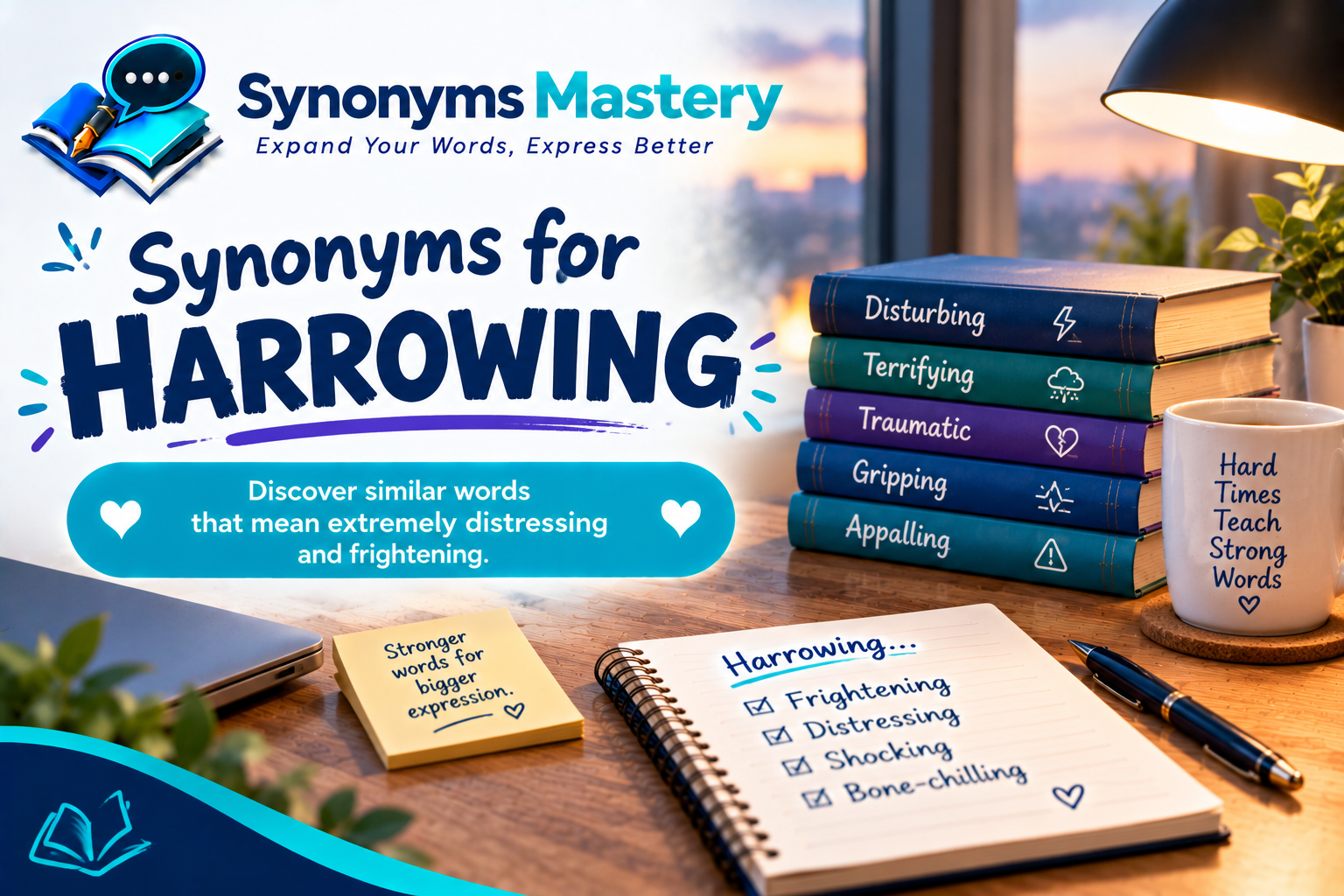
If you are looking for synonyms of harrowing, the best choices include distressing, agonizing, excruciating, torturous, traumatic, disturbing, frightening, terrifying, heartbreaking, and painful. However, these words are not interchangeable in every sentence. The right choice depends on whether you want to emphasize fear, emotional suffering, physical or psychological pain, shock, or anxiety.
This guide explains the most useful alternatives to harrowing, with clear differences, examples, and context-based recommendations.
Quick Answer: What Are the Best Synonyms of Harrowing?
The closest alternatives to harrowing are distressing, agonizing, torturous, excruciating, and painful. Other strong contextual alternatives include traumatic, disturbing, frightening, terrifying, heartbreaking, horrifying, and nerve-racking.
The key distinction is that harrowing usually describes something that causes intense emotional distress because it involves suffering, shock, fear, or an extremely difficult experience. Cambridge defines it as extremely upsetting because it is connected with suffering, while Oxford emphasizes the shock or fear that makes something very upsetting.
What Does “Harrowing” Mean?
Harrowing is an adjective meaning extremely upsetting, distressing, painful, shocking, or frightening, especially when something involves serious suffering or a difficult experience.
For example:
- a harrowing experience
- a harrowing journey
- a harrowing story
- a harrowing ordeal
- harrowing scenes
- a harrowing account
Oxford specifically gives common collocations such as harrowing experience, harrowing journey, and harrowing tale.
The word is stronger than simply saying something was difficult or unpleasant. It normally suggests that the experience caused significant emotional distress.
Core Synonyms of Harrowing
| Word | Relationship | Main emphasis | Best context |
| Distressing | Direct/near synonym | Emotional upset | Experiences, news, situations |
| Agonizing | Strong near synonym | Severe suffering | Pain, decisions, emotional experiences |
| Excruciating | Strong near synonym | Extreme pain or distress | Pain, waiting, emotional suffering |
| Torturous | Strong near synonym | Prolonged suffering | Experiences, conditions, situations |
| Painful | Broad synonym | Pain or emotional hurt | Experiences, memories, losses |
| Traumatic | Contextual alternative | Psychological impact | Events, accidents, experiences |
| Disturbing | Contextual alternative | Unease or alarm | Images, stories, behavior, events |
| Frightening | Contextual alternative | Fear | Experiences, situations, events |
| Terrifying | Strong contextual alternative | Extreme fear | Dangerous or frightening events |
| Heartbreaking | Contextual alternative | Deep sadness | Loss, grief, personal stories |
| Horrifying | Contextual alternative | Horror or shock | Events, scenes, discoveries |
| Shocking | Contextual alternative | Surprise and disbelief | News, revelations, events |
| Alarming | Contextual alternative | Concern or fear | Situations, reports, developments |
| Nerve-racking | Contextual alternative | Anxiety and tension | Waiting, tests, journeys, situations |
| Gut-wrenching | Contextual alternative | Intense emotional pain | News, scenes, losses |
| Upsetting | Weaker alternative | Emotional disturbance | General situations |
| Tormenting | Contextual alternative | Ongoing suffering | Thoughts, memories, conditions |
| Grim | Related/contextual | Bleakness | Situations, outlooks, conditions |
Not every word above can replace harrowing naturally in every sentence. That distinction matters.
1. Distressing
Distressing is one of the closest and most versatile alternatives to harrowing. It means causing significant worry, sadness, or emotional discomfort.
Example:
The family received some deeply distressing news.
Choose distressing when you want to emphasize emotional upset without necessarily suggesting extreme fear.
Harrowing: stronger and often associated with suffering or frightening circumstances.
Distressing: broader and generally more neutral.
2. Agonizing
Agonizing emphasizes severe physical or emotional suffering.
The family endured an agonizing wait for news.
It is particularly effective when the suffering is intense.
Best for: pain, uncertainty, grief, difficult decisions, and prolonged emotional suffering.
Cambridge lists agonizing among the closest synonyms of harrowing.
3. Excruciating
Excruciating suggests an exceptionally high degree of pain or suffering.
The victim described the accident as an excruciating experience.
It can describe physical pain, but it is also commonly used figuratively:
The two-hour wait was excruciating.
Compared with harrowing, excruciating puts greater emphasis on extreme intensity of pain or suffering.
4. Torturous
Torturous describes something that causes severe or prolonged suffering.
The survivors endured a torturous journey through the mountains.
It can sound stronger and more dramatic than harrowing.
Use it when the experience seems prolonged, unbearable, or intensely painful.
5. Painful
Painful is a much broader and often weaker alternative.
She recalled the painful experience years later.
It works well when you want a straightforward word without the dramatic intensity of harrowing.
Harrowing usually creates a stronger impression of distress, fear, or suffering.
6. Traumatic
Traumatic is related to harrowing, but it should not automatically be treated as an exact synonym.
The accident was a traumatic experience for everyone involved.
Traumatic emphasizes the psychological impact of a disturbing event. It may suggest lasting emotional consequences.
Choose traumatic when the focus is on how an event affects someone’s mental or emotional well-being.
7. Disturbing
Disturbing emphasizes something that causes unease, discomfort, alarm, or emotional disturbance.
The documentary contained some disturbing footage.
It is often more appropriate than harrowing for:
- images
- videos
- behavior
- discoveries
- stories
- information
A disturbing image may be upsetting without being an intensely difficult personal experience.
8. Frightening
Frightening focuses primarily on fear.
It was a frightening experience for the passengers.
This is a good choice when fear is the main element of the situation.
Harrowing can involve fear, but it also commonly conveys suffering and emotional distress.
9. Terrifying
Terrifying is a stronger alternative to frightening.
The hikers had a terrifying encounter with a wild animal.
Use it when the central idea is extreme fear.
If the event involves fear plus suffering, harrowing may be more precise.
10. Heartbreaking
Heartbreaking emphasizes profound sadness or emotional pain.
The documentary tells the heartbreaking story of a family separated by war.
It is especially natural for:
- loss
- grief
- separation
- tragedy
- personal stories
A heartbreaking event is not necessarily frightening, so heartbreaking should not be treated as a universal replacement for harrowing.
11. Horrifying
Horrifying emphasizes horror, shock, or extreme disgust and fear.
The investigation revealed horrifying details about the incident.
It is particularly effective when the reader or observer feels horror toward what happened.
12. Shocking
Shocking emphasizes surprise, disbelief, or unexpected severity.
The report contained shocking details about the accident.
It is generally less focused on suffering than harrowing.
Something can be shocking without being harrowing.
13. Alarming
Alarming describes something that creates concern, fear, or a sense of danger.
The researchers reported an alarming increase in pollution levels.
This is particularly useful in formal, academic, journalistic, and professional writing.
14. Nerve-Racking
Nerve-racking describes something that creates intense nervousness or anxiety.
Waiting for the examination results was nerve-racking.
It works well for:
- interviews
- exams
- competitions
- uncertain situations
- difficult journeys
- tense waits
It is usually less associated with serious suffering than harrowing.
15. Gut-Wrenching
Gut-wrenching is an expressive alternative for something that causes intense emotional pain.
The film contains a gut-wrenching account of the disaster.
It is especially natural in informal and journalistic writing.
Which Word Should You Use?
Choosing the best synonym depends on what you want the reader to notice.
Choose “distressing” when:
You want to emphasize emotional upset in a broad, neutral way.
Choose “agonizing” when:
You want to emphasize severe emotional or physical suffering.
Choose “traumatic” when:
You want to emphasize psychological impact.
Choose “disturbing” when:
You want to emphasize unease, discomfort, or troubling content.
Choose “terrifying” when:
Extreme fear is the dominant emotion.
Choose “heartbreaking” when:
Deep sadness, grief, or emotional loss is central.
Choose “nerve-racking” when:
Anxiety and tension are the main features.
Choose “horrifying” when:
The situation creates intense horror or shock.
Choose “excruciating” when:
The suffering or pain is exceptionally severe.
Harrowing vs. Distressing
Both words describe something that causes emotional discomfort or suffering.
Harrowing is generally more intense and often suggests an experience involving serious suffering, fear, or shock.
Distressing is broader and can describe anything that causes substantial emotional upset.
Compare:
It was a distressing conversation.
It was a harrowing ordeal.
The second sentence suggests a much more severe experience.
Harrowing vs. Traumatic
These words overlap, but their focus differs.
| Harrowing | Traumatic |
| Emphasizes extreme distress | Emphasizes psychological impact |
| Can describe experiences, stories, journeys, scenes | Commonly describes events or experiences |
| Often involves fear, suffering, or shock | May imply lasting emotional effects |
| Does not necessarily imply a clinical condition | Can have a stronger psychological meaning |
Example:
The rescue mission was harrowing.
This focuses on the difficult and distressing nature of the mission.
The accident was traumatic.
This focuses more on its psychological effect.
Harrowing vs. Terrifying
Terrifying specifically emphasizes extreme fear.
Harrowing can include fear but also encompasses suffering, distress, pain, and emotional devastation.
The storm was terrifying.
The survivors described the aftermath as harrowing.
The first emphasizes fear; the second conveys a broader and deeper sense of suffering.
Harrowing vs. Heartbreaking
These words can overlap in descriptions of tragedy, but they emphasize different emotions.
Harrowing → suffering, fear, distress, shock
Heartbreaking → grief, sadness, emotional pain
The rescue footage was harrowing.
The final goodbye was heartbreaking.
The words are not interchangeable in every context.
Common Collocations With “Harrowing”
Some combinations sound especially natural in English:
- harrowing experience
- harrowing ordeal
- harrowing journey
- harrowing story
- harrowing tale
- harrowing account
- harrowing scenes
- harrowing details
- harrowing evidence
- harrowing memories
- harrowing footage
- harrowing incident
Oxford specifically identifies experience, journey, and tale among nouns commonly used with harrowing.
Useful alternatives by collocation
Harrowing experience can be described as a distressing, traumatic, frightening, or agonizing experience.
For a harrowing story, suitable alternatives include heartbreaking, disturbing, tragic, and distressing story.
A harrowing journey may also be described as a difficult, perilous, terrifying, or arduous journey.
When referring to harrowing details, alternatives such as disturbing, shocking, horrifying, and distressing details work well.
The best alternative changes according to the noun being described.
Common Mistakes When Choosing a Synonym for Harrowing
1. Treating “traumatic” as an exact replacement
A traumatic event may be harrowing, but traumatic places more emphasis on psychological impact.
2. Using “terrifying” when fear is not central
A painful or heartbreaking experience does not necessarily need to be described as terrifying.
3. Using “heartbreaking” for every tragic event
Heartbreaking specifically emphasizes emotional sadness and grief.
4. Using “excruciating” too casually
Excruciating is a very strong word. It is best reserved for exceptionally intense pain or suffering.
5. Using “disturbing” when you mean physically painful
Disturbing generally describes emotional unease or alarm, not physical pain.
6. Assuming every thesaurus entry is interchangeable
Large synonym databases can contain words with different shades of meaning. For example, broad lists may include tragic, terrible, grim, cruel, dire, and frightening, but these do not all preserve the meaning of harrowing in every sentence.
Related Words That Are Not Exact Synonyms
Some words are associated with harrowing but should be treated as contextual alternatives rather than direct synonyms.
Tragic
Emphasizes a disastrous or sorrowful outcome.
Grim
Emphasizes bleakness, seriousness, or unpleasant reality.
Dire
Emphasizes extreme seriousness or urgency.
Difficult
Emphasizes hardship but is much weaker emotionally.
Unbearable
Emphasizes that something cannot reasonably be endured.
These words can work in particular contexts, but replacing harrowing with them may change the meaning.
Antonyms of Harrowing
The opposite of harrowing depends on the context, but useful antonyms include:
- comforting
- pleasant
- reassuring
- calming
- peaceful
- enjoyable
- soothing
- uplifting
- reassuring
For example:
a harrowing experience → a reassuring experience
a harrowing journey → a peaceful journey
The contrast is essentially between severe distress or suffering and comfort, calm, or enjoyment.
Pronunciation of “Harrowing”
US: /ˈhær.oʊ.ɪŋ/
UK: /ˈhær.əʊ.ɪŋ/
Cambridge gives the American pronunciation as /ˈher.oʊ.ɪŋ/ and the British pronunciation as /ˈhær.əʊ.ɪŋ/.
The word is pronounced roughly like HAIR-oh-ing in American English.
Frequently Asked Questions
What is the closest synonym for harrowing?
Distressing is one of the closest broad alternatives, while agonizing, excruciating, and torturous can be closer when the emphasis is on severe suffering. Cambridge specifically lists agonizing, excruciating, and torturous as synonyms.
What is a stronger word than harrowing?
Words such as excruciating, agonizing, horrifying, and terrifying can be stronger in particular contexts, but they emphasize different aspects. There is no single universally “stronger” synonym because intensity and meaning are not identical.
Is “traumatic” a synonym for “harrowing”?
Traumatic is a near-synonym in some contexts, but it is not an exact substitute. Traumatic emphasizes psychological impact, while harrowing emphasizes an extremely upsetting experience involving suffering, fear, or shock.
What is another word for a harrowing experience?
Depending on the context, you could say distressing experience, traumatic experience, agonizing experience, frightening experience, terrifying experience, or painful experience.
What is another word for a harrowing story?
Good alternatives include distressing story, heartbreaking story, disturbing story, tragic story, or horrifying story. The best choice depends on whether the story primarily causes sadness, fear, shock, or general emotional distress.
Is “distressing” stronger than “harrowing”?
Generally, harrowing conveys a stronger sense of extreme suffering or distress. Distressing is broader and can describe less severe emotional upset.
Is “heartbreaking” the same as “harrowing”?
No. Heartbreaking focuses primarily on profound sadness or grief, whereas harrowing can involve fear, suffering, shock, and intense distress.
Is “frightening” a synonym for “harrowing”?
It can be a contextual alternative, particularly when fear is the dominant feature. However, harrowing is broader because something can be harrowing because of suffering or emotional distress even when fear is not the main emotion.
Conclusion
The best synonyms of harrowing depend on the exact meaning you want to communicate. Distressing is a versatile general alternative, agonizing and excruciating emphasize severe suffering, traumatic highlights psychological impact, terrifying emphasizes fear, and heartbreaking focuses on deep sadness.
For the most natural word choice, do not simply replace harrowing with the first thesaurus entry you find. Consider the emotion, intensity, context, and collocation first. That approach produces more precise and natural English.

Ava Thompson is a linguistic analyst who studies word meanings, origins, and usage patterns. She focuses on semantic relationships between words, helping readers understand how synonyms differ in tone, context, and application. Her content is ideal for advanced learners and writers who want deeper language insights.