
Synonyms for Peninsula: Better Alternatives With Meanings and Examples
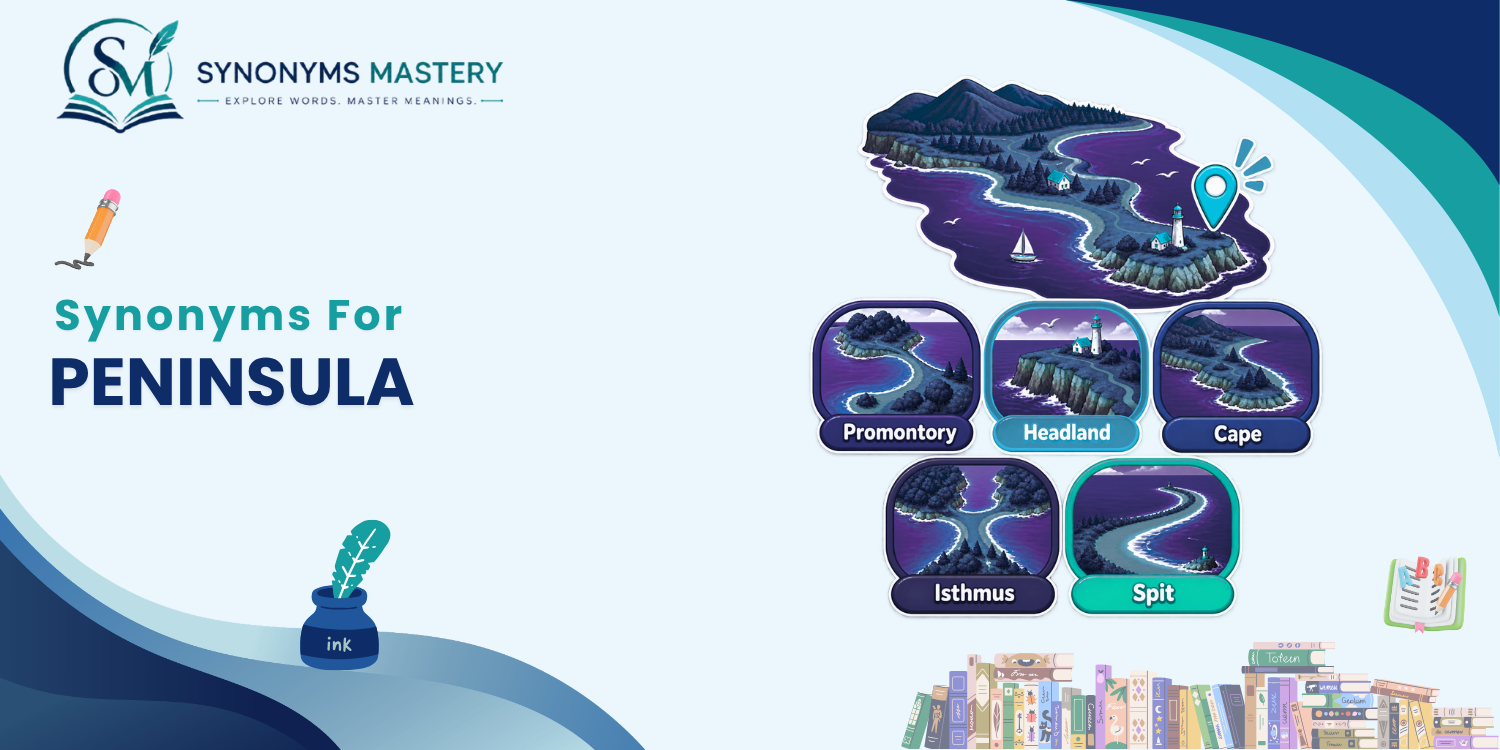
If you’re looking for synonyms for peninsula, the closest alternatives include cape, headland, promontory, point, foreland, and, in narrower contexts, spit or ness. However, these words are not perfect substitutes.
A peninsula is a substantial area of land that extends into water while remaining connected to a larger landmass, whereas terms such as cape and point usually describe more specific types or shapes of projecting land.
This distinction matters because geography vocabulary is highly context-dependent. The best alternative depends on the size, shape, elevation, and physical character of the landform.
Quick Answer: What Are the Synonyms for Peninsula?
The closest synonyms or related alternatives for peninsula include:
- Headland — land projecting into the sea, usually forming part of a coastline
- Promontory — a high or prominent area of land projecting into water
- Cape — a prominent point or projection of land extending into water
- Point — a projecting piece of land, often smaller or more sharply defined
- Foreland — land projecting toward or into a larger body of water
- Ness — a projecting headland, especially in geographical names
- Spit — a narrow strip of land extending into water, usually formed from sediment
- Arm — a projecting part of land, especially when shaped like an extension
The important point is that none of these words is a universal replacement for peninsula. Cape, headland, and promontory are often the closest alternatives, while spit and ness have more specialized meanings.
Major dictionaries likewise group these terms together but distinguish them as related geographical features.
What Does Peninsula Mean?
Peninsula is a noun referring to an area of land that extends from a larger landmass into a body of water while remaining connected to the mainland.
Cambridge defines it as a piece of land that projects from a larger area into the sea or a lake. Merriam-Webster similarly describes it as land nearly surrounded by water and connected to a larger landmass, while noting that it can also refer more broadly to land jutting into water.
Examples:
- The town is located on a narrow peninsula.
- The Florida Peninsula extends between the Atlantic Ocean and the Gulf of Mexico.
- They drove around the entire peninsula before sunset.
The word is a noun.
Pronunciation
- US: /pəˈnɪn.sə.lə/
- UK: /pəˈnɪn.sjə.lə/
The word comes from Latin paeninsula, combining words meaning approximately “almost island.”
Core Synonyms and Related Alternatives for Peninsula
| Word | Relationship | Meaning | Best Context |
| Headland | Near-synonym | Land projecting into the sea | Coastal geography |
| Promontory | Near-synonym | Prominent or elevated projecting land | Formal/geographical description |
| Cape | Near-synonym | A projecting point of land | Coastal features and place names |
| Point | Contextual alternative | A projecting piece of land | Smaller coastal projections |
| Foreland | Near-synonym | Land projecting toward water | Geographical descriptions |
| Ness | Specialized alternative | A projecting headland | British geographical usage/place names |
| Spit | Specialized alternative | A narrow, usually sandy projection | Sedimentary coastal features |
| Arm | Contextual alternative | An extension or projection of land | Broad geographical descriptions |
Merriam-Webster lists cape, point, headland, arm, promontory, spit, ness, and foreland among words associated with peninsula in its thesaurus. Cambridge similarly groups terms such as headland, point, promontory, and spit within the vocabulary of geographical projections.
1. Headland
Headland is one of the closest alternatives to peninsula in coastal contexts.
A headland is a piece of land that projects outward from a coastline. It can be relatively large, but the term emphasizes its position and prominence along the coast rather than simply its connection to a larger landmass.
Example:
The hikers followed the trail toward the rocky headland.
Use “headland” when:
- describing a coastal projection
- discussing physical geography
- emphasizing a prominent section of coastline
Peninsula: The entire projecting landmass may be called a peninsula.
Headland: The focus is generally on the projecting coastal feature itself.
2. Promontory
Promontory is a strong alternative when the projecting land is prominent, elevated, or visually distinctive.
The word often has a more formal or geographical tone than peninsula.
Example:
A rocky promontory overlooked the harbor.
Choose “promontory” when:
The landform rises prominently above the surrounding coastline or is being described in formal geographical language.
A promontory does not necessarily have the same broad scale as a peninsula, so substituting one for the other can change the meaning.
3. Cape
Cape is probably the most familiar alternative people encounter when searching for a synonym for peninsula.
A cape is a prominent point or projection of land extending into a body of water. Merriam-Webster lists cape among the principal synonyms associated with peninsula.
Example:
The lighthouse stands at the end of the cape.
Peninsula vs. cape
A peninsula usually describes a broader area of land connected to the mainland.
A cape usually emphasizes a projecting coastal point.
Therefore:
The peninsula was home to several villages.
sounds natural when discussing a larger land area.
But:
The ship passed the cape.
works naturally when referring to a prominent coastal point.
4. Point
Point can describe a projecting piece of land, particularly along a coast.
Example:
The fishermen gathered near the rocky point.
It is generally more flexible and less geographically specific than peninsula. A point may be relatively small, narrow, or sharply projecting.
Best use
Use point when the projection itself is the important feature rather than the entire connected landmass.
5. Foreland
Foreland is a more specialized geographical term for land that projects toward or into a body of water.
Example:
The coastal foreland provided an excellent viewpoint over the bay.
It is more formal and less common in everyday English than peninsula.
Best use
Choose foreland primarily in geographical or descriptive writing when the context specifically concerns a projecting coastal area.
6. Ness
Ness is a specialized word meaning a projecting headland. It appears particularly in British geographical names.
For example, place names ending in -ness often preserve the idea of a headland or projecting piece of land.
Example
The lighthouse was built on the rocky ness.
Because ness is specialized and relatively uncommon in general American English, it is not a practical replacement for peninsula in most everyday writing.
7. Spit
A spit is a narrow strip of land extending into water, usually formed by deposited sediment.
Example:
A long sandy spit stretches across the entrance to the bay.
This is an important distinction: spit is not a general synonym for peninsula.
A spit has a particular geological or coastal shape. If you call a large rocky peninsula a spit, you may give the reader an inaccurate picture of the landform.
8. Arm
Arm can describe a projecting section of land, particularly when it resembles an extension from a larger landmass.
Example:
A narrow arm of land separates the two bays.
It is a contextual alternative rather than a direct replacement for peninsula.
Which Word Should You Use?
The easiest way to choose is to focus on what you want to emphasize.
Choose “peninsula” when:
You mean a relatively substantial piece of land extending into water while remaining connected to the mainland.
The peninsula is surrounded by water on three sides.
Choose “headland” when:
You are emphasizing a coastal projection.
The rocky headland attracts thousands of visitors.
Choose “promontory” when:
You want to emphasize a prominent or elevated projection.
The castle stood on a steep promontory.
Choose “cape” when:
You mean a prominent point of land projecting into the sea.
The ship rounded the cape at dawn.
Choose “point” when:
You are referring to a smaller or more sharply projecting coastal feature.
They stopped at the point to watch the sunset.
Choose “spit” when:
The landform is a narrow sedimentary projection.
A sandy spit extends across the mouth of the lagoon.
Peninsula vs. Cape
Peninsula and cape overlap, but they are not interchangeable in every sentence.
| Peninsula | Cape |
| Usually refers to a broader land area | Usually refers to a projecting coastal point |
| Can contain towns, roads, mountains, or other features | Often emphasizes the outer coastal projection |
| Remains connected to the mainland | Also connected to the mainland |
| Often used for major geographical regions | Common in coastal names and landmarks |
For example:
The peninsula contains several small communities.
This describes the broader landmass.
The lighthouse sits on the cape.
This emphasizes the projecting coastal point.
Bottom line: A cape can be a projecting part of a larger peninsula, but cape does not automatically mean peninsula.
Peninsula vs. Headland
A headland is a coastal projection, so it overlaps strongly with peninsula. However, headland generally focuses on the land’s position along the coast.
The trail follows the headland.
The sentence emphasizes a prominent coastal feature.
The entire peninsula was declared a protected area.
Here, the focus is the broader landmass.
Best choice: Use peninsula for the larger geographic area and headland when the coastal projection itself is the focus.
Peninsula vs. Promontory
Promontory often suggests a prominent or elevated piece of land projecting into water.
The monastery stood on a rocky promontory.
The word creates an image of elevated, noticeable land.
By contrast:
The village occupies most of the peninsula.
Here, peninsula identifies the larger geographical region.
Promontory is therefore best treated as a near-synonym, not a universal replacement.
Peninsula vs. Spit
These terms describe distinctly different landforms.
A peninsula can be broad, mountainous, rocky, or developed.
A spit is generally a narrow projection created by sediment deposition.
Compare:
The peninsula contains several forests and villages.
with:
A sandy spit extends into the bay.
Calling the second feature a peninsula would lose important information about its shape and formation.
Are There Exact Synonyms for Peninsula?
Not really.
Peninsula is a specific geographical term, and English does not have a single everyday word that can replace it in every context without changing the meaning.
Words such as cape, headland, promontory, point, and foreland overlap with the concept, but each has its own typical usage. Dictionary thesauruses list these terms as synonyms or related alternatives because they describe projecting landforms, but that does not mean they are interchangeable in every sentence.
For precise geographical writing, peninsula is usually the safest choice when you mean the complete landform.
Common Mistakes When Using Peninsula Synonyms
Mistake 1: Treating every coastal term as an exact synonym
Words such as cape, spit, and headland describe different types or aspects of coastal projections.
Better approach: Identify the physical feature before choosing the alternative.
Mistake 2: Using “spit” for any peninsula
A spit is much more specific.
Incorrect:
The entire mountainous region is a sandy spit.
Better:
A narrow sandy spit extends from the coast.
Mistake 3: Assuming “cape” always means peninsula
A cape can be a smaller projecting point rather than a broad peninsula.
Mistake 4: Using “point” in formal geographical writing without context
Point is common but broad. It may not communicate the scale or physical characteristics of a peninsula.
Mistake 5: Calling related words exact synonyms
Terms such as isthmus, island, coastline, and landform are related to peninsula, but they are not synonyms.
An isthmus, for example, is a narrow strip of land connecting two larger land areas. It describes the connection rather than the peninsula itself.
Related Words That Are Not Synonyms
Understanding what not to use is just as important as knowing the alternatives.
Island
An island is surrounded by water, whereas a peninsula remains connected to a larger landmass.
Isthmus
An isthmus is a narrow connection of land between larger land areas. It can form the connection between a peninsula and the mainland.
Coastline
A coastline is the boundary between land and a body of water. It is not a projecting landform.
Landform
Landform is a broad category that includes peninsulas, mountains, valleys, plateaus, and many other physical features.
Atoll
An atoll is a ring-shaped coral reef or island structure surrounding a lagoon. It is not another word for peninsula.
Examples of Peninsula Synonyms in Sentences
Peninsula
The coastal town occupies a narrow peninsula.
Headland
The hikers reached the rocky headland before sunset.
Promontory
The ancient fortress was built on a steep promontory.
Cape
The sailors carefully navigated around the cape.
Point
We walked to the western point to watch the waves.
Foreland
The elevated foreland offered views of the surrounding sea.
Ness
A lighthouse marks the ness at the edge of the coastline.
Spit
A long sandy spit protects the entrance to the harbor.
Arm
A narrow arm of land separates the two inlets.
FAQ About Synonyms for Peninsula
What is another word for peninsula?
Common alternatives include headland, promontory, cape, point, foreland, and arm. More specialized terms include ness and spit, although these do not have exactly the same meaning as peninsula.
What is the closest synonym for peninsula?
There is no perfect one-word substitute in every context. Headland, cape, and promontory are among the closest alternatives, depending on the shape and character of the landform.
Is cape a synonym for peninsula?
Cape can function as a near-synonym in some contexts because both describe land projecting into water. However, a cape generally emphasizes a prominent coastal point, while a peninsula can refer to a much broader area of land.
Is headland another word for peninsula?
Sometimes, but not always. A headland is a piece of land projecting from a coastline, whereas a peninsula is a larger connected landmass extending into water. The two terms overlap but should not automatically be substituted for each other.
What is a formal synonym for peninsula?
Promontory or foreland may work in formal geographical contexts, depending on the physical feature being described. However, neither is an exact replacement in every situation.
What is the difference between a peninsula and a spit?
A peninsula is a broad category of projecting land connected to the mainland. A spit is a narrow projection, usually formed from deposited sediment. They can both extend into water, but their physical characteristics differ.
What is the opposite of a peninsula?
There is no exact lexical antonym for peninsula. An island provides a useful contrast because it is completely surrounded by water, whereas a peninsula remains connected to a larger landmass.
What are some words related to peninsula?
Related geographical vocabulary includes island, isthmus, coastline, cape, headland, promontory, point, spit, foreland, and landform. These words describe connected or contrasting geographical features rather than all being exact synonyms.
Conclusion
The best synonyms for peninsula depend on the particular landform and the context. Headland, cape, promontory, point, and foreland are useful near-synonyms, while spit and ness describe more specialized types of projecting land.
If you need the most precise general term, peninsula is usually the safest choice. Use cape for a prominent coastal point, headland for a projecting coastal feature, promontory for a prominent or elevated projection, and spit for a narrow sedimentary strip of land.
The key is not simply finding a different word—it is choosing the geographical term that communicates the right shape, scale, and context.

Chloe Mitchell is a professional content writer with expertise in building clear and engaging vocabulary resources. She focuses on creating easy-to-read synonym guides, helping users understand word meanings quickly. Her writing style is simple, user-friendly, and optimized for search engines.