Synonyms of Compare: 10 Better Alternatives
The best synonyms of compare depend on what you mean by compare. If you are simply looking at two or more things to identify similarities and differences, contrast, examine, analyze, assess, evaluate, match, and juxtapose may work in specific contexts. However, these words are not interchangeable in every sentence.
For academic and professional writing, choosing the right alternative can make your meaning more precise. Contrast emphasizes differences, evaluate suggests judging quality or value, and match focuses on how well two things correspond. Understanding these distinctions helps you avoid awkward or inaccurate word choices.
Quick Answer: What Are the Best Synonyms of Compare?
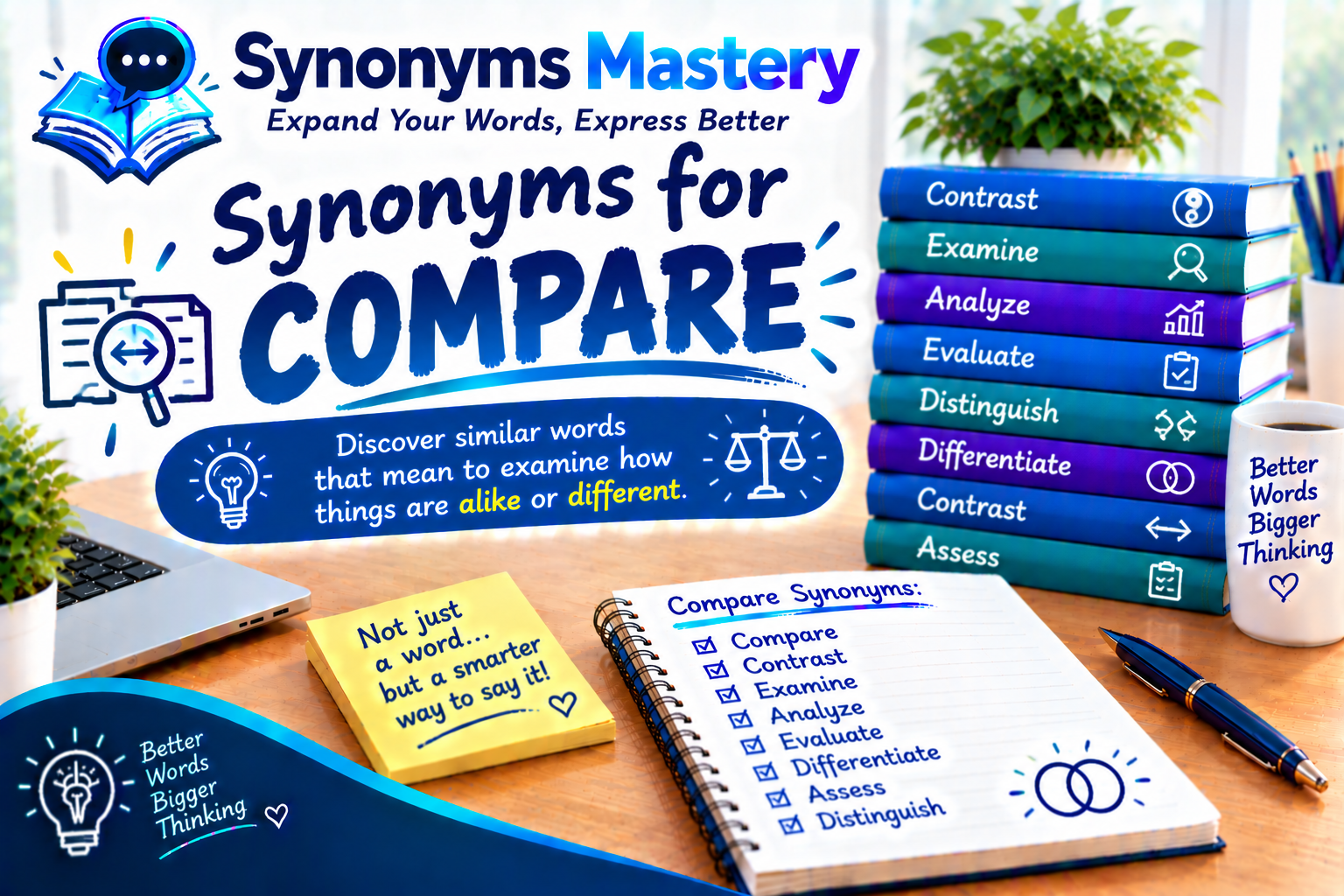
Some of the most useful synonyms and contextual alternatives for compare are contrast, examine, analyze, assess, evaluate, match, juxtapose, differentiate, measure, and review. The best choice depends on your purpose. Use contrast when focusing on differences, evaluate when judging quality or value, and match when determining whether two things correspond or are compatible.
10 Synonyms and Alternatives for Compare
| Word | Relationship | Meaning | Best Context | Formality |
|---|---|---|---|---|
| Contrast | Near synonym | Compare mainly for differences | Writing, analysis | Formal/Neutral |
| Examine | Contextual alternative | Look at something closely | Academic, professional | Formal |
| Analyze | Contextual alternative | Study parts and relationships | Academic, technical | Formal |
| Assess | Near synonym | Judge or estimate something | Professional, academic | Formal |
| Evaluate | Near synonym | Judge quality, value, or effectiveness | Academic, professional | Formal |
| Match | Contextual alternative | Determine correspondence or similarity | Products, data, people | Neutral |
| Juxtapose | Contextual alternative | Place things together for comparison | Literary, academic | Formal |
| Differentiate | Contextual alternative | Identify differences | Academic, technical | Formal |
| Measure | Contextual alternative | Compare against a standard or scale | Performance, results | Neutral/Formal |
| Review | Contextual alternative | Examine and consider information | Professional, academic | Neutral/Formal |
Important: These are not all exact substitutes for compare. Some overlap with its meaning only in particular contexts.
What Does Compare Mean?
Compare means to examine two or more people, things, ideas, or situations to identify their similarities, differences, or relative qualities.
For example:
The study compares two different approaches to education.
The verb can be used when the goal is simply to identify similarities and differences, but it can also be used when determining relative quality, performance, or value.
Pronunciation
US: /kəmˈper/
UK: /kəmˈpeə/
Compare is normally used as a verb. Its related noun is comparison.
1. Contrast
Contrast is one of the closest alternatives to compare, but it places stronger emphasis on differences.
The report compares the two economic models.
The report contrasts the two economic models.
The second sentence suggests that the writer is particularly interested in how the models differ.
Best for:
- differences
- opposing characteristics
- academic writing
- literary analysis
- analytical writing
Example
The article contrasts traditional teaching methods with modern approaches.
Choose “contrast” when:
The differences between the subjects matter more than their similarities.
2. Examine
Examine means to look at something carefully or closely. It can replace compare when comparison is part of a broader investigation.
The researchers examined the results of the two experiments.
This does not necessarily mean they compared the results, although comparison may be involved.
Best for:
- academic research
- reports
- evidence
- documents
- detailed investigation
Example
The study examines the effects of two different teaching methods.
Use examine when the main idea is careful investigation, not necessarily direct comparison.
3. Analyze
Analyze means to study something carefully by examining its components, relationships, or underlying structure.
The researchers analyzed the two datasets.
This can involve comparison, but analyze is broader and often more detailed.
Best for:
- academic writing
- data
- research
- technical subjects
- arguments
- complex information
Example
The researchers analyzed the performance of the two systems.
Compare vs. analyze
Compare asks:
How are these things similar or different?
Analyze asks:
What can we learn by examining how these things work or relate to one another?
4. Assess
Assess means to judge or estimate the quality, importance, value, effectiveness, or condition of something.
The manager assessed the performance of both employees.
Comparison may be involved, but assessment usually adds an element of judgment.
Best for:
- performance
- risks
- quality
- effectiveness
- professional reports
- academic evaluation
Example
The committee assessed the strengths and weaknesses of the two proposals.
Choose assess when you are not merely identifying differences but forming a judgment.
5. Evaluate
Evaluate is closely related to assess. It means to judge the quality, effectiveness, value, or importance of something.
The researchers evaluated two treatment methods.
This suggests that they examined the methods and reached a judgment about their effectiveness or value.
Best for:
- academic writing
- research
- performance
- products
- policies
- proposals
Example
The study evaluated the effectiveness of two training programs.
Compare vs. evaluate
Compare can be neutral.
We compared the two plans.
Evaluate normally implies judgment.
We evaluated the two plans.
The second sentence suggests deciding which plan is more effective, suitable, or valuable.
6. Match
Match can be an alternative to compare when you are checking whether two things correspond, agree, or are similar enough to go together.
We matched the results with the original predictions.
It can also mean comparing characteristics to determine suitability.
Best for:
- data
- results
- compatibility
- characteristics
- products
- people
- records
Example
The software matches the customer’s preferences with available products.
Do not use match as a general replacement for compare. Its meaning is more specific.
7. Juxtapose
Juxtapose means to place two or more things close together so their similarities or differences become noticeable.
It is more formal and is especially common in literary, artistic, and academic contexts.
The author juxtaposes traditional values with modern attitudes.
Best for:
- literature
- art
- criticism
- academic writing
- contrasting ideas
Example
The film juxtaposes wealth and poverty to highlight social inequality.
Juxtapose is usually stronger and more deliberate than simply compare.
8. Differentiate
Differentiate means to recognize or show the difference between two or more things.
Unlike compare, it focuses specifically on distinguishing one thing from another.
The study differentiates between short-term and long-term effects.
Best for:
- identifying differences
- technical writing
- academic writing
- categories
- definitions
Example
The researcher differentiated the two approaches based on their underlying assumptions.
Choose differentiate when the goal is to separate or distinguish, rather than simply examine similarities and differences.
9. Measure
Measure can function as a contextual alternative when one thing is assessed against another standard, benchmark, or performance level.
The company measures its performance against industry standards.
This is different from simply comparing two things.
Best for:
- performance
- progress
- results
- standards
- benchmarks
- business metrics
Example
The company measures its customer satisfaction against its competitors’ results.
Use measure when there is a standard, scale, benchmark, or metric involved.
10. Review
Review means to examine something carefully, often to understand, evaluate, or reconsider it.
It can overlap with compare when several options are examined together.
The team reviewed the two proposals before making a decision.
However, review does not necessarily involve comparison.
Best for:
- proposals
- documents
- policies
- products
- plans
- professional decisions
Example
The committee reviewed and compared the three applications.
In this example, reviewed and compared perform different roles.
Which Word Should I Use Instead of Compare?
Choosing the right alternative depends on your intended meaning.
Use “contrast” when:
You want to emphasize differences.
The essay contrasts the two political theories.
Use “examine” when:
You want to emphasize careful investigation.
The researchers examined the two cases.
Use “analyze” when:
You want to study structure, components, or relationships.
The researcher analyzed the two datasets.
Use “assess” when:
You want to judge quality, condition, or effectiveness.
The manager assessed both candidates.
Use “evaluate” when:
You want to reach a judgment about value or effectiveness.
The researchers evaluated the two methods.
Use “match” when:
You want to determine correspondence or compatibility.
The system matched the results against previous records.
Use “juxtapose” when:
You deliberately place things together to highlight a contrast.
The writer juxtaposes two opposing viewpoints.
Use “differentiate” when:
You want to identify or establish differences.
The study differentiates between the two approaches.
Use “measure” when:
You compare performance against a standard or benchmark.
The company measures its results against industry averages.
Compare vs. Contrast
Compare and contrast are closely related, but they are not identical.
| Compare | Contrast |
|---|---|
| Looks at similarities and/or differences | Primarily emphasizes differences |
| Broad term | More specific |
| Neutral | Often highlights opposition |
| Common in general and academic English | Common in analytical and academic writing |
Example
Compare the two novels.
This instruction could require discussing similarities and differences.
Contrast the two novels.
This specifically directs attention to their differences.
Compare vs. Evaluate
These words overlap when someone examines multiple options, but they have different purposes.
Compare focuses on relationships between things.
The buyer compared the three laptops.
Evaluate focuses on judgment.
The buyer evaluated the three laptops before choosing one.
You can compare products without deciding which one is best. Evaluation normally involves some judgment about their quality, usefulness, effectiveness, or value.
Compare vs. Assess
Assess is similar to evaluate because it often involves judgment.
The teacher compared the two essays.
This suggests looking at similarities and differences.
The teacher assessed the two essays.
This suggests judging their quality or performance, perhaps using grading criteria.
Therefore, assess is often a better choice when your purpose is evaluation rather than simple comparison.
Compare vs. Analyze
These verbs are frequently used in academic writing but serve different purposes.
Compare focuses on similarities and differences.
Analyze involves a deeper examination of components, relationships, causes, or structure.
For example:
The paper compares two approaches to climate policy.
The paper identifies how the approaches differ or overlap.
The paper analyzes two approaches to climate policy.
The paper investigates how the approaches work, what assumptions they make, and what their implications are.
Common Collocations With Compare
Some combinations with compare are especially natural:
- compare prices
- compare products
- compare options
- compare results
- compare data
- compare methods
- compare performance
- compare features
- compare two approaches
- compare the differences
- compare similarities
- compare alternatives
Which alternative fits?
For prices, assess prices can work in some contexts, but compare prices is more natural.
When discussing performance, evaluate performance works when judgment is involved.
In discussions of theories, contrast two theories works when emphasizing differences.
Against a standard, measure results against a standard is more precise.
This illustrates why a general synonym is not always the most natural replacement.
Common Mistakes With Synonyms of Compare
1. Using “contrast” when similarities are the main focus
Contrast emphasizes differences, so it may change the intended meaning.
2. Treating “evaluate” as an exact replacement
Evaluate adds the idea of judging value, quality, or effectiveness.
3. Using “analyze” when you only mean compare
Analysis suggests a deeper investigation. It can be more specific than your intended meaning.
4. Using “match” as a universal synonym
Match generally concerns correspondence, similarity, compatibility, or suitability.
5. Using “differentiate” when you need to discuss similarities too
Differentiate focuses on distinguishing things from one another.
6. Assuming all comparison verbs mean the same thing
Words such as compare, contrast, evaluate, and assess overlap, but their purposes differ. Choosing among them based on context produces more precise writing.
Related Words to Compare
These words are related to comparison but should not automatically be treated as synonyms:
- comparison
- similarity
- difference
- similar
- different
- benchmark
- criterion
- evaluation
- assessment
- analysis
- distinction
- correspondence
For example, comparison is the noun form associated with compare, while similarity refers specifically to a shared characteristic.
Frequently Asked Questions
What is another word for compare?
Useful alternatives include contrast, examine, analyze, assess, evaluate, match, juxtapose, differentiate, measure, and review. However, most are contextual alternatives rather than exact synonyms. Contrast focuses on differences, evaluate adds judgment, and match emphasizes correspondence or compatibility.
What is the best synonym for compare?
There is no single best synonym for every context. Contrast is a strong choice when emphasizing differences, while evaluate or assess works when judging quality or effectiveness. For academic investigation, examine or analyze may be more appropriate.
What is a formal synonym for compare?
Formal alternatives include contrast, examine, analyze, assess, evaluate, juxtapose, and differentiate. The best choice depends on the intended meaning. In academic writing, analyze and evaluate are especially useful when the writer is examining evidence or judging competing ideas.
What is a professional synonym for compare?
In professional writing, useful alternatives include assess, evaluate, examine, measure, and review. For example, a manager may evaluate performance, review proposals, or measure results against industry standards rather than simply compare them.
What is the difference between compare and contrast?
Compare is a broad term that can involve similarities, differences, or both. Contrast specifically emphasizes differences between two or more things. For example, you can compare two products by discussing their similarities and differences, while contrasting them focuses primarily on how they differ.
Is analyze a synonym for compare?
Analyze can be a contextual alternative, but it is not an exact synonym. Compare focuses on identifying similarities or differences, whereas analyze means examining something in detail to understand its components, relationships, structure, or significance.
Is evaluate a synonym for compare?
Evaluate overlaps with compare when several things are examined to determine their relative value or effectiveness. However, evaluation normally includes judgment. You can compare two products without deciding which is better, but evaluating them usually involves assessing their quality or usefulness.
What is another way to say compare two things?
Depending on the purpose, you can say contrast two things, examine two things, analyze two things, assess two things, evaluate two things, or differentiate between two things. Choose contrast for differences, evaluate for judgment, and differentiate when identifying distinctions.
Conclusion
The best synonym of compare depends on what you are actually doing. Contrast is best for emphasizing differences, examine for careful investigation, analyze for detailed study, assess and evaluate for judgment, and match for correspondence or compatibility.
For academic and professional writing, avoid replacing compare automatically. First identify your purpose: Are you finding similarities, highlighting differences, investigating details, judging quality, or measuring performance? Once that purpose is clear, choosing the right alternative becomes much easier.

Ava Thompson is a linguistic analyst who studies word meanings, origins, and usage patterns. She focuses on semantic relationships between words, helping readers understand how synonyms differ in tone, context, and application. Her content is ideal for advanced learners and writers who want deeper language insights.