Synonyms for Indigenous: 15 Words and Their Meanings
Finding the right synonyms for indigenous depends on what you are describing. When discussing people and cultures, words such as native, aboriginal, and original may communicate a similar idea.
When describing plants, animals, or other natural features, alternatives such as endemic, local, and autochthonous may be more appropriate. However, these words are not always interchangeable. Understanding their differences helps you choose accurate, respectful language for academic writing, everyday communication, and professional content.
Quick Answer: What Are the Best Synonyms for Indigenous?
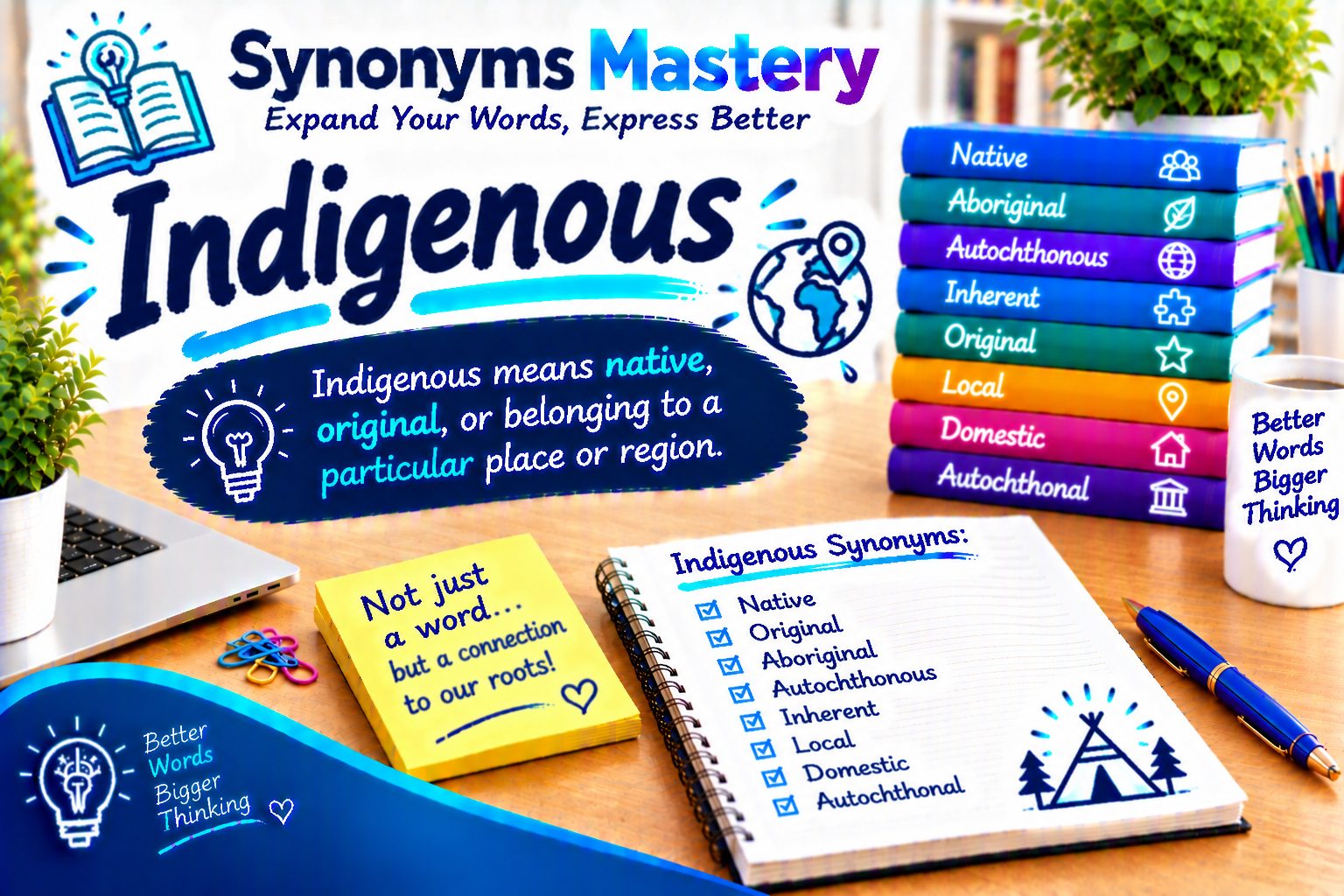
The closest synonyms for indigenous include native, aboriginal, autochthonous, and original. Other alternatives include endemic, local, and homegrown, depending on context. When writing about Indigenous peoples, use respectful and accurate terminology that reflects the names and identities of the communities being discussed. For plants and animals, native or endemic may be more precise.
15 Synonyms and Alternatives for Indigenous
Here are 15 alternatives, classified according to their relationship with indigenous.
| Word or phrase | Relationship | Meaning | Best context |
|---|---|---|---|
| 1. Native | Direct synonym | Originating naturally in a particular place | People, plants, animals |
| 2. Aboriginal | Near synonym | Belonging to the earliest known inhabitants of a region | Historical and cultural contexts |
| 3. Autochthonous | Direct/near synonym | Originating in the place where something is found | Academic and scientific writing |
| 4. Original | Contextual alternative | Existing in a place from the beginning or earliest period | Communities and inhabitants |
| 5. Endemic | Contextual alternative | Naturally restricted to a particular geographical area | Plants, animals, diseases |
| 6. Local | Contextual alternative | Belonging to or associated with a particular area | Communities and natural resources |
| 7. Homegrown | Contextual alternative | Produced or developed within a particular place | Crops, products, talent |
| 8. Home-bred | Contextual alternative | Bred or developed locally | Animals and agricultural contexts |
| 9. First Peoples | Contextual alternative | Original peoples of a particular region | Cultural and historical writing |
| 10. First Nations | Specific regional term | Distinct Indigenous peoples, particularly in Canada | Canadian contexts |
| 11. Native-born | Contextual alternative | Born in a particular country or place | Individual birthplace |
| 12. Ancestral | Related/contextual | Connected with ancestors and inherited heritage | Land, traditions, history |
| 13. Inherent | Related/contextual | Existing as a natural or essential characteristic | Qualities and characteristics |
| 14. Innate | Related/contextual | Naturally present from birth or beginning | Abilities and characteristics |
| 15. Indigenous-origin | Descriptive phrase | Originating with an Indigenous community or tradition | Cultural and historical contexts |
Important: This is not a list of 15 interchangeable synonyms. The first three are the closest lexical alternatives, while the remaining entries include context-specific expressions and related terms. Their differences matter, particularly when discussing Indigenous identities.
What Does Indigenous Mean?
Indigenous is an adjective describing people, communities, plants, animals, or things that originate naturally in a particular place.
When referring to people, it generally describes the original inhabitants of a region and their descendants, cultures, languages, and traditions. When referring to nature, it describes species that originated or occur naturally in a geographical area rather than being introduced from elsewhere.
Examples:
- The Indigenous communities have preserved their cultural traditions.
- Several indigenous plant species grow in the region.
- The museum displays artifacts from Indigenous cultures.
The word can also appear in expressions such as indigenous knowledge, indigenous languages, and indigenous rights.
According to Oxford Learner’s Dictionary, the word is pronounced /ɪnˈdɪdʒənəs/ in both British and American English, with slight pronunciation variation between accents. Oxford Learner’s Dictionaries+1
Best Synonyms for Indigenous and Their Meanings
Not every alternative communicates exactly the same idea. Here are the most useful words and the situations in which they work.
1. Native
Meaning: Originating in or belonging naturally to a particular place.
Native is usually the closest everyday alternative to indigenous. It works for people, plants, animals, languages, and other things associated with a particular geographical origin.
Example: The region is home to several native plant species.
Best for: General writing, geography, biology, and discussions of people.
Register: Neutral.
2. Aboriginal
Meaning: Relating to the earliest known inhabitants of a particular region.
Aboriginal overlaps significantly with indigenous, particularly in historical and cultural discussions. However, its acceptability varies by country and community. In Australia and Canada, it also has specific historical and institutional uses.
Example: The exhibition explores Aboriginal history and cultural heritage.
Best for: Historical discussions and contexts where the relevant community or institution uses the term.
Register: Formal.
Usage tip: When discussing people, use the terminology preferred by the specific community. Avoid using aboriginals as a general noun.
3. Autochthonous
Meaning: Originating in the same place where something is found.
Autochthonous is a precise but uncommon alternative to indigenous. It frequently appears in academic, geological, ecological, and anthropological writing.
Example: Researchers documented autochthonous plant species in the protected area.
Best for: Scientific research and academic writing.
Register: Highly formal.
4. Original
Meaning: Existing from the beginning or belonging to the earliest stage of something.
Original can describe the earliest inhabitants of a region, but it is broader than indigenous. It does not always communicate the same cultural or historical meaning.
Example: The community continues to preserve the traditions of its original inhabitants.
Best for: Historical writing and discussions of early settlement.
Register: Neutral.
5. Endemic
Meaning: Naturally restricted to a particular geographical area.
Endemic is especially useful in biology and ecology. Unlike native, which can describe a species that naturally occurs in multiple regions, endemic emphasizes that its natural distribution is limited to a specific area.
Example: This island is home to several endemic bird species.
Best for: Biodiversity, conservation, and scientific writing.
Register: Technical.
6. Local
Meaning: Belonging to or associated with a particular area.
Local is a broader and less precise alternative. It describes geographical association but does not necessarily mean that something originated there.
Example: The project incorporates knowledge from local communities.
Best for: Community discussions, regional resources, and everyday writing.
Register: Neutral.
7. Homegrown
Meaning: Produced, developed, or grown within a particular country or community.
Homegrown is particularly useful for agricultural products, local businesses, and talent. It is not generally a direct substitute for indigenous when discussing peoples.
Example: The organization supports homegrown agricultural products.
Best for: Agriculture, business, and local development.
Register: Informal to neutral.
8. Home-bred
Meaning: Bred or raised within a particular place or establishment.
This expression is more limited than indigenous. It usually relates to animals or agricultural breeding rather than original inhabitants or cultural identity.
Example: The farm specializes in home-bred livestock.
Best for: Farming and animal breeding.
Register: Neutral.
9. First Peoples
Meaning: A collective expression for the original peoples of a particular geographical region.
This phrase is useful in historical, cultural, and educational discussions. However, it is not a universal replacement for every Indigenous identity.
Example: The museum recognizes the history and contributions of the First Peoples of the region.
Best for: Cultural education and historical writing.
Register: Respectful and formal.
10. First Nations
Meaning: A term referring specifically to Indigenous peoples in Canada, particularly those who are neither Inuit nor Métis.
It is not a universal synonym for Indigenous peoples worldwide.
Example: The research project collaborates with First Nations communities in Canada.
Best for: Canadian history, culture, and public communication.
Register: Formal.
11. Native-born
Meaning: Born in the country or region being discussed.
This expression focuses on birthplace rather than ancestry, historical presence, or cultural identity.
Example: The native-born residents participated in the national survey.
Best for: Demographic and biographical contexts.
Register: Neutral.
12. Ancestral
Meaning: Connected with ancestors, inherited traditions, or family history.
Ancestral is not a direct synonym for indigenous. It works when discussing inherited relationships with land, culture, and traditions.
Example: The community continues to protect its ancestral lands.
Best for: Cultural heritage and historical discussions.
Register: Formal.
13. Inherent
Meaning: Existing as a natural, essential, or permanent characteristic of something.
This word is useful when indigenous is used metaphorically to describe a characteristic rather than a geographical origin.
Example: Creativity is an inherent part of the artistic process.
Best for: Abstract concepts and descriptive writing.
Register: Formal.
14. Innate
Meaning: Naturally present from birth rather than acquired through learning or experience.
Innate can replace indigenous in certain expressions involving natural characteristics, but not when describing the original inhabitants of a region.
Example: The ability to recognize patterns may involve innate tendencies.
Best for: Psychology, biology, and discussions of natural abilities.
Register: Formal.
15. Indigenous-origin
Meaning: A descriptive expression indicating that something originated within an Indigenous community, culture, or tradition.
This is not an established direct dictionary synonym. It can be useful when the writer needs to identify the origin of a particular practice, product, or cultural tradition.
Example: The researchers documented several Indigenous-origin agricultural practices.
Best for: Cultural research and historical descriptions.
Register: Formal.
Synonyms for Indigenous in Different Contexts
Choosing the right alternative becomes easier when you consider what the word describes.
For Indigenous People and Communities
When writing about original inhabitants and their descendants, accuracy and respect should come before stylistic variation.
Useful terms include:
- Indigenous peoples
- Native peoples
- Aboriginal peoples
- First Peoples
- First Nations (Canada-specific)
Example: The organization works with Indigenous communities to preserve traditional knowledge.
Tip: Whenever possible, identify the specific nation or community rather than replacing its identity with a broad general term.
For Indigenous Plants and Animals
In scientific and environmental writing, the following expressions are more useful:
- Native species
- Endemic species
- Autochthonous species
- Locally occurring species
Example: The conservation program protects native plants and endemic wildlife.
Remember that a native species is not necessarily endemic. A species may be native to several geographical regions without being restricted to any one of them.
For Indigenous Culture and Traditions
When describing cultural practices, history, and inherited knowledge, consider:
- Ancestral traditions
- Original cultural practices
- Traditional knowledge
- Indigenous heritage
- Native cultural traditions
Example: The documentary highlights the community’s ancestral traditions and cultural heritage.
These are contextual expressions, not interchangeable replacements for Indigenous culture.
For Academic and Scientific Writing
When precision matters, consider:
- Autochthonous
- Native
- Endemic
- Naturally occurring
Example: The study examines naturally occurring plant populations in the region.
Use endemic only when the species is geographically restricted. Use autochthonous when the emphasis is on originating in the place itself.
Indigenous vs. Native vs. Aboriginal vs. Autochthonous
These four words are closely related, but their meanings and usage differ.
| Word | Main distinction | Typical use |
|---|---|---|
| Indigenous | Original inhabitants or natural geographical origin | People, cultures, species |
| Native | Originating naturally in a place | People, plants, animals |
| Aboriginal | Relating to earliest known inhabitants | Historical and cultural contexts |
| Autochthonous | Originating in the place where found | Academic and scientific contexts |
Indigenous vs. Native
Both words can describe people, plants, and animals originating in a particular region.
However, indigenous often carries a stronger historical and cultural meaning when referring to original peoples, while native is broader and can simply describe geographical origin.
- Indigenous peoples have maintained their cultural traditions.
- The garden contains native flowers.
Indigenous vs. Aboriginal
These words overlap when discussing the original inhabitants of a region.
However, Indigenous is widely used in contemporary international discussions, while Aboriginal has particular regional and historical applications.
The preferred term depends on the country and the community being discussed.
Indigenous vs. Endemic
Both words can describe naturally occurring species, but they are not equivalent.
- Indigenous means naturally originating in a particular area.
- Endemic means naturally restricted to that area.
For example, a bird species may be native to several countries but endemic to only one island.
Indigenous vs. Autochthonous
Both can describe something originating in the place where it is found.
However, autochthonous is much more specialized and less common in everyday English. Indigenous is generally the more accessible choice, particularly in writing about people and cultures.
Which Synonym for Indigenous Should You Use?
Choose your alternative according to the meaning you want to communicate.
| If you mean… | Best word or phrase |
|---|---|
| Original inhabitants of a region | Indigenous peoples |
| People originating in a particular place | Native peoples |
| Earliest known inhabitants | Aboriginal peoples |
| Species naturally found in a region | Native species |
| Species restricted to one region | Endemic species |
| Scientific geographical origin | Autochthonous |
| Original cultural heritage | Ancestral heritage |
| Canadian Indigenous communities | First Nations, where appropriate |
| Locally produced goods | Homegrown |
| A natural characteristic | Innate or inherent |
My recommendation: Use indigenous or the community’s specific name when discussing original peoples. Use native for general geographical origin and endemic for species restricted to a particular area.
Common Mistakes When Using Synonyms for Indigenous
Even closely related words can create confusion when used in the wrong context.
1. Treating Native and Indigenous as Identical in Every Context
Both describe geographical origin, but indigenous can carry additional historical, cultural, and political meaning.
Better approach: Use the word that accurately reflects the context.
2. Using Endemic for All Native Species
A species can be native to several countries without being endemic to any single one.
Better approach: Reserve endemic for species naturally restricted to a particular geographical area.
3. Using Aboriginal as a Universal Replacement
The acceptability and meaning of Aboriginal vary across countries and communities.
Better approach: Follow the terminology preferred by the people being discussed.
4. Confusing First Nations With All Indigenous Peoples
First Nations is a specific term used in Canada. It does not include every Indigenous group worldwide, and it does not encompass Inuit and Métis peoples.
Better approach: Use the specific community’s recognized name or an appropriate broader term.
5. Ignoring Capitalization
When referring to Indigenous peoples and their identities, many contemporary American English style guides capitalize Indigenous.
When describing general biological or geographical origins, lowercase indigenous is commonly appropriate.
Examples:
- Indigenous communities have distinct cultural traditions.
- The region contains several indigenous plant species.
Frequently Asked Questions
1. What is the closest synonym for indigenous?
Native is generally the closest and most widely usable synonym for indigenous. Both describe people or things originating naturally in a particular place. However, when discussing original peoples, indigenous often carries additional cultural and historical significance.
2. What is another word for indigenous people?
Depending on the context, alternatives include Native peoples, Aboriginal peoples, and First Peoples. In Canada, First Nations, Inuit, and Métis refer to distinct peoples and should not be treated as interchangeable.
3. Is native the same as indigenous?
Not always. Both words can describe something originating naturally in a particular location. However, indigenous often refers specifically to original peoples, their descendants, and their cultural heritage. Native has a broader meaning and can describe anything originating naturally in a particular region.
4. What is a formal synonym for indigenous?
Autochthonous is a highly formal alternative, particularly in academic, scientific, and geographical writing. Aboriginal can also be appropriate in certain historical and regional contexts. However, when discussing people, choose terminology based on the community’s preferred usage rather than formality alone.
5. What is the difference between indigenous and endemic?
Indigenous describes something that originates naturally in a particular place. Endemic describes a species that is naturally restricted to a specific geographical area. A plant can be indigenous to several regions, whereas an endemic species has a limited natural distribution.
6. What is a respectful alternative to indigenous?
There is no single alternative that is universally more respectful. Indigenous peoples is widely accepted in international contexts, but specific communities may prefer their own nation or cultural name. In Canada, for example, First Nations, Inuit, and Métis are distinct identities.
7. What is the opposite of indigenous?
Common antonyms of indigenous include non-native, introduced, and foreign. In ecological writing, non-native and introduced are generally more precise terms for species that originate outside a particular region.
In ecological writing, introduced or non-native is often more precise because these terms describe species brought into an area from elsewhere. The best opposite depends on the context.
8. Should Indigenous always be capitalized?
When referring to Indigenous peoples, communities, or identities, capitalize Indigenous in line with widely used contemporary style guidance. When describing plants, animals, or general geographical origins, lowercase indigenous is normally appropriate. Always follow the relevant publication’s style guide.
Conclusion
Choosing the best synonym for indigenous requires more than finding a similar word. The right alternative depends on whether you are discussing people, cultures, plants, animals, or geographical origins. Native is the most versatile everyday alternative, while aboriginal and autochthonous suit particular historical and academic contexts.
Endemic is more precise for species restricted to a specific region. When writing about Indigenous peoples, prioritize respectful terminology and use specific community names whenever possible. Understanding these distinctions helps you communicate accurately, avoid misleading substitutions, and make your writing clearer and more meaningful.

Chloe Mitchell is a professional content writer with expertise in building clear and engaging vocabulary resources. She focuses on creating easy-to-read synonym guides, helping users understand word meanings quickly. Her writing style is simple, user-friendly, and optimized for search engines.