
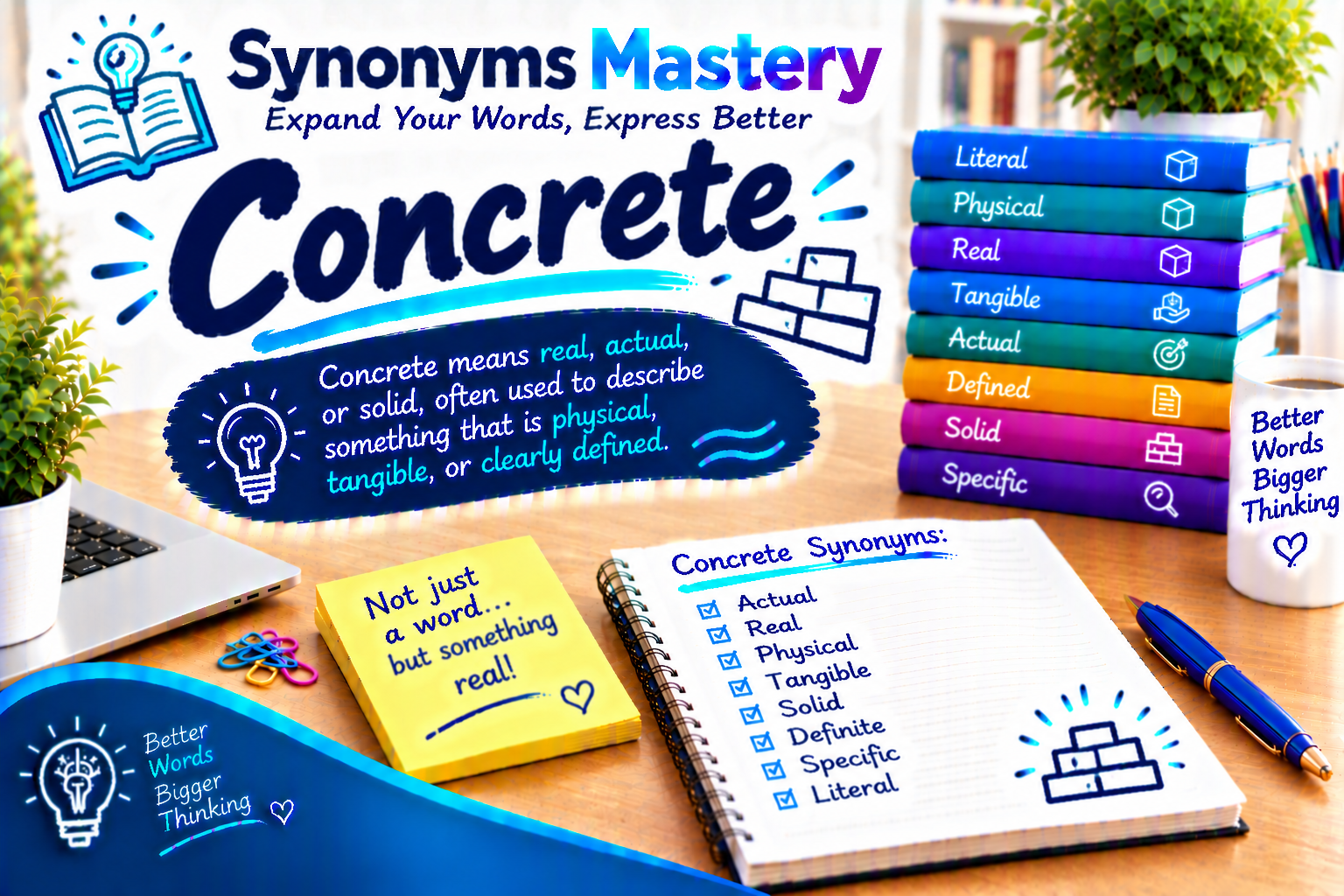
Synonyms for Concrete: 20 Words and Examples
The best synonyms for concrete depend on what the word describes. When concrete means specific or clearly defined, alternatives include specific, definite, and precise. When it refers to something that exists physically, tangible, material, and physical may be more appropriate.
In phrases such as concrete evidence or concrete results, the best replacement depends on the intended meaning. Understanding these differences helps you choose a word that sounds natural and communicates exactly what you mean.
Quick Answer: What Are the Best Synonyms for Concrete?
The most useful synonyms for concrete include specific, definite, precise, tangible, actual, real, factual, material, physical, and solid. Use specific for clearly identified details, tangible for something perceptible or practically noticeable, precise for exact information, and actual for what exists in reality. These words overlap with concrete, but they are not interchangeable in every sentence.
20 Synonyms for Concrete With Meanings
The following table focuses primarily on the adjective concrete, especially when it means specific, real, or physically existing.
| Word | Relationship | Meaning and best context |
|---|---|---|
| Specific | Close synonym | Clearly identified rather than general |
| Definite | Close synonym | Clearly established or certain |
| Tangible | Close synonym | Perceptible or capable of being experienced; also used figuratively |
| Precise | Close synonym | Exact and carefully defined |
| Actual | Near synonym | Existing in reality rather than merely supposed |
| Real | Near synonym | Existing or genuine rather than imaginary |
| Factual | Contextual alternative | Based on facts rather than opinions or speculation |
| Material | Contextual alternative | Relating to physical substance or the material world |
| Physical | Contextual alternative | Relating to the body or the physical world |
| Solid | Contextual alternative | Firm or substantial; also used figuratively for reliable evidence |
| Particular | Near synonym | Referring to an individual case, item, or instance |
| Explicit | Contextual alternative | Expressed clearly and directly |
| Distinct | Contextual alternative | Clearly distinguishable from others |
| Substantial | Near synonym | Significant, considerable, or materially present |
| Objective | Contextual alternative | Based on observable facts rather than personal feelings |
| Measurable | Contextual alternative | Capable of being quantified or assessed |
| Observable | Contextual alternative | Able to be noticed or examined |
| Definable | Contextual alternative | Capable of being clearly described or bounded |
| Evident | Contextual alternative | Clear or apparent from available information |
| Practical | Contextual alternative | Concerned with real situations or workable action rather than theory alone |
Important: These 20 words are useful alternatives across different contexts, not 20 perfect synonyms. For example, measurable adds the idea that something can be quantified, while objective emphasizes freedom from personal bias.
What Does Concrete Mean?
Concrete is both a noun and an adjective.
- As a noun: Concrete is a hard construction material made from cement, water, and aggregates such as sand and gravel.
- As an adjective: Concrete can describe something physical and real, or something specific, definite, and based on identifiable facts.
For example:
- Physical meaning: The building has a concrete floor.
- Specific meaning: We need a concrete plan before starting the project.
- Evidence-based meaning: The investigators found concrete evidence supporting the claim.
The intended meaning determines which synonym will work. English meaning – Cambridge Dictionary+1
Best Synonyms for Concrete by Context
1. When Concrete Means Specific or Definite
Use these alternatives when you want to replace a general statement with clearly identified information.
- Specific: Focuses on an identifiable detail or requirement.
- Definite: Emphasizes certainty or a clearly established outcome.
- Precise: Highlights exactness and accuracy.
- Particular: Refers to a specific item, case, or example.
- Explicit: Emphasizes direct and unmistakable wording.
Examples:
- Original: We need a concrete explanation.
- Better: We need a specific explanation.
- Original: The company has no concrete deadline.
- Better: The company has no definite deadline.
- Original: Please provide concrete measurements.
- Better: Please provide precise measurements.
Best choice: Use specific for details, definite for established plans or decisions, and precise for exact measurements or wording.
2. When Concrete Means Real or Tangible
These words work when the emphasis is on existence, physical presence, or something that can be experienced.
- Tangible: Something perceptible or demonstrable, including figurative results.
- Actual: Something that exists or has happened in reality.
- Real: Something genuine rather than imaginary or merely theoretical.
- Physical: Something related to the body or material world.
- Material: Something associated with physical substance.
Examples:
- Original: The training produced concrete benefits.
- Better: The training produced tangible benefits.
- Original: We need concrete proof that the process worked.
- Better: We need actual proof that the process worked.
- Original: The lesson uses concrete objects.
- Better: The lesson uses physical objects.
Best choice: Choose tangible for demonstrable benefits, actual for reality, and physical for objects or bodily things.
3. When Concrete Means Supported by Evidence
In academic, legal, analytical, and professional writing, concrete often describes evidence, examples, facts, or reasons that support a claim.
Useful alternatives include:
- Factual: Based on facts.
- Solid: Convincing or reliable in context.
- Objective: Based on observable evidence rather than personal preference.
- Substantial: Significant in amount or importance.
- Specific: Clearly identified rather than vague.
Examples:
- The report provides concrete evidence of improvement.
- The report provides factual evidence of improvement.
- The team presented concrete reasons for the decision.
- The team presented specific reasons for the decision.
- The claim lacks concrete support.
- The claim lacks solid support.
These substitutions change the emphasis. Factual concerns truth and facts, solid suggests reliability, and substantial emphasizes significance or quantity.
4. When Concrete Means Practical or Actionable
Sometimes concrete describes a plan, recommendation, step, or proposal that is sufficiently developed to act on.
Possible alternatives include:
- Specific: Identifies what needs to happen.
- Practical: Focuses on what can work in real circumstances.
- Actionable: Indicates that someone can take action based on the information.
- Detailed: Includes relevant particulars.
- Measurable: Provides an outcome that can be assessed.
Examples:
- We need concrete steps to improve customer service.
- We need specific steps to improve customer service.
- The manager offered a concrete solution.
- The manager offered a practical solution.
- The proposal includes concrete targets.
- The proposal includes measurable targets.
Actionable is especially useful in business writing, while practical emphasizes feasibility. Neither is a universal replacement for concrete.
Important Synonym Differences
Concrete vs. Specific
Both words can describe information that is clearly defined.
However, specific focuses on identifying particular details, while concrete can also emphasize reality, substance, or practical clarity.
- Specific: Please identify a specific department.
- Concrete: Please provide a concrete example of the problem.
Use specific when narrowing down a choice and concrete when asking for something tangible, definite, or illustrative.
Concrete vs. Tangible
Tangible emphasizes something that can be perceived or demonstrated. Concrete can describe that same quality, but it also means definite or specific.
- Concrete plan: A clearly defined plan.
- Tangible benefit: A benefit that can be experienced or demonstrated.
A plan can be concrete without being tangible because a plan is not necessarily a physical object.
Concrete vs. Definite
Both can describe something clearly established, but definite often emphasizes certainty or firm determination.
- Concrete proposal: A developed proposal with identifiable details.
- Definite answer: An answer expressed with certainty.
A proposal can be concrete even if it is still subject to approval.
Concrete vs. Precise
Precise means exact or carefully defined. Concrete emphasizes specificity or reality without necessarily requiring exactness.
- Concrete instructions: Instructions with meaningful details.
- Precise instructions: Instructions that specify exactly what to do.
Use precise when accuracy and exact wording are central.
Concrete vs. Solid
Solid can describe physical firmness, but it also means reliable or convincing in phrases such as solid evidence and solid reasoning.
Concrete more often emphasizes definite details or identifiable reality.
- Concrete evidence: Evidence that is specific or actual.
- Solid evidence: Evidence that is convincing or reliable.
The phrases overlap, but their emphasis differs.
Concrete vs. Actual
Actual contrasts reality with assumptions, appearances, or estimates. Concrete can refer to real things but also to clearly defined details.
- Concrete results: Results that are definite or demonstrable.
- Actual results: The results that really occurred.
Use actual when distinguishing what happened from what was expected.
Which Synonym Should You Use?
| If you mean… | Choose… | Example |
|---|---|---|
| Clearly identified details | Specific | Give me a specific example. |
| A firmly established decision | Definite | We need a definite date. |
| Exact information | Precise | Record the precise dimensions. |
| Demonstrable benefits | Tangible | The changes brought tangible benefits. |
| Something that really exists | Actual | Compare the estimate with the actual cost. |
| Evidence that is convincing | Solid | The claim requires solid evidence. |
| A solution that can work | Practical | We need a practical solution. |
| Results that can be quantified | Measurable | Set measurable objectives. |
| Directly stated information | Explicit | The policy contains explicit instructions. |
| Facts rather than opinions | Factual | The article provides factual information. |
Common Mistakes When Using Synonyms for Concrete
1. Treating cement and concrete as identical
In construction, cement is an ingredient used to make concrete. It is not a precise substitute for the finished material.
- Correct: The workers poured concrete into the foundation.
- Incorrect in the same technical sense: The workers poured cement into the foundation.
The second sentence may occur in casual speech, but concrete is the technically appropriate term for the mixture used in the foundation. English meaning – Cambridge Dictionary+1
2. Replacing concrete with tangible in every sentence
Tangible works well with benefits, results, and assets, but it may sound unnatural when describing a deadline or a detailed explanation.
- Natural: The program delivered tangible benefits.
- Better: The manager established a definite deadline.
3. Assuming factual means specific
A statement can be factual without providing specific details. For example, “The meeting took place yesterday” may be factual, but it is not necessarily detailed.
Choose factual when emphasizing truth and specific when emphasizing identifiable information.
4. Using practical when you mean precise
A practical recommendation can be useful without being exact. A precise recommendation provides carefully defined details.
Choose the word according to whether you mean workable or exact.
Antonyms of Concrete
The most appropriate antonym depends on the meaning of concrete.
| Antonym | Meaning | Example |
|---|---|---|
| Abstract | Based on ideas rather than physical objects or particular instances | The discussion remained abstract. |
| Vague | Lacking clarity or detail | The instructions were vague. |
| Indefinite | Not clearly established or fixed | The deadline remains indefinite. |
| Intangible | Not physically perceptible, or not easily measured or grasped | Trust is an intangible asset. |
| Theoretical | Based on principles or ideas rather than practical application | The discussion was theoretical rather than practical. |
Abstract is the clearest opposite when concrete refers to physical things or particular instances. Vague is more appropriate when the intended meaning is clear, specific information.
Frequently Asked Questions
What is the closest synonym for concrete?
There is no single best synonym for every meaning. Specific is often the closest alternative when concrete means clearly defined. Tangible fits physical or demonstrable things, while definite works well for established plans and decisions.
What is another word for concrete in writing?
In writing, specific, precise, definite, and explicit are useful alternatives. For example, “Provide concrete details” can become “Provide specific details.” If the emphasis is on exact wording or measurements, precise may be more appropriate.
What is a formal synonym for concrete?
Specific, definite, precise, and substantial can all suit formal writing, depending on the sentence. For example, “The research provides substantial evidence” emphasizes the amount or importance of evidence, while “The research provides specific evidence” emphasizes identifiable details.
Is tangible the same as concrete?
Not exactly. Both can refer to things that are physically perceptible or demonstrable. However, concrete can also mean definite or specific, while tangible emphasizes perceptibility or something that can be experienced. A concrete proposal may be detailed without being a physical object.
What is a synonym for concrete evidence?
Depending on the intended meaning, alternatives include specific evidence, factual evidence, solid evidence, and actual evidence. Use specific for identifiable details, factual for information grounded in facts, and solid when emphasizing the strength of the supporting evidence.
What is the opposite of concrete?
The most direct opposite is often abstract, especially when discussing physical objects and ideas. When concrete means clear and specific, suitable opposites include vague and indefinite. The correct antonym depends on the context.
Is cement a synonym for concrete?
Not in precise construction terminology. Cement is a binding ingredient, while concrete is a mixture that typically includes cement, water, and aggregates. The terms are sometimes confused in everyday speech, but they refer to different materials.
Conclusion
The best synonyms for concrete are specific, definite, precise, tangible, actual, and solid, but each communicates a slightly different idea. Choose specific for identifiable details, tangible for demonstrable benefits or physical things, definite for established decisions, and precise for exact information. When referring to the construction material, retain concrete unless a technically accurate description of another material is intended. Matching the word to the sentence produces clearer, more natural writing.

Oliver Grant is a vocabulary researcher who focuses on uncovering the subtle differences between similar words. He specializes in synonyms, antonyms, and contextual usage, helping readers choose the most accurate word in any situation. His content is designed for writers, bloggers, and students who want to elevate their language skills and write with precision.