Synonyms for Sure: 20 Alternatives With Examples
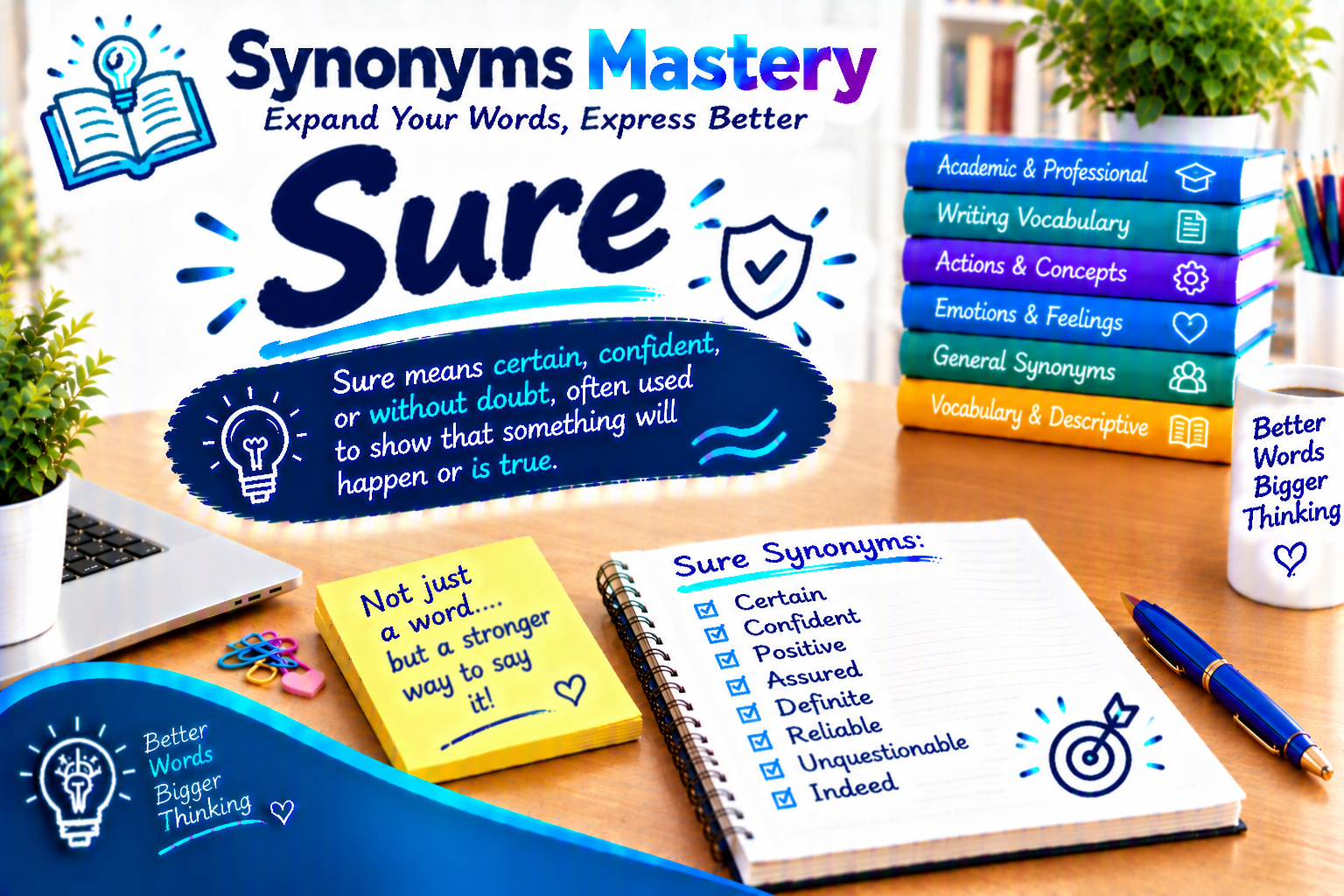
Finding the right synonym for “sure” depends on what you want to express. You might mean that you know something is true, feel confident about a future outcome, or simply agree to a request. Words such as certain, confident, convinced, and positive share some meanings with “sure,” but they are not interchangeable in every sentence.
Some emphasize evidence, others express personal belief, and a few sound more formal or emphatic. This guide explains 20 useful alternatives, shows how they differ, and provides natural examples to help you choose the best word for everyday conversations, school assignments, and professional writing.
Quick Answer: What Are the Best Synonyms for Sure?
The closest synonyms for sure include certain, confident, convinced, positive, assured, and definite. Use certain when you have little or no doubt, confident when you trust your judgment or expect a favorable outcome, and convinced when evidence or reasoning supports your belief. In informal conversation, “for sure” means “without doubt,” while “sure” can also mean “yes” or “all right.”
20 Synonyms for Sure With Meanings
The following words and expressions are grouped by how closely they match the main meanings of “sure.” Some are direct synonyms in common contexts; others work only in specific situations.
| Word or phrase | Relationship | Meaning | Best context |
|---|---|---|---|
| Certain | Direct synonym | Having no doubt about something | Facts, decisions, outcomes |
| Confident | Near synonym | Trusting your judgment or expecting success | Plans, predictions |
| Convinced | Near synonym | Firmly believing something is true | Evidence, arguments |
| Positive | Near synonym | Completely sure, often emphatically | Everyday conversation |
| Assured | Near synonym | Confident or free from hesitation | Professional communication |
| Definite | Contextual alternative | Clearly established or settled | Plans, decisions |
| Conclusive | Contextual alternative | Settling a question or removing doubt | Evidence, findings |
| Persuaded | Near synonym | Led to believe something through reasons or evidence | Arguments, discussions |
| Undeniable | Contextual alternative | Impossible or very difficult to deny | Facts, evidence |
| For sure | Informal phrase | Without doubt; certainly | Everyday conversation |
Usage note: These alternatives do not all replace “sure” in the same sentence. For example, “I am sure about the answer” can become “I am certain about the answer,” but “I am conclusive about the answer” is unnatural. Choose according to the sentence’s meaning and grammar.
What Does “Sure” Mean?
“Sure” is an adjective that commonly means confident that something is true, correct, or likely to happen. It can also describe something dependable or an outcome considered certain. In informal conversation, “Sure!” is an affirmative response meaning “yes,” “of course,” or “all right.”
Examples:
- Belief: I am sure that I locked the door.
- Expectation: She is sure to do well in the competition.
- Reliability: This is a sure way to check the result.
- Agreement: “Can you help me?” “Sure!”
Because these meanings differ, the best replacement depends on how “sure” is being used.
The Best Synonyms for Sure, Explained
1. Certain
Meaning: Having no doubt that something is true or will happen.
“Certain” is one of the closest alternatives to “sure.” It often sounds slightly more formal, particularly in academic or professional writing.
- Sure: I am sure that the figures are correct.
- Certain: I am certain that the figures are correct.
Best for: Facts, decisions, conclusions, and predictions.
2. Confident
Meaning: Feeling trust in your abilities, judgment, or the likelihood of success.
“Confident” often emphasizes a positive expectation rather than simply knowing that something is true.
- She is sure she can finish the project.
- She is confident she can finish the project.
The second sentence emphasizes her belief in her ability to succeed.
Best for: Interviews, presentations, goals, performances, and future outcomes.
3. Convinced
Meaning: Firmly believing that something is true or correct.
“Convinced” is particularly useful when reasoning, information, or evidence has led someone to a conclusion.
- I am sure that the explanation is correct.
- I am convinced that the explanation is correct.
The second version suggests a firm belief supported by reasoning or persuasion.
Best for: Arguments, investigations, conclusions, and personal beliefs.
4. Positive
Meaning: Completely sure about something, often expressed emphatically.
In this sense, “positive” is common in conversational English.
- Are you sure you sent the email?
- Are you positive you sent the email?
“Positive” can sound more emphatic than “sure,” although it does not automatically mean the speaker has stronger evidence.
Best for: Direct questions, confident assertions, and informal discussions.
5. Assured
Meaning: Confident, composed, or certain, depending on the context.
“Assured” can describe someone’s confidence or a result that is considered secure. It often sounds more formal than “sure.”
- She sounded sure during the presentation.
- She sounded assured during the presentation.
Here, “assured” emphasizes a composed, confident manner.
Best for: Professional communication, presentations, and descriptions of someone’s manner.
6. Definite
Meaning: Clearly established, settled, or not subject to change.
“Definite” is often better than “sure” when discussing plans, decisions, arrangements, or answers rather than a person’s mental state.
- Is the meeting date sure?
- Is the meeting date definite?
The second sentence is the natural choice when asking whether the date has been finalized.
Best for: Schedules, arrangements, decisions, and firm answers.
7. Conclusive
Meaning: Providing a decisive result that settles a question.
“Conclusive” is not a general replacement for “sure.” It describes evidence, findings, or results that settle an issue.
- We are sure about the result.
- We have conclusive evidence of the result.
The second sentence changes the grammatical structure but makes the role of evidence clearer.
Best for: Research, investigations, scientific findings, and formal reports.
8. Persuaded
Meaning: Led to believe something by reasoning, evidence, or another person’s arguments.
“Persuaded” emphasizes how someone came to believe a claim, rather than simply describing their level of certainty.
- I am sure that we should change the plan.
- I am persuaded that we should change the plan.
The second version suggests that reasons or arguments influenced the decision.
Best for: Debates, discussions, recommendations, and decisions.
9. Satisfied
Meaning: Having enough information or evidence to accept a claim or conclusion.
This word is especially useful when someone has reviewed information before reaching a judgment.
- The reviewer was sure that the requirements had been met.
- The reviewer was satisfied that the requirements had been met.
The second sentence suggests that the reviewer checked the requirements and found them adequate.
Best for: Evaluations, reviews, checks, and formal assessments.
10. Undoubted
Meaning: Not subject to reasonable doubt.
“Undoubted” is relatively formal and often describes a fact, quality, or achievement rather than someone’s personal state of mind.
- Her talent is undoubted.
- Her talent is certain.
The first sentence is more natural because “undoubted” describes an accepted quality.
Best for: Formal prose and statements about established qualities or facts.
Other Useful Alternatives and When They Work
The following expressions are valuable when the context calls for a more specific meaning.
- Unquestionable: Something that is not reasonably open to challenge. Example: Her contribution to the project was unquestionable.
- Undeniable: Something that cannot reasonably be denied. Example: There is undeniable evidence of improvement.
- Unmistakable: Something so clear that it is difficult to misidentify. Example: There was an unmistakable change in his tone.
- Certain beyond doubt: A formal or emphatic phrase. Example: The identity of the winner was certain beyond doubt.
- Absolutely certain: An emphatic expression of certainty. Example: I am absolutely certain that I submitted the form.
- For sure: An informal expression meaning “without doubt.” Example: I will be there for sure.
- Bound to: An informal expression for an expected outcome. Example: With this much preparation, she is bound to improve.
- Certain to: Used when an outcome is regarded as inevitable or highly predictable. Example: The announcement is certain to attract attention.
- Guaranteed: Used for a promise or an outcome presented as assured. Example: This offer comes with a guaranteed refund under the stated conditions.
Be careful with “guaranteed”: it can imply a promise or formal assurance, so it should not replace “sure” unless that meaning is appropriate.
Sure vs. Certain vs. Confident vs. Convinced
These four words are closely related, but they emphasize different things.
| Word | Main emphasis | Example |
|---|---|---|
| Sure | General absence of doubt | I am sure this is the right address. |
| Certain | Firm belief or established fact | I am certain that the address is correct. |
| Confident | Trust in judgment or expected success | I am confident that we will arrive on time. |
| Convinced | Firm belief supported by reasoning or persuasion | I am convinced that this approach will work. |
Sure vs. Certain
Both words express a lack of doubt and often work interchangeably. However, “sure” is more common in everyday speech, whereas “certain” can sound slightly more formal.
- Everyday: Are you sure about the answer?
- More formal: Are you certain about the answer?
Sure vs. Confident
“Sure” often expresses belief in a fact. By comparison, “confident” emphasizes trust in your abilities, judgment, or expected success.
- I am sure that the information is correct.
- I feel confident about explaining the information clearly.
Sure vs. Convinced
“Convinced” describes a strong belief that often develops through evidence or reasoning. However, “sure” expresses certainty without necessarily explaining its source.
- I am sure he is telling the truth.
- After reviewing the evidence, I am convinced that he is telling the truth.
Sure vs. Positive
“Positive” can make a statement sound emphatic or insistent. It is common in informal conversation.
- “Did you turn off the lights?” “I am sure I did.”
- “Did you turn off the lights?” “I am positive I did.”
The second answer sounds more emphatic, but the context determines whether that emphasis is appropriate.
Which Synonym for Sure Should You Use?
Choose the word that matches your intended meaning.
For everyday conversation
Use sure or certain.
Example: “I am sure I left my notebook here.”
For academic writing
Use certain, convinced, or conclusive, depending on the sentence. Use “conclusive” for evidence or findings, not as a direct substitute for a person’s belief.
Example: “The findings provide conclusive evidence of a relationship.”
For professional communication
Use confident, certain, or definite.
Example: “I am confident that we can complete the project by Friday.”
For evidence-based conclusions
Use convinced, satisfied, conclusive, or undeniable where appropriate.
Example: “The committee was satisfied that the criteria had been met.”
For strong emphasis
Use absolutely certain, positive, or convinced.
Example: “I am absolutely certain that the figures have been checked.”
For informal agreement
Use sure, sure thing, or for sure, depending on the sentence.
Example: “Would you like me to send the notes?” “Sure!”
Remember that “Sure!” as a response means “yes,” not “certain.”
Common Collocations With Sure
A collocation is a combination of words that commonly occurs in natural English. Learning these patterns can help you choose an alternative that fits the sentence.
| Common expression | Natural alternative | Example |
|---|---|---|
| Sure about something | Certain about something | She is certain about her decision. |
| Sure that something is true | Convinced that something is true | I am convinced that the claim is accurate. |
| Sure of success | Confident of success | The team is confident of success. |
| Sure to happen | Bound to happen | Changes are bound to happen. |
| A sure sign | A clear or reliable sign | A sudden drop in temperature is a clear sign of a change in weather. |
| Make sure | Make certain; check | Please check that every field is complete. |
| For sure | Certainly; without doubt | I cannot say for sure. |
| Sure answer | Definite answer, when a firm answer is meant | We need a definite answer by tomorrow. |
Important: “Make sure” often means to check that something is true or completed. In this context, “check” may be more natural than “be certain.”
Common Mistakes When Choosing Synonyms for Sure
1. Using “confident” when you mean verified fact
“Confident” often expresses belief or expectation; it does not prove that a claim is true.
Less precise: “The measurements are confident.”
Better: “The researcher is confident that the measurements are accurate.”
2. Using “conclusive” to describe a person
“Conclusive” normally describes evidence, findings, or results.
Unnatural: “I am conclusive about the answer.”
Better: “I am certain about the answer” or “The evidence is conclusive.”
3. Treating “guaranteed” as a universal synonym
“Guaranteed” can imply a promise, assurance, or outcome that is presented as certain. It is not always appropriate for personal beliefs.
Less natural: “I am guaranteed that he is right.”
Better: “I am sure he is right.”
4. Confusing “sure” with “surely”
“Sure” is commonly an adjective, as in “I am sure.” “Surely” is an adverb, often used to express an expectation or make an emphatic statement.
- Adjective: I am sure that the answer is correct.
- Adverb: Surely, there is another option.
In casual American speech, “sure” can also function informally as an adverb, as in “That sure looks good,” but “surely” is the more standard choice in formal writing.
5. Using formal language in casual situations
“Undoubted” and “unquestionable” can sound unnecessarily formal in an everyday conversation.
Natural: “I am sure he will come.”
More formal and context-dependent: “His attendance is beyond question.”
Antonyms of Sure
The best antonym depends on which meaning of “sure” you intend.
| Antonym | Meaning | Example |
|---|---|---|
| Unsure | Not certain | I am unsure about the answer. |
| Uncertain | Not known or settled with confidence | The outcome remains uncertain. |
| Doubtful | Having doubts or seeming unlikely | I am doubtful that the plan will work. |
| Unconvinced | Not persuaded that something is true | The reviewer remained unconvinced. |
| Hesitant | Slow to act because of uncertainty | She was hesitant to make a decision. |
“Unsure” is usually the simplest opposite when “sure” means having no doubt. “Uncertain” works especially well for unresolved facts, plans, or outcomes.
Frequently Asked Questions
What is the closest synonym for sure?
Certain is usually the closest synonym when “sure” means having no doubt that something is true or will happen. For example, “I am sure the answer is correct” can become “I am certain the answer is correct.” In other contexts, “confident” or “convinced” may be more precise.
What is a formal word for sure?
Certain is a good formal alternative in many sentences. “Convinced” works when reasoning supports a belief, while “definite” describes something settled, such as a date or decision. “Conclusive” is appropriate for decisive evidence, but it does not normally describe a person’s state of mind.
What is another way to say “for sure”?
Common alternatives include “certainly,” “without doubt,” “definitely,” and “for certain.” The best choice depends on the sentence and tone. “For sure” is informal and common in conversation, while “certainly” and “without doubt” can suit more formal contexts.
Are “sure” and “confident” the same?
Not exactly. Both can express belief, but “sure” commonly indicates an absence of doubt, whereas “confident” often emphasizes trust in one’s judgment, ability, or expected success. You can be confident that a presentation will go well without knowing its outcome for certain.
What is a stronger word than sure?
“Absolutely certain,” “positive,” and “convinced” can communicate strong certainty in suitable contexts. “Positive” often sounds emphatic in conversation, while “convinced” can suggest that evidence or reasoning supports the belief. No single word is always stronger in every situation.
What is a synonym for sure in professional writing?
“Certain,” “confident,” and “definite” are useful professional alternatives, but their meanings differ. Use “certain” for a firm belief, “confident” for a positive expectation or trust in ability, and “definite” for a settled plan or decision.
What does “sure” mean when someone replies “Sure!”?
In conversation, “Sure!” usually means “yes,” “of course,” or “all right.” For example, if someone asks, “Can you share your notes?” the response “Sure!” signals agreement. In this use, “certain” is not a natural replacement.
Is “definitely” a synonym for sure?
“Definitely” is a useful alternative in some sentences, but it is an adverb rather than an adjective. You can say “I am sure” or “I will definitely attend.” To preserve the grammar, match the replacement to the role the original word plays in the sentence.
Conclusion
The best synonyms for “sure” include certain, confident, convinced, positive, and assured, but each emphasizes a different aspect of certainty. Choose “certain” for a firm belief, “confident” for trust or expected success, “convinced” for a belief supported by reasoning, and “definite” for settled plans or decisions. For informal agreement, “Sure!” remains a natural way to say yes. The most effective word is the one that communicates your intended meaning clearly and naturally.

Chloe Mitchell is a professional content writer with expertise in building clear and engaging vocabulary resources. She focuses on creating easy-to-read synonym guides, helping users understand word meanings quickly. Her writing style is simple, user-friendly, and optimized for search engines.