Synonyms for LOL: 20 Alternatives for Texting and Online Chats
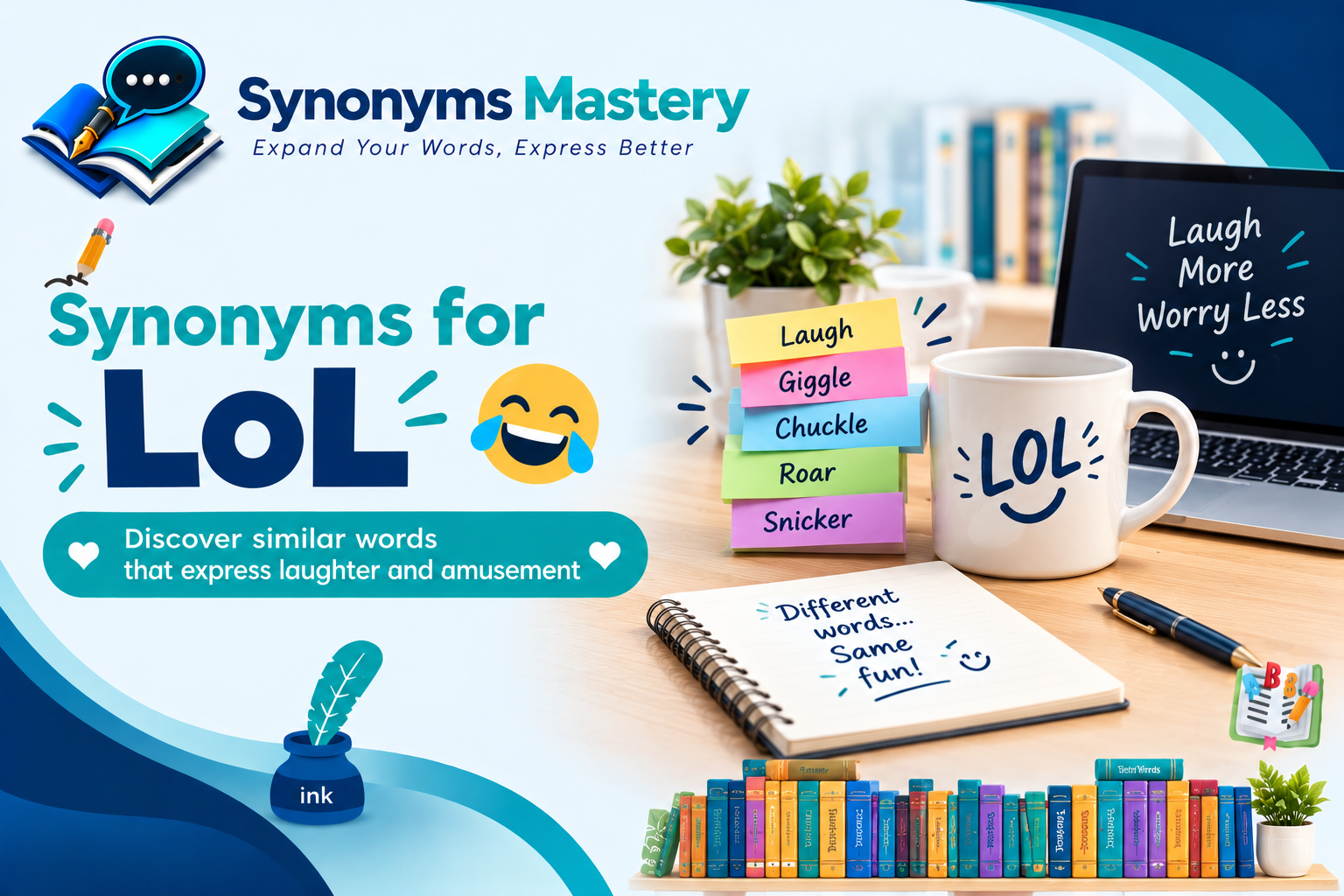
If you are looking for synonyms for LOL, the best alternatives include haha, hahaha, hehe, lmao, rofl, I’m laughing, that’s hilarious, that’s funny, and 😂. However, these expressions are not all exact synonyms.
Some indicate mild amusement, while others suggest stronger laughter or create a different tone.
Because LOL is informal internet slang, the best replacement depends on what you want to communicate: casual amusement, genuine laughter, sarcasm, excitement, or a stronger reaction.
Quick Answer: What Are the Best Synonyms for LOL?
The closest everyday alternatives to LOL are haha, hahaha, hehe, I’m laughing, that’s funny, and that’s hilarious. For stronger online laughter, LMAO and ROFL are common alternatives. The laughing emoji 😂 can also perform a similar function in casual digital communication.
There is an important distinction, though: LOL is an abbreviation rather than a conventional synonym-based vocabulary word. Cambridge defines it as an informal abbreviation for “laughing out loud,” used especially in social media and text messages.
20 Alternatives to LOL
| Alternative | Relationship to LOL | Tone | Best Use |
|---|---|---|---|
| haha | Close contextual alternative | Casual | Mild amusement |
| hahaha | Stronger laughter alternative | Casual | Genuine or stronger laughter |
| hehe | Contextual alternative | Playful | Light, mischievous amusement |
| I’m laughing | Natural phrase alternative | Casual | Explicitly expressing laughter |
| I’m cracking up | Stronger alternative | Very casual | Something is extremely funny |
| That’s funny | Meaning-based alternative | Neutral-casual | Saying something amused you |
| That’s hilarious | Stronger alternative | Casual | Something is very funny |
| That’s so funny | Meaning-based alternative | Casual | Friendly reactions |
| This is hilarious | Stronger phrase | Casual | Reacting enthusiastically |
| I can’t stop laughing | Strong laughter expression | Casual | Genuine strong amusement |
| LMAO | Stronger slang alternative | Very informal | Intense online laughter |
| LMFAO | Very strong slang alternative | Very informal | Extremely strong reaction |
| ROFL | Stronger internet slang | Very informal | Extreme laughter |
| ROTFL | Variant of ROFL | Very informal | Extreme laughter |
| 😂 | Nonverbal digital alternative | Casual | Laughter or strong amusement |
| 🤣 | Stronger emoji alternative | Casual | Something is extremely funny |
| I’m dead | Modern slang alternative | Very casual | Something is hilariously funny |
| Dead 😂 | Slang + emoji | Very casual | Strong reaction in chats |
| I can’t 😂 | Contextual reaction | Very casual | Amusement or disbelief |
| That got me | Natural reaction | Casual | Something genuinely made you laugh |
An Important Note About “Synonyms”
Not every expression above is a dictionary synonym for LOL. That distinction matters.
Haha, hehe, LMAO, and ROFL are alternative ways of expressing laughter or amusement in digital communication. But they differ in intensity, register, and implied tone.
For example:
- LOL → casual amusement
- haha → light or friendly laughter
- hahaha → more obvious laughter
- LMAO → much stronger informal laughter
- ROFL → exaggerated extreme laughter
- 😂 → visual expression of laughter
- I’m cracking up → natural spoken-style expression of strong amusement
This classification is more useful than simply treating every laughter-related expression as an interchangeable synonym.
What Does LOL Mean?
LOL stands for “laughing out loud” and is used mainly in informal digital communication. It can appear in text messages, social media posts, comments, chats, and other casual online conversations.
For example:
“I accidentally sent the email to the wrong person lol.”
The writer may genuinely be laughing, but LOL does not always mean that someone is literally laughing out loud. In modern casual communication, it can simply signal amusement or make a statement sound lighter or more playful.
Example
“I forgot my password again lol.”
Here, LOL may simply communicate self-aware amusement rather than intense laughter.
Merriam-Webster likewise defines LOL as an abbreviation for “laugh out loud” or “laughing out loud.”
The Best Synonyms and Alternatives for LOL
1. Haha
Haha is probably one of the most natural replacements for LOL in casual conversation.
It usually communicates light amusement or laughter.
Example:
“You really thought that was going to work? Haha.”
Best for:
- Text messages
- Friendly conversations
- Social media
- Light jokes
Tone: Casual and friendly.
2. Hahaha
Hahaha generally communicates more obvious laughter than a single haha.
Example:
“He walked into the wrong classroom and didn’t realize it for ten minutes. Hahaha.”
It is especially useful when you want your reaction to appear more enthusiastic.
Tone: Casual, expressive, playful.
3. Hehe
Hehe expresses a lighter or sometimes mischievous type of amusement.
Example:
“I may have eaten the last cookie. Hehe.”
Compared with haha, hehe can sound more playful, shy, teasing, or mischievous.
Best choice when: You want a softer or more playful reaction.
4. I’m Laughing
I’m laughing is a straightforward phrase that communicates the same basic reaction without using internet shorthand.
Example:
“That reply was unexpected. I’m laughing.”
It works particularly well when you want your message to sound conversational rather than abbreviation-heavy.
5. I’m Cracking Up
I’m cracking up is a stronger informal expression.
It suggests that something is making you laugh a lot.
Example:
“That video is so ridiculous. I’m cracking up.”
Strength:
LOL < I’m cracking up
This phrase is best suited to casual communication.
6. That’s Funny
That’s funny is a simple, natural alternative when you want to state that something amused you.
Example:
“You actually brought three umbrellas? That’s funny.”
It is less like texting slang and more like ordinary conversational English.
7. That’s Hilarious
That’s hilarious is considerably stronger than a mild LOL.
Example:
“The way he tried to explain what happened was hilarious.”
Use it when something genuinely strikes you as very funny.
Strength:
LOL → that’s funny → that’s hilarious
This is an approximate intensity distinction rather than a strict linguistic scale.
8. This Is Hilarious
This is hilarious works especially well when reacting to a video, story, conversation, image, or situation.
Example:
“This comment section is hilarious.”
It is natural in both conversation and online communication.
9. I Can’t Stop Laughing
This phrase expresses stronger, more sustained laughter.
Example:
“I can’t stop laughing at that video.”
It is more explicit than LOL and should generally be reserved for situations where the reaction is genuinely strong.
10. LMAO
LMAO is a much stronger and more explicitly slang-oriented alternative to LOL.
It traditionally expands to “laughing my ass off.”
Example:
“You actually wore that to the party? LMAO.”
It is highly informal and belongs primarily in casual digital communication.
LOL vs LMAO
| Expression | Typical effect |
|---|---|
| LOL | Mild to moderate amusement |
| LMAO | Stronger, more emphatic amusement |
Do not use LMAO as a direct replacement in formal writing.
11. LMFAO
LMFAO is an even more emphatic slang expression derived from LMAO.
It is extremely informal and can sound exaggerated or intentionally dramatic.
Example:
“He really thought nobody would notice. LMFAO.”
Use it only where very casual language is appropriate.
12. ROFL
ROFL stands for “rolling on the floor laughing.”
It is an exaggerated internet expression for very strong amusement.
Example:
“That was the funniest plot twist ever. ROFL.”
It generally communicates stronger laughter than LOL.
13. ROTFL
ROTFL is another form of the same expression: “rolling on the floor laughing.”
It serves essentially the same purpose as ROFL.
Because both are highly informal internet slang, they are best reserved for casual online conversations.
14. 😂
The face with tears of joy emoji can serve a similar communicative function to LOL in informal digital communication.
Example:
“You really said that to your boss? 😂”
The emoji does not literally translate to LOL in every context, but it can communicate amusement without words.
15. 🤣
The rolling-on-the-floor-laughing emoji generally signals a stronger reaction than 😂.
Example:
“That ending was completely unexpected 🤣”
It is especially useful when you want to show intense amusement visually.
16. I’m Dead
I’m dead is informal slang meaning that something is so funny or ridiculous that the speaker is figuratively “dead” from laughter.
Example:
“He really posted that publicly? I’m dead.”
This is highly casual and should not be interpreted literally.
17. Dead 😂
Dead 😂 combines slang with an emoji to emphasize a strong humorous reaction.
Example:
“She really thought that was a good idea. Dead 😂”
This style is particularly suited to casual texting and social media.
18. I Can’t 😂
I can’t can function as an incomplete but widely understandable reaction in casual online communication.
Example:
“He brought a PowerPoint presentation to a two-minute meeting. I can’t 😂”
The phrase implies that the situation is so funny, ridiculous, or surprising that the speaker does not know how to respond.
19. That Got Me
That got me means that something successfully amused or surprised you.
Example:
“Okay, that joke got me.”
It sounds more conversational than LOL and works well in casual messages.
20. That’s So Funny
That’s so funny is a natural conversational alternative to LOL when you want to express amusement without slang.
Example:
“You gave the dog his own birthday cake? That’s so funny.”
It is useful when you want your message to sound warm and natural.
Which Alternative to LOL Should You Use?
The best choice depends on the reaction you want to communicate.
Choose haha when:
You want to show mild, friendly amusement.
“Yeah, I probably should have checked the weather first. Haha.”
Choose hahaha when:
You want your laughter to sound stronger or more obvious.
“He actually believed the story! Hahaha.”
Choose hehe when:
You want a playful, teasing, shy, or slightly mischievous tone.
“I might have eaten your fries. Hehe.”
Choose LMAO when:
You want strong, highly informal online laughter.
“You actually sent that message? LMAO.”
Choose ROFL when:
You want an exaggerated internet-slang reaction.
“That ending was ridiculous. ROFL.”
Choose 😂 when:
You want a simple visual expression of amusement.
“You did what? 😂”
Choose I’m cracking up when:
You want natural conversational English to express strong laughter.
“I’m cracking up at this video.”
Choose that’s hilarious when:
You want to explicitly describe something as extremely funny.
“That story is hilarious.”
LOL vs. Haha vs. Hehe vs. LMAO vs. ROFL
These expressions overlap, but they are not interchangeable in every situation.
| Expression | Intensity | Tone | Typical Setting |
|---|---|---|---|
| LOL | Mild–moderate | Casual | Texting, social media |
| haha | Mild | Friendly | Texting, conversation |
| hahaha | Moderate | Expressive | Casual messages |
| hehe | Mild | Playful/mischievous | Casual chats |
| LMAO | Strong | Very informal | Internet slang |
| ROFL | Very strong/exaggerated | Very informal | Online chats |
| 😂 | Moderate–strong | Casual | Social media, texting |
| 🤣 | Strong | Casual | Texting, social media |
| I’m cracking up | Strong | Conversational | Casual speech/text |
| That’s hilarious | Strong | Casual | Conversation and writing |
These are usage guidelines, not fixed numerical levels. Context can change how an expression is perceived.
Is “Haha” a Synonym for LOL?
Haha is a close contextual alternative to LOL, but it is not an exact synonym.
Both can express amusement in informal communication.
Compare:
“That was funny lol.”
and:
“That was funny haha.”
The first uses an internet abbreviation, while the second represents laughter more directly.
Haha can also suggest an actual laugh, whereas LOL may simply signal amusement, irony, or a playful tone.
Is LMAO a Synonym for LOL?
LMAO is a related alternative, but it is usually stronger and more emphatic than LOL.
Use:
- LOL for casual amusement.
- LMAO for a much stronger humorous reaction.
For example:
“I forgot my keys again lol.”
sounds like mild self-amusement.
“He just walked into the glass door. LMAO.”
sounds like a much stronger reaction.
Because LMAO is highly informal, neither expression is appropriate for most professional or formal writing.
Is ROFL a Synonym for LOL?
ROFL is a contextual alternative, not a perfect synonym.
ROFL stands for “rolling on the floor laughing” and is deliberately exaggerated.
It therefore suggests a stronger reaction than ordinary LOL.
“That was funny lol.”
has a much milder tone than:
“That was hilarious. ROFL!”
What Can I Say Instead of LOL in a Text?
For a natural text message, try:
- haha
- hahaha
- hehe
- that’s funny
- that’s hilarious
- I’m laughing
- I’m cracking up
- 😂
- 🤣
- I can’t 😂
- I’m dead
- LMAO
The best choice depends on how strong and playful you want your reaction to sound.
Formal Alternatives to LOL
There is no truly formal one-word synonym for the conversational function of LOL.
In professional or academic communication, it is usually better to describe the reaction directly or omit the laughter marker entirely.
Depending on context, alternatives might include:
- That was amusing.
- That’s funny.
- I found that amusing.
- That made me laugh.
- That’s quite humorous.
For example, instead of:
“Your presentation was great lol.”
a professional message might simply say:
“Your presentation was great.”
Or, if humor is genuinely relevant:
“That part of the presentation made me laugh.”
Common Mistakes When Replacing LOL
1. Treating every laughter expression as an exact synonym
LMAO, ROFL, haha, hehe, and LOL do not communicate exactly the same intensity or tone.
Choose according to context.
2. Using slang in formal communication
Avoid LOL, LMAO, ROFL, LMFAO, and similar expressions in academic papers, formal reports, and most professional documents.
3. Assuming LOL always means actual laughter
LOL can communicate simple amusement or make a message sound more playful. It does not necessarily mean the sender is literally laughing. Cambridge specifically describes it as something used when someone thinks something is funny or intends a joke.
4. Using “hehe” when “haha” would sound more natural
Hehe can carry playful, shy, or mischievous undertones. If you simply want to indicate ordinary laughter, haha is usually safer.
5. Assuming stronger always means better
A reply such as ROFL or LMFAO can sound exaggerated if the original joke is only mildly amusing.
Match the strength of the reaction to the situation.
Can LOL Be Used as a Verb?
Yes. Modern dictionaries recognize LOL as a verb in informal usage.
For example:
“I totally LOLed at that video.”
Cambridge gives examples of forms such as LOLed and LOLing, while Dictionary.com likewise lists LOL as a verb meaning to laugh.
However, this is very informal language.
For more conventional English, use:
“I laughed at that video.”
instead of:
“I LOLed at that video.”
Pronunciation of LOL
In American English, LOL can be pronounced as the individual letters:
/ˌel.oʊˈel/
It can also be pronounced as a single syllable in informal speech. Cambridge lists both the letter-name pronunciation and a spoken form.
Frequently Asked Questions
What is another word for LOL?
Common alternatives include haha, hahaha, hehe, that’s funny, that’s hilarious, I’m laughing, LMAO, ROFL, and 😂. The best option depends on the level of amusement and the tone you want to convey.
What is a more casual synonym for LOL?
Haha, hahaha, hehe, LMAO, ROFL, and 😂 are all casual alternatives. Haha is one of the most natural choices for ordinary friendly conversation.
What is a stronger version of LOL?
LMAO, LMFAO, ROFL, and 🤣 can express stronger or more exaggerated amusement than ordinary LOL. They are highly informal and mainly suited to casual digital communication.
Is “haha” better than LOL?
Neither is universally better. Haha sounds more like written laughter, while LOL functions as an abbreviation that can indicate amusement, joking, or a lighter tone. Choose the one that best fits the surrounding message.
What is the difference between LOL and LMAO?
LOL generally communicates casual amusement, while LMAO is a stronger and more emphatic internet-slang expression. LMAO is also more explicitly informal.
What is the difference between LOL and ROFL?
Both express laughter, but ROFL is intentionally more exaggerated. It stands for “rolling on the floor laughing,” while LOL stands for “laughing out loud.”
Can I use LOL in professional emails?
Generally, no. LOL is informal internet slang. In professional communication, it is usually better to express your reaction directly, such as “That was amusing,” or simply leave the laughter marker out.
Is LOL still used?
Yes. LOL remains a recognized informal abbreviation used in digital communication. However, the way people interpret and use it can vary by age, community, relationship, and context. Its modern function can extend beyond literal laughter.
Conclusion
The best synonyms for LOL depend on the reaction and tone you want to express. Haha and hahaha work well for ordinary amusement, while hehe gives the message a more playful tone. Stronger online laughter can be expressed with LMAO or ROFL.
In a natural conversational style, phrases such as I’m laughing, I’m cracking up, or that’s hilarious may sound more appropriate. Casual digital communication also allows emojis such as 😂 and 🤣 to replace LOL.
Not every laughter expression is an exact synonym. LOL is an informal internet abbreviation, and its alternatives differ in intensity, tone, and context. Choosing the right expression helps your writing sound more natural while communicating the specific reaction you intend.

Ava Thompson is a linguistic analyst who studies word meanings, origins, and usage patterns. She focuses on semantic relationships between words, helping readers understand how synonyms differ in tone, context, and application. Her content is ideal for advanced learners and writers who want deeper language insights.