Synonyms for However: 20 Better Alternatives With Examples
If you use however repeatedly in essays, emails, reports, or everyday writing, you may want alternatives that express contrast without sounding repetitive. The best synonym depends on what kind of contrast you mean and how formal your writing is.
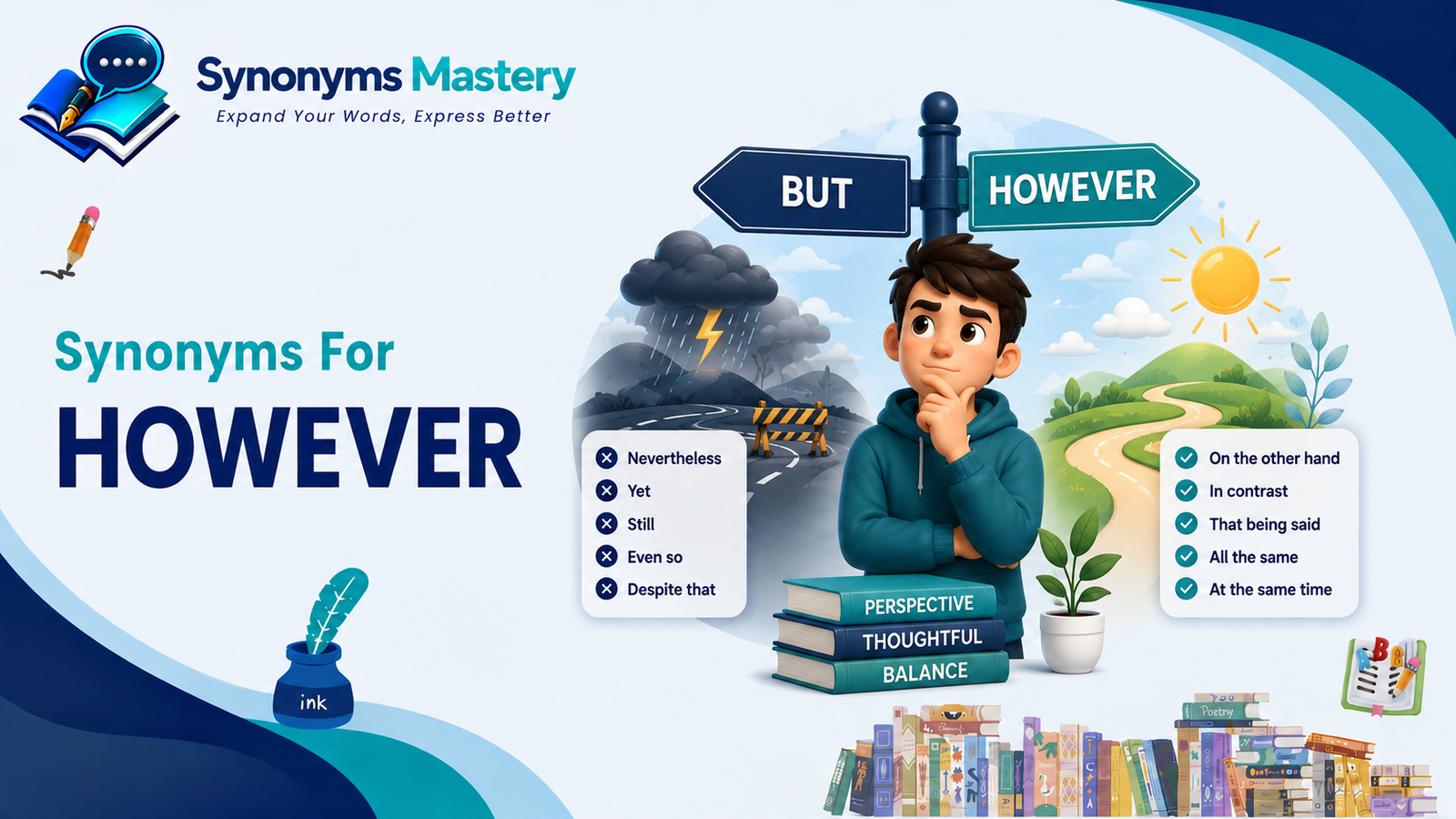
Nevertheless, nonetheless, still, yet, but, even so, on the other hand, and that said can all replace however in certain contexts, but they are not completely interchangeable.
Quick Answer
The closest synonyms for however when it means “despite this” or “in contrast” are nevertheless, nonetheless, still, yet, and even so. But is more direct and conversational, while on the other hand is useful when comparing two sides.
For formal writing, nevertheless, nonetheless, in contrast, or by contrast may be better choices depending on the sentence.
What Does “However” Mean?
However is most commonly used as an adverb to introduce a contrasting, surprising, or qualifying idea. In this sense, it can mean “nevertheless,” “despite this,” or “in contrast.”
Cambridge also recognizes other meanings of however, including “in whatever way” and “to whatever degree,” so not every synonym for one sense can replace it in every sentence.
For example:
The restaurant was expensive. However, the food was excellent.
Here, however tells the reader that the second statement contrasts with the first.
The word can also appear in constructions such as:
However hard she tried, she could not solve the problem.
In this sentence, however means approximately “no matter how”, not “nevertheless.” That distinction is important when choosing an alternative.
20 Synonyms and Alternatives for “However”
| Word or phrase | Relationship | Formality | Best use |
|---|---|---|---|
| Nevertheless | Very close synonym | Formal/neutral | Concession or contrast |
| Nonetheless | Very close synonym | Formal/neutral | Concession or contrast |
| Still | Near-synonym | Neutral | Contrast with a continuing result |
| Yet | Near-synonym | Neutral | Concise or emphatic contrast |
| But | Contextual alternative | Neutral/informal | Direct contrast |
| Even so | Close alternative | Neutral | “Despite that” |
| All the same | Close alternative | Neutral | Despite a previous point |
| On the other hand | Contextual alternative | Neutral | Comparing two sides |
| That said | Contextual alternative | Neutral/professional | Qualifying a previous statement |
| In contrast | Contextual alternative | Formal/neutral | Direct comparison |
| By contrast | Contextual alternative | Formal | Highlighting differences |
| Conversely | Contextual alternative | Formal | Reversed or opposite relationship |
| Though | Contextual alternative | Neutral | Informal or sentence-final contrast |
| Even then | Contextual alternative | Neutral | Contrast involving a condition/time |
| Despite that | Contextual alternative | Neutral | Explicit concession |
| For all that | Near-synonym | Formal/literary | Despite a preceding fact |
| Be that as it may | Contextual alternative | Formal/literary | Conceding a point before moving on |
| Nonetheless | Very close synonym | Formal/neutral | Strong concession |
| Notwithstanding | Context-dependent | Formal | Formal concession |
| At the same time | Contextual alternative | Neutral | Balancing two considerations |
Important: These alternatives are not equally interchangeable. A word such as conversely signals a stronger relationship than however, while on the other hand normally works best when two sides or perspectives are being weighed.
1. Nevertheless
Nevertheless is one of the closest alternatives to however. It means despite what has just been said and is particularly useful when the second statement remains true despite an opposing fact. Cambridge lists however, still, and yet among its synonyms.
Example:
The project was expensive. Nevertheless, the company decided to proceed.
Best for: essays, reports, professional writing, and formal arguments.
Choose it when: you want to emphasize that the second point remains valid despite the first.
2. Nonetheless
Nonetheless has essentially the same core meaning as nevertheless and is often interchangeable with it.
The evidence was limited. Nonetheless, the researchers reached a tentative conclusion.
It is particularly useful when you want a polished transition without repeating however.
Tone: formal and neutral.
However vs. nonetheless: There is usually little practical difference in meaning when both are used as contrastive sentence adverbs.
3. Still
Still can express contrast while suggesting that something remains true despite the preceding information.
The instructions were complicated. Still, I managed to complete the task.
It can sound slightly more conversational than nevertheless.
Choose “still” when: you want a natural, concise transition that emphasizes continuation despite a difficulty or concession.
4. Yet
Yet is a concise way to introduce contrast.
The solution is simple, yet surprisingly effective.
Unlike however, yet can naturally function as a coordinating conjunction between clauses. Cambridge identifies but and although/though as conjunctions that connect contrasting ideas, while warning that however itself should not simply be used as a conjunction in the same way as but.
Best for: concise prose, literary writing, journalism, and general English.
5. But
But is probably the most familiar alternative to however, but the two words do not have identical grammatical behavior.
I wanted to attend, but I was too busy.
Compare:
I wanted to attend. However, I was too busy.
But directly joins contrasting elements or clauses, whereas however commonly works as a sentence connector or adverb. Cambridge specifically notes that however should not replace but when connecting words or phrases.
Choose “but” when: you want direct, natural, straightforward contrast.
6. Even So
Even so means roughly “despite that” or “nevertheless.”
The forecast predicted heavy rain. Even so, we decided to go hiking.
It emphasizes that the second action or conclusion happened despite the first fact.
Tone: neutral.
Best for: everyday writing, professional communication, and explanatory prose.
7. All the Same
All the same is another way to express despite that.
The plan has several weaknesses. All the same, it is worth considering.
It is natural but generally less formal than nevertheless or nonetheless.
Best for: general prose and conversational writing.
8. On the Other Hand
On the other hand is useful when you are deliberately presenting another side, perspective, or consideration.
The apartment is small. On the other hand, it is close to the train station.
It is not always a perfect synonym for however. It often suggests that the writer is weighing two sides rather than simply contradicting or qualifying the previous statement.
Choose it when: the structure is essentially “one consideration is X; another consideration is Y.”
9. That Said
That said is a useful modern alternative in professional and general writing.
The first proposal is more expensive. That said, it offers better long-term value.
It acknowledges the previous point before introducing a qualification or different consideration.
Best for: business writing, articles, reports, presentations, and polished conversational English.
10. In Contrast
In contrast directly highlights a difference between two things.
The northern region received heavy rainfall. In contrast, the southern region experienced drought.
This is more specific than however. It is strongest when the writer is comparing two entities, situations, or results.
Best for: academic, analytical, and professional writing.
11. By Contrast
By contrast works similarly to in contrast.
The first model is lightweight. By contrast, the second model is designed for heavy-duty use.
It is especially useful when the second statement is being explicitly compared with the first.
Choose it when: you want the reader to notice a clear difference rather than merely a qualification.
12. Conversely
Conversely is a formal alternative, but it should not be used whenever two ideas are merely different.
Higher temperatures increased demand for electricity. Conversely, lower temperatures reduced demand.
The second idea here reverses the relationship established in the first.
Choose “conversely” when: the second statement represents a corresponding opposite or reversed situation.
Using conversely merely because two ideas contrast can make the writing less precise.
13. Though
Though can sometimes replace however, especially when it appears at the end of a sentence.
I enjoyed the presentation. It was a little too long, though.
It can also introduce a concessive clause:
Though the task was difficult, we completed it.
Because its grammatical role differs from sentence-adverbial however, it should be treated as a contextual alternative, not a universal substitute.
14. Despite That
Despite that makes the concessive relationship explicit.
The evidence was incomplete. Despite that, the committee approved the proposal.
It is especially useful when you want to clearly communicate “in spite of that fact.”
15. For All That
For all that means approximately “despite that” or “in spite of everything.”
The plan has several limitations. For all that, it remains a useful starting point.
This expression is more formal or literary and is less common in everyday American English.
16. Be That as It May
Be that as it may is a formal expression used to acknowledge a previous point before moving to another consideration.
The proposal has received criticism. Be that as it may, the board must still make a decision.
It can sound old-fashioned or rhetorical, so it should not be used simply to make ordinary writing sound more sophisticated.
17. Notwithstanding
Notwithstanding can express concession, particularly in formal or legal-style writing.
Notwithstanding these concerns, the agreement was approved.
It is not a drop-in replacement for however in every sentence because its grammatical structure is different.
Best for: formal, legal, administrative, and highly polished writing.
18. At the Same Time
At the same time can introduce a balancing consideration.
The software is powerful. At the same time, it requires considerable technical knowledge.
It is useful when both statements should remain valid rather than when one simply contradicts the other.
19. Anyway / Anyhow
Anyway and anyhow can sometimes convey a return to the main point despite a previous consideration.
The weather was uncertain. Anyway, we decided to leave early.
However, these are not general-purpose synonyms for however. Their meanings and discourse functions are broader, and they are more conversational.
Use them when: the intended meaning is closer to “in any case” or “regardless.”
20. No Matter How — For a Different Meaning of “However”
This is an important distinction.
Consider:
However hard he worked, he could not finish the project.
Here, however does not mean nevertheless. It means approximately “no matter how.”
Possible alternatives include:
No matter how hard he worked, he could not finish the project.
Regardless of how hard he worked, he could not finish the project.
Cambridge and Collins both distinguish this degree/extent meaning from the contrastive meaning of however.
Which Word Should You Use Instead of “However”?
The best choice depends on the relationship between your ideas.
Choose “nevertheless” when:
You want to emphasize that something remains true despite a previous fact.
The task was difficult. Nevertheless, we completed it.
Choose “nonetheless” when:
You want a formal alternative with almost the same function as nevertheless.
The results were unexpected. Nonetheless, they were significant.
Choose “but” when:
You want simple, direct contrast.
The plan is ambitious, but it is achievable.
Choose “still” when:
You want to show that a result remains true despite a difficulty.
It was expensive. Still, we bought it.
Choose “yet” when:
You want a concise contrast, especially within one sentence.
The method is simple, yet effective.
Choose “on the other hand” when:
You are weighing another side or consideration.
The apartment is small. On the other hand, the location is excellent.
Choose “that said” when:
You want to acknowledge a previous point before adding a qualification.
The first option is cheaper. That said, the second offers better support.
Choose “in contrast” or “by contrast” when:
You are explicitly comparing two different things.
Sales increased in the east. By contrast, they declined in the west.
Choose “conversely” when:
The second point is a genuine reversal or opposite relationship.
Demand rises when prices fall. Conversely, demand falls when prices rise.
However vs. Nevertheless vs. Nonetheless
These three are often interchangeable when however means “despite this.”
| Word | Main function | Tone | Example |
| However | Introduces contrast or qualification | Neutral | The idea is promising. However, it is expensive. |
| Nevertheless | Emphasizes concession | Formal/neutral | The idea is expensive. Nevertheless, it is promising. |
| Nonetheless | Similar to nevertheless | Formal/neutral | The idea is expensive. Nonetheless, it is promising. |
The practical difference is usually one of emphasis and style, rather than basic meaning. Cambridge explicitly groups nevertheless with however, still, and yet.
However vs. But
This is one of the most important distinctions.
However and but both express contrast, but they do not behave identically grammatically.
The product is affordable, but it has limited features.
The product is affordable. However, it has limited features.
The first sentence uses but as a coordinating conjunction. The second uses however as a sentence connector. Cambridge specifically warns against using however as a conjunction to connect words and phrases in the same way as but.
Quick rule:
Use but to directly join contrasting ideas. Use however to introduce a contrasting or qualifying statement.
However vs. On the Other Hand
These expressions overlap, but their emphasis differs.
However is a broad-purpose contrast marker:
The course is difficult. However, it is rewarding.
On the other hand usually introduces another side of a comparison:
The course is difficult. On the other hand, it is very rewarding.
If you are genuinely weighing two considerations, on the other hand is often more appropriate.
However vs. Conversely
Do not automatically replace however with conversely.
The first approach is inexpensive. However, it requires more time.
This does not necessarily establish a reversal.
But:
The first approach becomes more effective as costs increase. Conversely, the second approach becomes less effective.
Here, conversely works because the second relationship moves in the opposite direction.
Rule: However signals broad contrast; conversely signals a more specific reversal or opposite relationship.
Formal Alternatives to “However”
For academic and professional writing, useful choices include:
- nevertheless
- nonetheless
- in contrast
- by contrast
- notwithstanding
- that said
- conversely
- even so
However, “formal” does not automatically mean “better.” The most precise connector is the one that accurately describes the relationship between your ideas.
For example, conversely may sound more academic than however, but it would be inappropriate if the ideas are not actually reversed.
Alternatives to “However” in Essays
When writing an essay, vary your transitions according to meaning rather than replacing every instance mechanically.
For general contrast
however, nevertheless, nonetheless
For direct comparison
in contrast, by contrast
For an opposite relationship
conversely
For concession
even so, despite that, nevertheless
For a second perspective
on the other hand
For a qualification
that said
Example:
The policy reduced short-term costs. However, it created additional administrative work.
Could become:
The policy reduced short-term costs. Nevertheless, it created additional administrative work.
Or:
The policy reduced short-term costs. That said, it created additional administrative work.
The best choice depends on whether you want simple contrast, concession, or qualification.
Common Mistakes With “However” Synonyms
Mistake 1: Treating every related word as a perfect synonym
Words such as conversely, alternatively, anyway, and on the other hand can relate to contrast but do not always mean exactly the same thing.
Mistake 2: Using “however” like “but”
Incorrect:
I like the design however the price is too high.
Better:
I like the design, but the price is too high.
Or:
I like the design. However, the price is too high.
Mistake 3: Using “conversely” for any contrast
Conversely suggests a reversed or opposite relationship. It should not be used merely because the next sentence differs from the previous one.
Mistake 4: Replacing every “however” with “nevertheless”
Although the two can often substitute for one another, repeating nevertheless throughout an essay can sound just as repetitive.
Mistake 5: Confusing “however” with “no matter how”
However difficult the task is, we will continue.
Here, however means “no matter how.”
It is not equivalent to:
Nevertheless, the task is difficult.
Common Collocations and Sentence Patterns
Some of the most useful patterns include:
However + adjective/adverb
However difficult the problem seems, there is a solution.
Meaning: no matter how difficult
However + sentence
The plan is expensive. However, it may be worthwhile.
Meaning: nevertheless/despite this
Sentence + however
The plan is expensive. It may be worthwhile, however.
This placement is common in polished prose.
But + contrasting clause
The plan is expensive, but it may be worthwhile.
Nevertheless/nonetheless + sentence
The plan is expensive. Nevertheless, it may be worthwhile.
Understanding these patterns is more useful than memorizing a long list of replacement words.
Antonyms and Contrastive Complements
There is no single perfect antonym for however because however is primarily a discourse connector rather than a word describing a concrete quality.
When however introduces contrast, the opposite discourse function would generally involve agreement, continuation, or addition rather than opposition. Depending on the sentence, connectors such as also, furthermore, moreover, similarly, likewise, or in addition may create a non-contrastive relationship.
For example:
The product is affordable. Moreover, it is reliable.
This adds supporting information rather than contrasting it.
Frequently Asked Questions
What is the closest synonym for “however”?
The closest common synonyms are nevertheless and nonetheless when however means “despite this” or “in spite of that.” Still, yet, and even so can also work, although their tone and grammatical behavior differ slightly.
What is a formal word for “however”?
Nevertheless, nonetheless, notwithstanding, in contrast, and by contrast can work in formal writing, depending on the intended relationship. However itself is already appropriate for formal and academic writing, so replacing it is not always necessary.
What is a professional way to say “however”?
In professional writing, useful alternatives include nevertheless, nonetheless, that said, in contrast, by contrast, and even so. The best choice depends on whether you are showing concession, comparison, or qualification.
Can “but” replace “however”?
Sometimes, but not always. But is a conjunction that directly connects contrasting words, phrases, or clauses, while however commonly functions as an adverb or sentence connector. They can express similar contrast but have different grammatical patterns.
Is “nevertheless” stronger than “however”?
Not necessarily. Both commonly introduce a contrasting or concessive point. Nevertheless can place slightly more emphasis on the fact that the second point remains true despite the first, but the difference is often subtle.
Is “nonetheless” the same as “nevertheless”?
In most ordinary contexts, yes. Both mean approximately “despite that” or “in spite of what was just said.” They are often interchangeable.
What can I use instead of “however” in an essay?
Try nevertheless, nonetheless, in contrast, by contrast, yet, even so, or that said, depending on your meaning. Do not replace however automatically; select the connector that describes the relationship between the two ideas.
What is another word for “however” meaning “no matter how”?
When however means “to whatever degree,” alternatives include no matter how and regardless of how.
For example:
However difficult the exam is, she will finish it.
can become:
No matter how difficult the exam is, she will finish it.
Conclusion
The best synonym for however depends on the relationship you want to express. Nevertheless and nonetheless are the closest formal alternatives, while but is more direct, still and yet are concise, and on the other hand is better for weighing two sides.
In contrast and by contrast emphasize comparison, while conversely is reserved for a genuine reversal.
Most importantly, do not replace however simply to avoid repetition. Choose the word that communicates your exact relationship between ideas. Good vocabulary is not about using the most sophisticated synonym—it is about choosing the most accurate and natural one.

Oliver Grant is a vocabulary researcher who focuses on uncovering the subtle differences between similar words. He specializes in synonyms, antonyms, and contextual usage, helping readers choose the most accurate word in any situation. His content is designed for writers, bloggers, and students who want to elevate their language skills and write with precision.