Synonyms for Unable: Better Alternatives With Examples
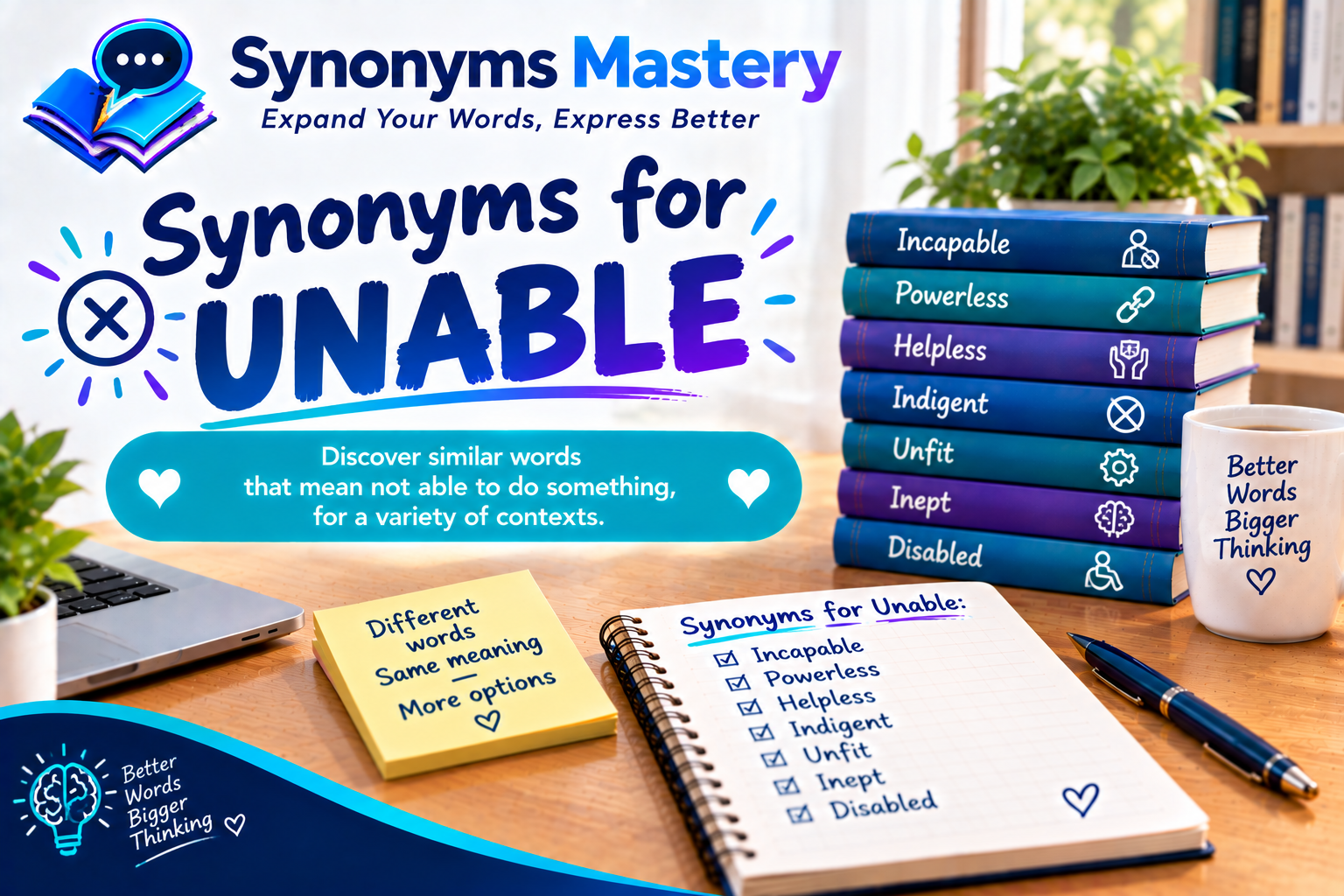
Finding the right synonym for unable depends on why someone cannot do something. Words such as incapable, powerless, helpless, incapacitated, unqualified, and inept can overlap with unable, but they do not all mean exactly the same thing.
Unable is an adjective meaning “not able to do something,” commonly used in the structure be unable to + verb. For example, “She was unable to attend the meeting.”
The best alternative depends on whether the problem involves lack of ability, lack of power or control, insufficient qualifications, physical limitation, or lack of skill.
Quick Answer
The closest synonyms for unable include incapable, powerless, helpless, incapacitated, and ineffectual, but each has a different use. Incapable emphasizes a lack of ability or capacity, powerless emphasizes a lack of control or authority, and helpless emphasizes an inability to act or provide help. For professional writing, unable itself is often the clearest and most neutral choice.
Synonyms for Unable
| Word or phrase | Relationship | Main meaning | Best context | Formality |
|---|---|---|---|---|
| Incapable | Direct/near synonym | Lacking the ability to do something | Ability or capacity | Neutral–formal |
| Not able to | Direct equivalent | Cannot do something | General use | Neutral |
| Powerless | Contextual alternative | Lacking power or control | Situations beyond one’s control | Neutral |
| Helpless | Contextual alternative | Unable to act, help, or protect | Difficult situations | Neutral |
| Incapacitated | Contextual alternative | Unable to function or act normally | Physical or functional limitations | Formal |
| Ineffectual | Near synonym | Unable to produce the desired result | Actions, efforts, methods | Formal |
| Inept | Near synonym | Lacking skill or ability | People and performance | Neutral |
| Incompetent | Near synonym | Lacking necessary competence | Work or professional ability | Strong/negative |
| Unqualified | Contextual alternative | Lacking required qualifications | Jobs, roles, permissions | Neutral–formal |
| Unskilled | Contextual alternative | Lacking a particular skill | Tasks or occupations | Neutral |
| Inadequate | Contextual alternative | Not sufficient for a purpose | Resources, ability, performance | Neutral–formal |
| Not in a position to | Phrase-level alternative | Unable because circumstances prevent action | Professional communication | Formal |
| Not in a position to | Contextual alternative | Lacking the circumstances or authority to act | Business and official writing | Formal |
| Unable to | Standard phrase | Not able to do something | Almost any context | Neutral–formal |
Cambridge’s thesaurus includes several of these terms among words related to unable, including powerless, incapable, incapacitated, incompetent, ineffectual, inefficient, inept, unqualified, and unskilled.
What Does Unable Mean?
Unable means not able to do something.
It is an adjective and is commonly followed by to + verb:
- unable to attend
- unable to understand
- unable to respond
- unable to continue
- unable to complete the task
For example:
We were unable to contact the customer.
The word itself does not necessarily explain why the person cannot do something. The reason might be lack of skill, lack of opportunity, physical limitation, lack of authority, or circumstances beyond their control.
That neutrality is one reason unable is especially useful in professional and formal writing.
1. Incapable
Incapable is one of the closest alternatives to unable, but it often focuses more strongly on a person’s or thing’s lack of ability or capacity.
The device is incapable of processing such large files.
He was incapable of making the necessary decision.
Use incapable when the emphasis is on whether someone or something has the ability or capacity to perform an action.
Unable vs. incapable
- Unable: simply states that something cannot be done.
- Incapable: emphasizes a lack of ability or capacity.
Unable is generally more neutral.
2. Powerless
Powerless means lacking the power, authority, or control necessary to change a situation.
The manager was powerless to stop the decision.
This is different from simply being unable.
Someone may be unable to solve a problem because they lack the necessary skill. Someone may be powerless because they have no control over the situation.
Choose “powerless” when:
The important idea is lack of control or authority.
3. Helpless
Helpless describes someone who cannot act effectively, provide assistance, or protect themselves or someone else.
She felt helpless as the situation became more complicated.
The word can also describe an emotional reaction, so it often carries more feeling than the neutral unable.
Choose “helpless” when:
The person wants or needs to act but cannot effectively do so.
4. Incapacitated
Incapacitated means unable to function or act normally, often because of a physical condition, injury, or other serious limitation.
The accident left him temporarily incapacitated.
This is more specific and formal than unable.
Do not automatically replace unable with incapacitated. The latter suggests a significant loss of normal functioning.
5. Ineffectual
Ineffectual describes something that fails to produce the intended result.
Their attempts to resolve the dispute were ineffectual.
This is not always a direct synonym for unable. It is usually better when describing an action, effort, method, or measure rather than simply stating that a person cannot do something.
Compare:
She was unable to solve the problem.
Her attempts to solve the problem were ineffectual.
The first focuses on her inability. The second focuses on the failure of her efforts.
6. Inept
Inept describes someone who lacks skill or competence in performing a particular task.
He was inept at handling difficult negotiations.
It can sound critical or negative, so it is not a neutral replacement for unable.
Choose “inept” when:
The issue is poor skill or competence, rather than circumstances preventing action.
7. Incompetent
Incompetent means lacking the necessary ability, knowledge, or skill to perform a task properly.
The employee was considered incompetent to manage the project.
This is much more evaluative than unable. Saying someone is unable to complete a task does not necessarily criticize their ability. Calling them incompetent does.
Use it carefully, particularly in professional communication.
8. Unqualified
Unqualified means lacking the qualifications, training, experience, or requirements needed for a particular role or task.
She was unqualified to perform the procedure.
This does not simply mean that she could not do something. It explains that she lacked the necessary qualifications.
Best contexts:
- jobs
- professional roles
- licenses
- technical responsibilities
- regulated activities
9. Unskilled
Unskilled means lacking a particular skill or having little training or experience.
He was unskilled at repairing complex machinery.
This is more specific than unable because it identifies lack of skill as the reason.
10. Inadequate
Inadequate means insufficient or not good enough for a particular purpose.
The available resources were inadequate to complete the project.
It can sometimes overlap with unable, but it usually describes resources, preparation, ability, performance, or conditions rather than the simple inability itself.
11. Not in a Position to
Not in a position to is a useful formal phrase, especially in business and professional communication.
We are not in a position to approve the request at this time.
This often means that circumstances, authority, responsibility, or available information prevent someone from taking action.
It can sound more diplomatic than directly saying that someone is unable to do something.
Which Word Should I Use?
Choose unable when:
You simply need to state that something cannot be done.
We are unable to provide the requested information.
Choose incapable when:
You want to emphasize a lack of ability or capacity.
The old system is incapable of handling the new software.
Choose powerless when:
The person lacks control or authority.
The committee was powerless to change the decision.
Choose helpless when:
Someone cannot effectively act or help.
The witnesses felt helpless during the emergency.
Choose unqualified when:
Someone lacks the required qualifications.
He was unqualified for the position.
Choose inept when:
Someone lacks practical skill or competence.
She was inept at managing complex negotiations.
Choose incapacitated when:
Someone is unable to function or act normally.
The injury left him temporarily incapacitated.
Choose not in a position to when:
You want a formal or diplomatic expression for an inability caused by circumstances or authority.
We are not in a position to make a final decision yet.
Unable vs. Incapable
Unable and incapable are closely related, but they are not identical in every context.
| Unable | Incapable |
|---|---|
| States that something cannot be done | Emphasizes lack of ability or capacity |
| Usually neutral | Can imply a more inherent limitation |
| Very common in formal writing | Often stronger |
| “She was unable to attend.” | “She was incapable of completing the task.” |
For many everyday sentences, unable is the safer and more neutral choice.
Unable vs. Powerless
These words differ mainly in why something cannot be done.
I was unable to open the file.
This could mean I lacked the technical ability or encountered a problem.
I was powerless to stop the decision.
This means I lacked the authority or control to change it.
Powerless therefore adds the idea of lack of control.
Unable vs. Helpless
Helpless often carries a stronger emotional or situational meaning.
The technician was unable to repair the machine.
This is a neutral statement.
The passengers felt helpless during the crisis.
Here, helpless describes a person’s inability to act effectively in a difficult situation and can also convey emotion.
Unable vs. Unqualified
These words should not normally be treated as interchangeable.
She was unable to apply for the position.
This means she could not apply, perhaps because of circumstances.
She was unqualified for the position.
This means she did not meet the required qualifications.
Unqualified identifies a specific reason for inability in a professional or eligibility context.
Common Mistakes With Unable Synonyms
1. Treating every related word as an exact synonym
Words such as incompetent, unskilled, and unqualified describe particular reasons for inability. They should not automatically replace unable.
2. Using “powerless” for every type of inability
Powerless is best when the person lacks control or authority.
The employee was powerless to change the policy.
It would be strange to use it merely because someone does not know how to perform a task.
3. Using “helpless” in neutral professional writing
Helpless can carry emotional or situational overtones. For a neutral business statement, unable is often clearer.
4. Using “incompetent” when you only mean “unable”
Calling someone incompetent suggests that they lack the necessary competence. It can sound strongly critical.
The team was unable to finish the project on time.
does not carry the same judgment as:
The team was incompetent.
5. Confusing “unable” with “unwilling”
Unable means a person cannot do something.
Unwilling means a person does not want to do something.
She was unable to attend.
means she could not attend.
She was unwilling to attend.
means she did not want to attend.
This distinction is especially important in professional writing.
Formal Alternatives to Unable
For formal or professional writing, useful alternatives include:
- incapable of
- unable to
- not in a position to
- not in a position to provide
- not able to
- incapacitated — when the context genuinely involves impaired functioning
- unqualified to — when qualifications are the issue
For example:
We are unable to confirm the information at this time.
can also be expressed as:
We are not in a position to confirm the information at this time.
The second version can sound more diplomatic because it does not directly attribute the limitation to a person’s ability.
Antonyms of Unable
The most direct antonym of unable is able.
Other opposites depend on context:
- capable
- competent
- qualified
- effective
- empowered
- skilled
- prepared
The correct antonym depends on the reason for the inability.
For example:
unable to perform the task → capable of performing the task
powerless to act → empowered to act
unqualified for the role → qualified for the role
FAQ About Synonyms for Unable
What is the closest synonym for unable?
Incapable is one of the closest synonyms, particularly when unable refers to a lack of ability or capacity. However, unable is more neutral and broadly applicable, while incapable can place greater emphasis on the person’s or thing’s inherent ability.
What is a formal word for unable?
Incapable, incapacitated, and not in a position to can work in formal contexts, depending on the meaning. However, unable itself is already a standard and appropriate word for formal writing.
What is another word for “unable to”?
Depending on context, alternatives include incapable of, not able to, powerless to, unable to, and not in a position to. The correct choice depends on whether the limitation involves ability, control, qualifications, or circumstances.
Is incapable the same as unable?
Not always. Both can describe a lack of ability, but incapable often emphasizes an underlying lack of capacity, whereas unable simply states that something cannot be done. Unable is generally more neutral.
What is a stronger word than unable?
There is no single universally stronger synonym. Incapable, powerless, helpless, and incapacitated can sound stronger in particular contexts, but each adds a different meaning rather than simply increasing the intensity of unable.
What is the difference between unable and unwilling?
Unable means someone cannot do something, while unwilling means someone does not want to do it. They describe completely different reasons for not taking an action.
What is a professional way to say unable?
Unable to is already professional and neutral. In some situations, not in a position to can be a more diplomatic alternative, especially when the limitation comes from authority, circumstances, or organizational constraints.
Conclusion
The best synonym for unable depends on the reason something cannot be done. Incapable emphasizes lack of ability, powerless emphasizes lack of control, helpless emphasizes inability to act or help, and unqualified points to missing qualifications.
Inept and incompetent introduce criticism about skill or competence, so they should not be used as neutral substitutes.When no additional meaning is needed, unable remains the clearest and most flexible choice.

Ethan Walker is a language tutor who helps learners improve their English through practical examples and real-life usage. He specializes in teaching synonyms, sentence formation, and writing clarity. His goal is to make complex vocabulary simple and usable for everyday communication.