Synonyms for Immortal: 25+ Alternatives With Meanings and Examples
Finding the right synonym for immortal depends on what you mean by the word. If you mean “not subject to death,” strong alternatives include eternal, everlasting, undying, deathless, and imperishable. If you mean something that lasts beyond a particular time or era, timeless or enduring may be more natural. When immortal refers to a person’s lasting fame, words such as legendary or iconic may fit better.
The key is not simply finding another word that appears in a thesaurus. A good synonym should match the original word’s meaning, grammatical role, tone, and context.
Quick Answer: What Are the Best Synonyms for Immortal?
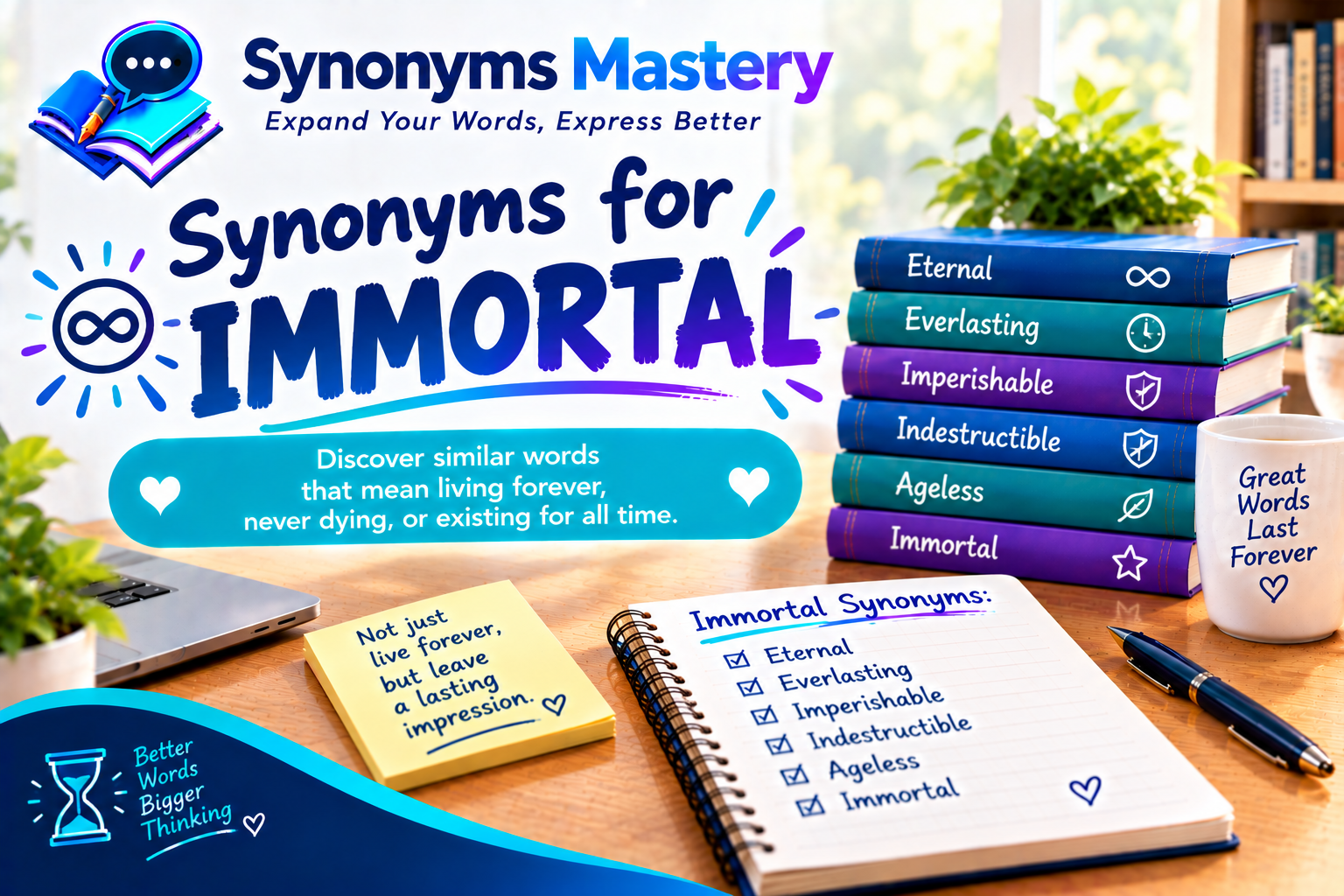
The closest synonyms for immortal include eternal, everlasting, undying, deathless, imperishable, timeless, enduring, perpetual, and ever-living.
However, these words are not interchangeable in every sentence. Eternal emphasizes existence without end, everlasting emphasizes continuation forever, undying often describes feelings or qualities that never fade, and timeless usually describes something that remains relevant or admired across generations.
For a famous person, achievement, or work remembered for generations, legendary, iconic, or illustrious may be more appropriate than a literal synonym of immortal.
Immortal Synonyms at a Glance
| Word | Relationship | Main Meaning | Best Context |
|---|---|---|---|
| Eternal | Direct synonym | Existing forever | Life, souls, spiritual ideas |
| Everlasting | Direct synonym | Continuing forever | Love, peace, life, memories |
| Undying | Direct/near synonym | Never dying or fading | Love, loyalty, admiration |
| Deathless | Direct synonym | Not subject to death | Literary or elevated writing |
| Imperishable | Near synonym | Unable to perish or disappear | Memories, qualities, things |
| Timeless | Contextual alternative | Unaffected by changing eras | Art, style, ideas |
| Enduring | Near synonym | Continuing for a long time | Influence, reputation, relationships |
| Perpetual | Near synonym | Continuing without interruption or end | States, conditions, processes |
| Infinite | Contextual alternative | Without limit or boundary | Time, space, existence |
| Ageless | Contextual alternative | Not appearing to grow old | People, beauty, art |
| Unfading | Contextual alternative | Not losing strength or beauty | Beauty, memories, glory |
| Lasting | Near synonym | Continuing for a long time | Effects, impressions, influence |
| Permanent | Near synonym | Intended or expected to remain | Conditions, changes, arrangements |
| Legendary | Contextual alternative | Famous and remembered | People, achievements, events |
| Iconic | Contextual alternative | Widely recognized and influential | People, images, works |
| Illustrious | Contextual alternative | Highly respected or famous | People, careers, achievements |
The distinction matters because immortal can describe literal freedom from death, something that lasts forever, or lasting fame depending on context.
What Does Immortal Mean?
Immortal is primarily an adjective meaning not subject to death or living forever.
For example:
The ancient legend describes the gods as immortal.
It can also describe something that seems destined to last forever or remain famous through history:
The author created an immortal work of literature.
As a noun, an immortal can refer to an immortal being, such as a god or deity, or to a person regarded as permanently important or famous.
Because immortal has more than one sense, the best synonym changes with the sentence.
1. Eternal
Eternal is one of the closest alternatives to immortal. It describes something that has no end or exists forever.
They believed that the soul was eternal.
Use eternal when the emphasis is on endless existence, especially in philosophical, religious, or abstract contexts.
Best for: life, souls, love, time, existence, spiritual ideas.
Immortal vs. Eternal
Immortal specifically carries a connection with death or mortality. Eternal focuses more broadly on existence without an end.
- immortal being → a being that cannot die
- eternal existence → existence with no end
2. Everlasting
Everlasting means continuing for an unlimited or apparently endless period.
They hoped their friendship would be everlasting.
It commonly works with abstract ideas such as love, peace, happiness, life, and friendship.
Compared with immortal, everlasting usually emphasizes duration rather than the ability of a living being to escape death.
3. Undying
Undying can mean never dying, but it is also frequently used for something that does not fade in intensity or importance.
She expressed her undying gratitude to her mentor.
This makes undying especially useful for:
- love
- loyalty
- admiration
- devotion
- gratitude
- affection
- fame
For example, undying love sounds natural, while immortal love can sound more literary or unusual.
4. Deathless
Deathless is a close synonym of immortal, particularly in literary or elevated language.
The poet sought to create deathless art.
It emphasizes freedom from death or the idea of surviving through time.
Deathless can sound more dramatic than the neutral eternal or everlasting, so it is especially useful in literary writing.
5. Imperishable
Imperishable describes something that cannot perish, disappear, or be destroyed.
The story has become an imperishable part of the country’s cultural heritage.
It is often better than immortal when talking about something abstract that survives through time.
Best contexts: memories, traditions, qualities, cultural achievements, values, influence.
6. Timeless
Timeless is related to immortal but should not automatically be treated as an exact synonym.
It usually describes something that remains valuable, attractive, relevant, or admired despite changes in fashion and time.
Her novel has a timeless appeal.
A timeless design is not literally immortal. Instead, it continues to feel appropriate or attractive across generations.
Choose timeless when the emphasis is on lasting relevance or appeal.
7. Enduring
Enduring means continuing to exist, remain effective, or remain important over a long period.
The artist left an enduring legacy.
It is particularly natural when discussing:
- influence
- reputation
- relationships
- traditions
- achievements
- legacies
Enduring generally does not mean literally unable to die. It emphasizes continued existence or importance.
8. Perpetual
Perpetual describes something that continues indefinitely or appears never to end.
The machine was caught in a perpetual cycle.
It can overlap with immortal when discussing endless duration, but it is often more appropriate for states, conditions, cycles, and processes.
Perpetual does not normally describe a person as an alternative to immortal.
9. Infinite
Infinite means without limit or boundary.
The universe may seem infinite.
It can overlap with immortal in philosophical or abstract discussions involving endless time or existence, but it is not a direct replacement in most everyday sentences.
For example:
- immortal being ✓
- infinite being → different meaning
Use infinite when the important idea is lack of limits rather than freedom from death.
10. Ageless
Ageless describes someone or something that does not appear to grow old or that seems unaffected by age.
The actress has an ageless elegance.
It can also describe art, stories, or ideas that remain relevant across generations.
Ageless is therefore useful when immortal is being used to suggest freedom from aging rather than literal freedom from death.
11. Unfading
Unfading describes something that does not lose its strength, beauty, brightness, or emotional significance.
He is remembered for his unfading courage.
It works especially well with:
- beauty
- memories
- glory
- affection
- admiration
- reputation
It is usually a contextual alternative rather than a universal replacement for immortal.
12. Lasting
Lasting means continuing for a long time or producing an effect that remains.
Her speech made a lasting impression.
It is more neutral and less absolute than immortal. Something can be lasting without continuing forever.
Use lasting when you want a natural everyday alternative without suggesting literal eternity.
13. Permanent
Permanent means intended or expected to remain rather than being temporary.
The discovery had a permanent impact on the field.
It overlaps with immortal only in certain contexts involving permanence. A permanent change is not necessarily eternal, and a permanent object is not necessarily incapable of destruction.
14. Legendary
Legendary is useful when immortal means famous or remembered for generations, rather than literally unable to die.
The player became a legendary figure in the sport.
This is an important distinction. Legendary does not mean physically immortal. It means exceptionally famous, memorable, or celebrated.
15. Iconic
Iconic describes a person, image, object, style, or work that has become widely recognized and culturally significant.
The photograph became an iconic image of the era.
Use iconic when the emphasis is on recognition and cultural importance rather than endless life.
16. Illustrious
Illustrious means highly respected, distinguished, or famous.
She had an illustrious career in medicine.
It is particularly suitable for formal writing about people’s careers, achievements, backgrounds, or reputations.
It should not replace immortal when the sentence literally means “unable to die.”
Which Synonym Should You Use?
Choose eternal when:
You mean something exists forever or has no end.
eternal life
Choose everlasting when:
You want to emphasize something continuing forever.
everlasting peace
Choose undying when:
You are describing a feeling, loyalty, admiration, or affection that never fades.
undying devotion
Choose deathless when:
You want a literary or elevated expression for something beyond death.
deathless poetry
Choose imperishable when:
Something cannot perish or is expected to survive through time.
an imperishable legacy
Choose timeless when:
Something remains relevant, beautiful, or admired across different eras.
timeless literature
Choose enduring when:
Something continues to have an effect or importance for a long time.
an enduring influence
Choose legendary when:
You mean a person or achievement remembered because of exceptional fame.
a legendary athlete
Choose ageless when:
You mean something appears unaffected by age.
ageless beauty
Immortal vs. Eternal
Immortal and eternal overlap strongly, but they emphasize different ideas. The word immortal is closely associated with death and mortality, describing a being that cannot die. Eternal, on the other hand, focuses on something that has no end or continues forever.
Compare:
The gods were believed to be immortal.
The soul was believed to be eternal.
In the first example, the emphasis is on freedom from death; in the second, the focus is on endless existence.
Immortal vs. Everlasting
Both words can describe something that continues forever.
Immortal is especially natural for beings or things associated with death and mortality.
Everlasting is especially natural for abstract things such as love, peace, life, and happiness.
The gods were immortal.
They wished for everlasting peace.
Immortal vs. Timeless
These words are sometimes confused because both can suggest survival beyond ordinary time.
Immortal can mean unable to die or destined to remain forever.
Timeless usually means unaffected by changing fashions, eras, or cultural trends.
The mythical creature was immortal.
The novel has a timeless appeal.
A timeless novel is not literally alive forever; its value or relevance continues across generations.
Immortal vs. Undying
Immortal and undying both relate to the idea of not dying, but undying is particularly common for emotions, loyalty, admiration, and devotion.
The character was immortal.
She expressed her undying love for her family.
The second sentence uses a collocation that sounds much more natural than immortal love in ordinary English.
Common Mistakes With Immortal Synonyms
Mistake 1: Treating every synonym as interchangeable
Words such as timeless, legendary, and permanent overlap with immortal but do not always carry the same meaning.
Mistake 2: Using “legendary” for literal immortality
Legendary means famous or celebrated, not physically incapable of dying.
Mistake 3: Using “infinite” when you mean “unable to die”
Infinite means without limits. It does not normally mean “not subject to death.”
Mistake 4: Assuming “permanent” means “eternal”
Something permanent is expected to remain, but the word does not necessarily communicate literal endless existence.
Mistake 5: Ignoring grammatical context
The noun immortal can refer to an immortal being or, in certain contexts, a person regarded as permanently famous. Adjective synonyms do not automatically work in these noun uses.
Antonyms of Immortal
The clearest opposite of immortal is mortal, meaning subject to death.
Other contextual opposites include:
- perishable
- temporary
- transient
- ephemeral
- fleeting
- short-lived
- mortal
The best antonym depends on the specific meaning. If immortal means “lasting forever,” temporary or short-lived may provide the clearest contrast. If it means “not subject to death,” mortal is the most direct opposite.
Frequently Asked Questions
What is the closest synonym for immortal?
Eternal is one of the closest general synonyms for immortal, particularly when referring to endless existence. Other close alternatives include everlasting, undying, and deathless. The best choice depends on whether the sentence focuses on life, duration, emotions, or lasting significance.
What is another word for immortal person?
If you mean a person who cannot die, deathless or undying may work in literary contexts. If you mean a person whose fame will last for generations, legendary, iconic, illustrious, or great may be more appropriate depending on the sentence.
Is eternal the same as immortal?
Not always. Eternal means existing or continuing forever, while immortal is especially associated with not being subject to death. The two words overlap substantially when discussing eternal life or beings that cannot die.
What is a synonym for immortal life?
Natural alternatives include eternal life, everlasting life, and undying life, although eternal life is generally the most established expression. The appropriate choice can depend on whether the context is religious, philosophical, literary, or fictional.
What is a synonym for immortal fame?
For fame that continues across generations, useful alternatives include legendary fame, enduring fame, lasting fame, and timeless renown. If describing the person rather than the fame, legendary or iconic may be more natural.
Is timeless a synonym for immortal?
Timeless can be a contextual synonym but is not always a direct replacement. Timeless usually means remaining relevant, attractive, or significant across different periods, whereas immortal can mean literally unable to die.
What is the opposite of immortal?
The most direct opposite is mortal. Other opposites include perishable, temporary, fleeting, ephemeral, and short-lived, depending on whether the intended contrast is death, permanence, or duration.
Conclusion
The best synonym for immortal depends on the meaning you want to preserve. Use eternal or everlasting for endless existence, undying for feelings or qualities that never fade, deathless for elevated or literary contexts, and imperishable for things that survive without perishing.
When the focus shifts from literal immortality to lasting influence or fame, timeless, enduring, legendary, and iconic may be more natural. Rather than choosing the longest thesaurus list, choose the word that matches the exact context, tone, and meaning of your sentence.

Oliver Grant is a vocabulary researcher who focuses on uncovering the subtle differences between similar words. He specializes in synonyms, antonyms, and contextual usage, helping readers choose the most accurate word in any situation. His content is designed for writers, bloggers, and students who want to elevate their language skills and write with precision.