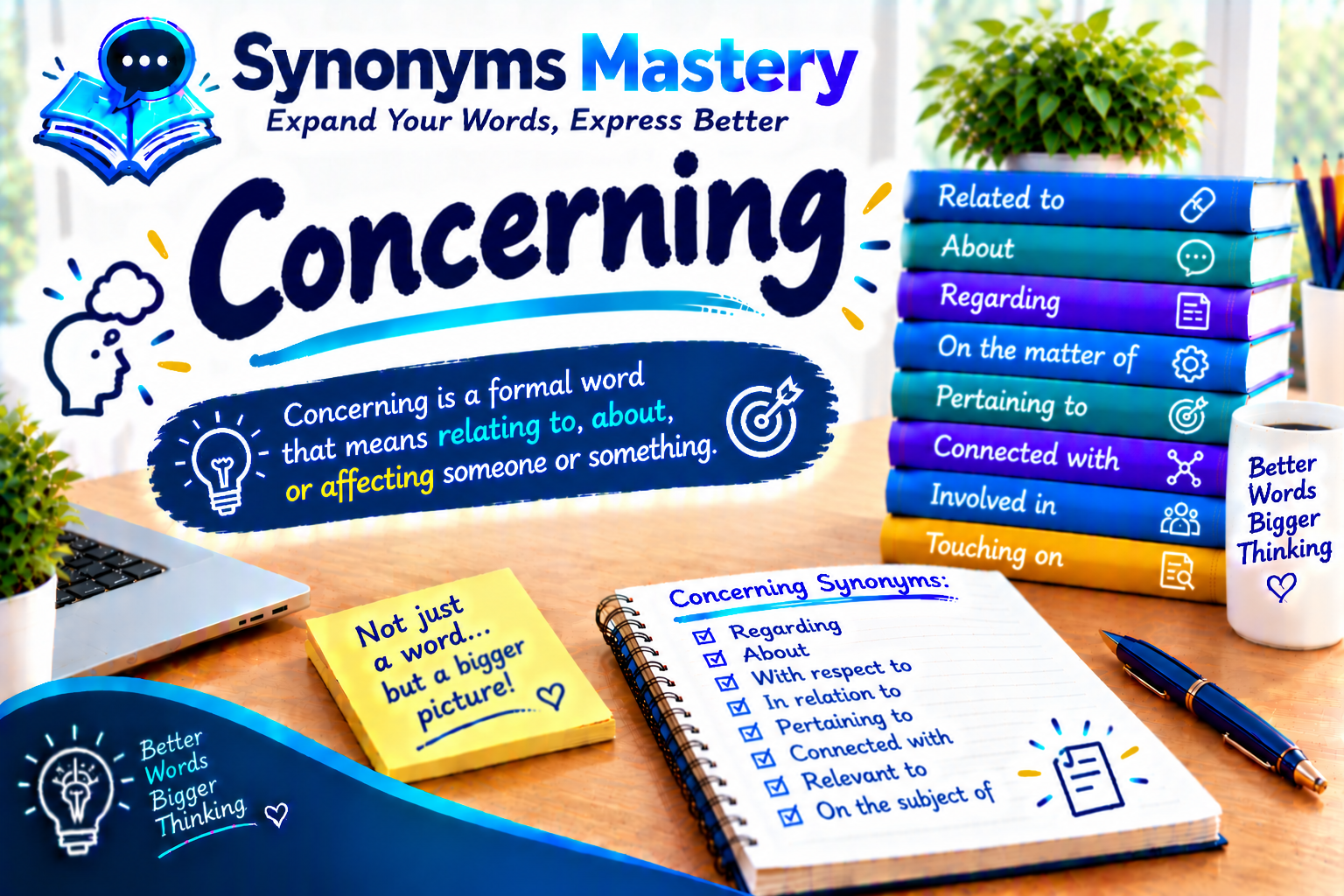
Synonyms for Concerning: Better Alternatives With Examples
The best synonyms for concerning depend on what you want to express. When the word means “about” or “related to a subject,” alternatives include regarding, about, pertaining to, and in relation to. When it means “causing worry,” suitable alternatives include worrying, troubling, alarming, and unsettling.
Choosing the right word depends on your sentence, intended meaning, and desired tone. This guide explains the differences between these alternatives so you can select the most natural word for everyday conversations, academic writing, and professional communication.
Quick Answer: What Are the Best Synonyms for Concerning?
The most useful synonyms for concerning are regarding, about, related to, pertaining to, worrying, troubling, alarming, and unsettling.
Use regarding when introducing a subject in formal communication, about for everyday English, and pertaining to for formal or technical contexts. When concerning describes something that causes worry, choose worrying for a general concern, troubling for a more serious problem, or alarming when the situation suggests a particularly serious threat. Cambridge Dictionary
1. Synonyms for Concerning at a Glance
The following table separates alternatives by meaning to help you choose the correct word.
| Word or Phrase | Relationship | Meaning | Formality | Best Context |
|---|---|---|---|---|
| About | Direct synonym in the subject-related sense | On the subject of | Neutral | Everyday conversation |
| Regarding | Direct synonym in the subject-related sense | In relation to a subject | Formal | Emails and business writing |
| With regard to | Direct synonym in the subject-related sense | In reference to | Formal | Reports and correspondence |
| With respect to | Direct synonym in the subject-related sense | In relation to | Formal | Academic and professional writing |
| Pertaining to | Near-synonym | Relating to a particular matter | Formal | Rules, policies, and technical documents |
| Related to | Contextual alternative | Connected with a subject | Neutral | General explanations |
| In relation to | Contextual alternative | In connection with something | Formal | Reports and discussions |
| Relevant to | Contextual alternative | Having a meaningful connection to a topic | Neutral/Formal | Research and decision-making |
| Worrying | Direct synonym in the adjective sense | Causing worry | Neutral | Everyday situations |
| Troubling | Near-synonym | Causing concern or distress | Neutral | Problems and developments |
| Worrisome | Near-synonym | Likely to cause worry | Neutral | Trends and uncertain situations |
| Unsettling | Near-synonym | Causing unease | Neutral | Uncertain or uncomfortable situations |
| Disturbing | Near-synonym | Causing strong discomfort or concern | Neutral | Upsetting information or behavior |
| Alarming | Near-synonym | Causing serious concern | Neutral | Urgent or potentially dangerous situations |
| Disquieting | Near-synonym | Causing uneasiness | Formal/Literary | Analytical and literary writing |
| Reassuring | Antonym in some contexts | Reducing worry | Neutral | Positive developments |
Important: These words are not interchangeable in every sentence. Regarding can replace concerning when introducing a subject, but it cannot replace concerning when the word describes something worrying.
2. What Does Concerning Mean?
Concerning has two main meanings in modern English.
Meaning 1: About or Relating to Something
As a preposition, concerning introduces the subject of a statement, question, document, or discussion. It is generally more formal than about.
Example:
“The manager received several questions concerning the new policy.”
Here, concerning means about. The sentence could be rewritten as:
“The manager received several questions about the new policy.”
Other alternatives include regarding, with respect to, and in relation to. Cambridge Dictionary
Meaning 2: Causing Worry or Concern
As an adjective, concerning describes something that makes people feel worried or uneasy.
Example:
“The sudden decline in customer satisfaction is concerning.”
Here, the word expresses worry about a negative development.
Possible alternatives include:
- “The sudden decline in customer satisfaction is worrying.”
- “The sudden decline in customer satisfaction is troubling.”
- “The sudden decline in customer satisfaction is alarming.”
Each alternative communicates a slightly different level or type of concern.
Cambridge Dictionary documents both meanings, while Collins also distinguishes the subject-related preposition from the adjective describing something that causes concern.
3. Synonyms for Concerning Meaning “About”
When concerning introduces a subject, the best alternatives are usually prepositions or phrases that express a similar relationship.
1. About
Meaning: On the subject of something.
About is the simplest and most common everyday alternative. It works in conversations, emails, school assignments, and most general writing.
Example:
Original: “I have a question concerning your application.”
Alternative: “I have a question about your application.”
Best for: Everyday English and clear, straightforward communication.
2. Regarding
Meaning: In relation to a particular subject.
Regarding is a natural choice for professional correspondence and formal writing. It often sounds more businesslike than about without becoming unnecessarily complicated.
Example:
Original: “I am contacting you concerning the project deadline.”
Alternative: “I am contacting you regarding the project deadline.”
Best for: Professional emails, business letters, and administrative communication.
3. Pertaining To
Meaning: Relating to a specific subject, matter, or category.
Pertaining to often appears in formal, technical, legal, and administrative writing. It can sound unnecessarily formal in casual conversation.
Example:
“Please review the documents pertaining to the agreement.”
This means the documents relate to the agreement.
Best for: Policies, official documents, technical explanations, and formal reports.
4. With Regard To
Meaning: In reference to a particular matter.
This phrase is useful when discussing a specific issue or responding to a particular point.
Example:
“With regard to your request, we will provide an update tomorrow.”
It can also replace concerning in sentences such as:
“We have received new information with regard to the proposal.”
Best for: Formal emails, reports, and professional discussions.
5. With Respect To
Meaning: In relation to a particular subject or aspect.
This phrase often introduces the specific aspect of a larger issue being discussed.
Example:
“With respect to the budget, the team has proposed several changes.”
Best for: Academic writing, formal discussions, and business reports.
6. Related To
Meaning: Connected with or associated with something.
Unlike regarding, which directly introduces a subject, related to emphasizes a connection between things.
Example:
“The report includes information related to customer satisfaction.”
This is a natural alternative when the information has a connection to the topic.
Best for: General writing, explanations, and descriptions of connected subjects.
7. In Relation To
Meaning: In connection with or with reference to something.
This phrase is useful when discussing how one issue connects to another.
Example:
“The committee requested additional information in relation to the proposed changes.”
Best for: Reports, formal communication, and analytical writing.
8. Relevant To
Meaning: Having a meaningful connection to a particular matter or being useful for a particular purpose.
Relevant to is not an exact synonym for concerning. Something can be concerning a subject without necessarily being relevant or useful to it.
Example:
“Please include any information relevant to the investigation.”
Here, the emphasis is on the usefulness or applicability of the information.
Best for: Research, professional documents, instructions, and decision-making.
4. Synonyms for Concerning Meaning “Worrying”
When concerning means that something causes worry, use alternatives that describe the emotional or practical effect of the situation.
1. Worrying
Meaning: Causing someone to feel worried.
Worrying is one of the closest everyday alternatives to concerning in this sense.
Example:
“The recent decline in attendance is concerning.”
Alternative:
“The recent decline in attendance is worrying.”
Both sentences communicate concern about a negative development.
Best for: Everyday English, general observations, and straightforward descriptions.
2. Troubling
Meaning: Causing worry, discomfort, or concern.
Troubling often suggests that a situation deserves attention because something appears wrong or problematic.
Example:
“The report revealed a troubling pattern of repeated errors.”
Compared with concerning, troubling can make the problem sound more substantial or disturbing.
Best for: Reports, workplace problems, social issues, and negative developments.
3. Worrisome
Meaning: Likely to cause worry or anxiety.
Worrisome often describes a situation, trend, or possibility that creates reason for concern.
Example:
“The continued decline in performance is worrisome.”
The word works particularly well when discussing developments that may lead to further problems.
Best for: Performance trends, uncertain outcomes, and emerging problems.
4. Unsettling
Meaning: Causing unease or making someone feel uncomfortable.
Unsettling emphasizes the feeling of discomfort or uncertainty created by a situation. It does not necessarily suggest an immediate threat.
Example:
“The unexplained changes in the schedule were unsettling.”
Best for: Uncertainty, unexpected behavior, unusual events, and uncomfortable situations.
5. Disturbing
Meaning: Causing strong emotional discomfort or concern.
Disturbing is appropriate when information, behavior, or an event causes a particularly strong negative reaction.
Example:
“The documentary presented disturbing evidence of environmental damage.”
It generally communicates a stronger emotional response than ordinary concerning.
Best for: Upsetting information, troubling behavior, and serious social issues.
6. Alarming
Meaning: Causing serious concern or fear.
Alarming suggests that a situation is serious enough to attract urgent attention.
Example:
“The rapid increase in equipment failures is alarming.”
Compared with concerning, this alternative communicates greater urgency.
Best for: Serious developments, warning signs, and situations requiring prompt attention.
7. Disquieting
Meaning: Causing uneasiness or a sense of concern.
Disquieting is a more formal or literary alternative. It is less common in everyday conversation than worrying or troubling.
Example:
“The investigation uncovered a disquieting lack of transparency.”
Best for: Formal analysis, essays, literary writing, and serious commentary.
8. Distressing
Meaning: Causing considerable emotional pain, upset, or anxiety.
Distressing emphasizes the emotional impact of an event or situation rather than simply indicating that it deserves attention.
Example:
“The family found the unexpected news distressing.”
Best for: Personally upsetting events, difficult news, and emotionally challenging circumstances.
5. Formal Synonyms for Concerning
The right formal alternative depends on which meaning you intend to communicate.
| Situation | Recommended Alternative | Example |
|---|---|---|
| Introducing a topic in an email | Regarding | “I am writing regarding your application.” |
| Referring to an official matter | With regard to | “With regard to your request, we need additional information.” |
| Discussing rules or requirements | Pertaining to | “Please read the guidelines pertaining to registration.” |
| Describing a negative development | Troubling | “The report identifies a troubling pattern.” |
| Describing a serious warning sign | Alarming | “The findings reveal an alarming increase in errors.” |
| Describing relevant evidence | Relevant to | “The team reviewed evidence relevant to the case.” |
Writing tip: Formal writing does not always require longer expressions. In many situations, about is clearer and more natural than a phrase such as with regard to. Choose formality according to the audience and purpose, not simply the length of the expression.
6. Concerning vs. Regarding vs. Worrying
These three words are easy to confuse because they can appear in similar sentences, but they do not perform the same function.
| Word | Meaning | Example | Main Difference |
|---|---|---|---|
| Concerning | About a subject; or causing worry | “The information concerning the case was incomplete.” | Has two distinct meanings |
| Regarding | About a subject | “The information regarding the case was incomplete.” | Introduces a topic |
| Worrying | Causing worry | “The incomplete information was worrying.” | Describes something that creates concern |
Concerning vs. Regarding
Use concerning and regarding when introducing a subject.
- “We received a letter concerning the changes.”
- “We received a letter regarding the changes.”
Both are natural.
However, regarding cannot normally replace concerning in this sentence:
“The delay is concerning.”
Writing “The delay is regarding” would not preserve the original meaning.
Concerning vs. Worrying
Use concerning or worrying when describing something that causes concern.
- “The results are concerning.”
- “The results are worrying.”
Both sentences are natural. Worrying is a straightforward alternative, while concerning can sound slightly more restrained in some professional contexts.
Concerning vs. Troubling
Both words describe something that causes concern, but troubling often conveys a stronger sense that a situation is problematic.
- “The findings are concerning.” — Expresses concern.
- “The findings are troubling.” — Emphasizes the problematic nature of the findings.
The difference depends on context, so neither word is automatically stronger in every sentence.
7. Which Synonym for Concerning Should You Use?
The easiest way to choose the right alternative is to identify your intended meaning first.
If You Mean “About”
Choose:
- About: For simple, natural English.
- Regarding: For professional emails and formal correspondence.
- Pertaining to: For technical or official documents.
- With respect to: For formal discussion of a specific aspect.
- Related to: When emphasizing a connection between topics.
If You Mean “Causing Worry”
Choose:
- Worrying: For a direct, everyday alternative.
- Troubling: For a situation that appears problematic.
- Worrisome: For a development that creates reason for concern.
- Unsettling: For something that creates unease or uncertainty.
- Disturbing: For something that causes strong emotional discomfort.
- Alarming: For a serious development that calls for attention.
Examples in Different Contexts
Professional email
Original: “I am contacting you concerning the invoice.”
Better alternative: “I am contacting you regarding the invoice.”
Academic writing
Original: “The research raises questions concerning data accuracy.”
Alternative: “The research raises questions about data accuracy.”
Workplace report
Original: “The repeated delays are concerning.”
Alternative: “The repeated delays are troubling.”
Everyday conversation
Original: “The change in his behavior is concerning.”
Alternative: “The change in his behavior is worrying.”
Formal analysis
Original: “The findings are concerning.”
Alternative: “The findings are troubling.”
The best choice is the one that preserves the intended meaning while sounding natural in its context.
8. Common Mistakes When Using Synonyms for Concerning
Mistake 1: Treating Every Alternative as Interchangeable
Regarding means about a subject, while worrying means causing worry.
Incorrect substitution can change the sentence’s meaning or make it grammatically incomplete.
Remember: Identify the intended meaning before replacing the word.
Mistake 2: Using Alarming for Every Negative Situation
Alarming communicates serious concern or fear. Using it for a minor inconvenience may exaggerate the situation.
For example, a small delay might be concerning in a particular context, but calling it alarming could sound disproportionate.
Choose a word that reflects the seriousness of the situation.
Mistake 3: Assuming Pertaining To Is Always Better Than About
Pertaining to can suit official and technical writing, but it may sound unnecessarily formal in ordinary conversation.
For example:
“I have a question about the schedule.”
This is generally more natural than:
“I have a question pertaining to the schedule.”
Both can be correct, but the first is simpler.
Mistake 4: Confusing Relevant With Related
Related to means connected with something. Relevant to means connected in a way that matters to the subject or purpose.
A piece of information may be related to a topic without being useful to the decision being made.
9. Antonyms of Concerning
The opposite of concerning depends on its meaning.
When Concerning Means “Causing Worry”
Possible antonyms or contrasting expressions include:
- Reassuring
- Comforting
- Encouraging
- Promising
- Unproblematic
Example:
Concerning: “The initial results are concerning.”
Contrasting alternative: “The initial results are reassuring.”
These words are not exact opposites in every context, but they express a contrasting emotional or evaluative meaning.
When Concerning Means “About”
There is no single direct antonym for this use of concerning. Depending on the sentence, words such as unrelated or irrelevant may express the opposite of a connection to a subject.
Example:
“The information is relevant to the discussion.”
Contrasting alternative:
“The information is irrelevant to the discussion.”
Here, irrelevant is the opposite of relevant, not a universal antonym of concerning.
10. Frequently Asked Questions
1. What is the closest synonym for concerning?
The closest synonym depends on the meaning. When concerning means “about,” regarding is a strong alternative. When it means “causing worry,” worrying is one of the closest everyday synonyms. Always consider the sentence before choosing a replacement.
2. What is another word for concerning in a professional email?
Regarding is usually an excellent choice when you are introducing a subject in a professional email.
For example, “I am writing concerning the meeting” can become “I am writing regarding the meeting.” You can also use about when you prefer a simpler, more conversational tone.
3. What is a formal synonym for concerning?
When concerning means “about,” formal alternatives include regarding, pertaining to, with regard to, and with respect to.
When it means “causing worry,” formal alternatives may include troubling or disquieting, depending on the sentence.
4. Are concerning and worrying the same?
They can have essentially the same meaning when describing something that causes worry. For example, “The results are concerning” and “The results are worrying” communicate similar ideas. However, concerning also means “about a subject,” while worrying does not have that meaning.
5. What is the difference between concerning and regarding?
Concerning and regarding can both mean “about” when introducing a topic. For example, “a question concerning the project” and “a question regarding the project” are similar. However, regarding does not ordinarily mean “causing worry,” whereas concerning can describe something that causes concern.
6. What is a stronger word for concerning?
When concerning means “causing worry,” alarming can communicate a greater sense of urgency, while disturbing emphasizes a strong negative emotional response. Troubling is useful when a situation appears seriously problematic. The most suitable word depends on what makes the situation concerning.
7. Can I use about instead of concerning?
Yes. When concerning introduces a subject, about is often a natural replacement.
For example, “We discussed several issues concerning the project” can become “We discussed several issues about the project.” In some sentences, related to or regarding may sound more natural, depending on the intended relationship.
8. Is concerning formal or informal?
As a preposition meaning “about,” concerning is generally formal. In everyday conversation, about is often simpler. As an adjective meaning “causing worry,” concerning is widely used in modern English, including professional and general contexts.
Conclusion
The best synonyms for concerning depend on the meaning you want to express.
Use about, regarding, or pertaining to when referring to a subject. Choose worrying, troubling, or unsettling when describing something that causes concern. Reserve alarming for situations that justify a stronger sense of urgency.
Understanding these distinctions will help you write more clearly, avoid awkward substitutions, and choose vocabulary that fits your intended meaning.

Chloe Mitchell is a professional content writer with expertise in building clear and engaging vocabulary resources. She focuses on creating easy-to-read synonym guides, helping users understand word meanings quickly. Her writing style is simple, user-friendly, and optimized for search engines.