
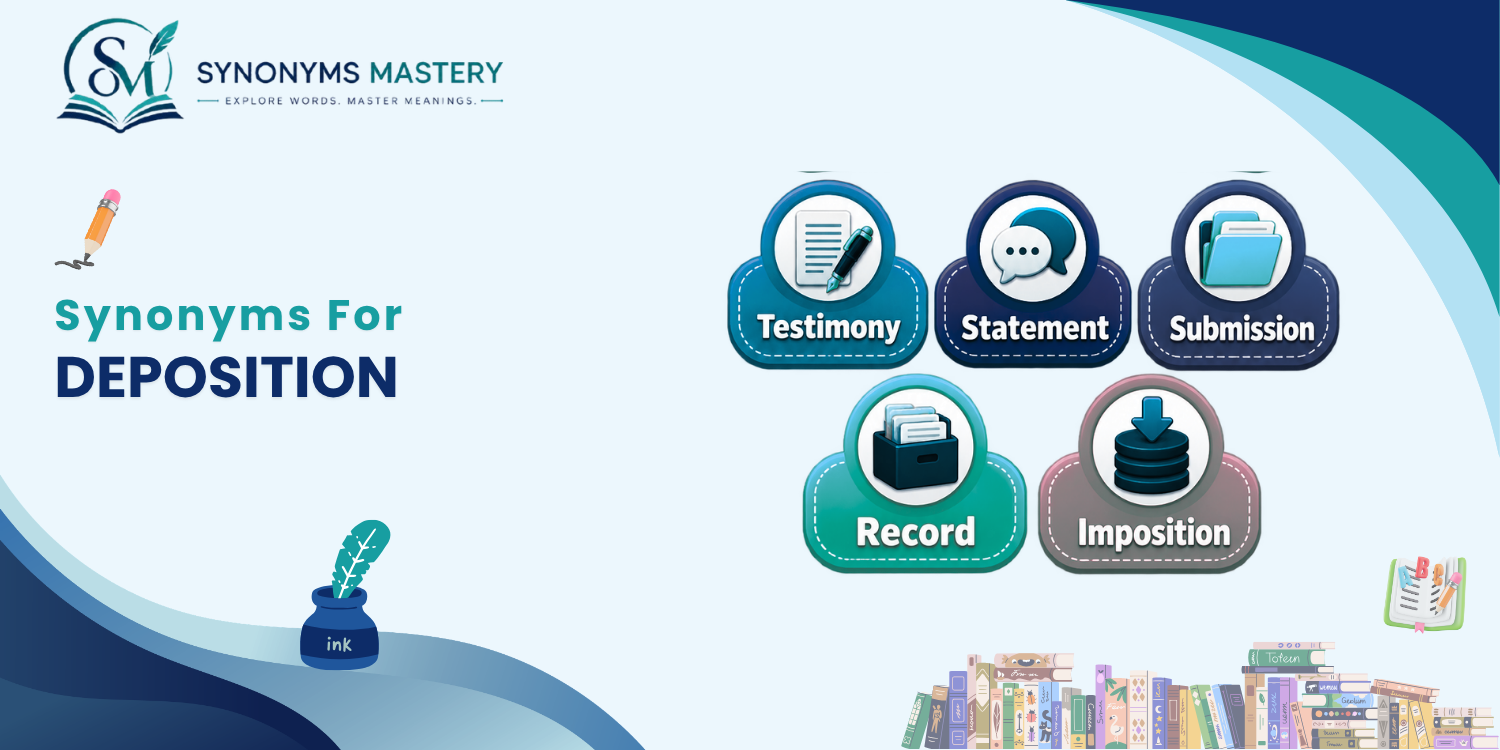
Synonyms for Deposition: Better Alternatives for Every Context
Finding a synonym for deposition is not as simple as choosing another word from a thesaurus. The noun deposition has several distinct meanings, particularly in law, politics or history, and science. A legal deposition can refer to sworn testimony, while scientific deposition describes the formation or accumulation of a substance. In historical contexts, it can also mean removing someone from a position of power. Cambridge, Collins, and Merriam-Webster all distinguish multiple senses of the word.
The best synonym therefore depends on what kind of deposition you mean. This guide separates the major meanings and explains which alternatives are genuinely interchangeable, which are only near-synonyms, and which should be used only in specific contexts.
Quick Answer: What Are the Synonyms for Deposition?
The best synonym for deposition depends on its meaning. In a legal context, the closest alternatives are testimony, statement, declaration, and, in some contexts, affidavit. For scientific or geological deposition, useful alternatives include deposit, accumulation, settling, and precipitation. When deposition means removal from a position of power, alternatives include removal, ousting, dethronement, and displacement. These words are not interchangeable across all contexts.
Deposition Synonyms at a Glance
| Word | Relationship | Meaning | Formality | Best Context |
| Testimony | Near-synonym | A person’s evidence or statements, especially under oath | Formal | Law |
| Statement | Near-synonym | Something said or written by a person | Neutral | Law, general |
| Declaration | Near-synonym | A formal or explicit statement | Formal | Law, official writing |
| Affidavit | Contextual alternative | A written statement made under oath | Very formal | Law |
| Evidence | Broader related term | Information used to establish a fact | Formal | Law |
| Deposit | Contextual synonym | Material placed or accumulated somewhere | Neutral/formal | Science, geology |
| Accumulation | Near-synonym | A gradual gathering or build-up | Neutral/formal | Science |
| Settling | Contextual alternative | Material coming to rest in a particular place | Neutral | Geology, chemistry |
| Precipitation | Technical alternative | Formation and separation of a solid from a solution | Technical | Chemistry |
| Removal | Near-synonym | The act of taking someone out of a position | Neutral/formal | Politics, history |
| Ousting | Near-synonym | Forcibly or decisively removing someone from power | Neutral/formal | Politics |
| Dethronement | Contextual synonym | Removal of a monarch from power | Formal | History, monarchy |
The distinction between these categories matters. For example, testimony can describe what a witness says, but affidavit specifically refers to a written statement made under oath. Likewise, accumulation can describe a build-up of material but does not necessarily imply the same physical process as deposition.
What Does Deposition Mean?
Deposition is a noun with several meanings.
In law, it refers to a statement made under oath by a witness or party, generally during a legal proceeding outside the courtroom. Merriam-Webster defines the legal sense as a statement made under oath in response to oral examination or written questions, while Cambridge describes it as a formal written statement made or used in court.
In science and geology, deposition refers to the process of material being deposited or a layer of material being formed. Cambridge gives examples involving soil and rock, while Merriam-Webster includes the broader sense of a process of depositing something.
In political or historical contexts, deposition can mean removing a person from a position of authority. Thesaurus sources list terms such as removal, ousting, and dethronement for this sense.
1. Synonyms for Deposition in Law
When deposition refers to sworn legal testimony, the closest alternatives are testimony, statement, declaration, and, in limited contexts, affidavit.
Testimony
Testimony is probably the most useful broad alternative when referring to what a witness says as evidence.
Example:
The witness’s deposition was consistent with her earlier testimony.
However, testimony is broader than deposition. Testimony can be given in court or in other formal settings, whereas a deposition is a particular legal procedure.
The Federal Rules of Civil Procedure recognize that deposition testimony can later be used in court under specified circumstances.
Statement
Statement is a broader and less technical alternative.
The attorney reviewed the witness’s deposition before the hearing.
could become:
The attorney reviewed the witness’s statement before the hearing.
But the second sentence is less precise because a statement does not necessarily involve sworn testimony or a formal deposition procedure.
Declaration
Declaration works when the emphasis is on a formal assertion or account.
The deposition contained an important statement about the incident.
A suitable alternative in some contexts may be:
The declaration contained an important statement about the incident.
The two words overlap, but declaration does not automatically mean a deposition.
Affidavit
Affidavit is a particularly important near-synonym, but it should not be treated as an exact substitute.
An affidavit is a written statement made under oath. A legal deposition also involves sworn testimony, but the procedures and circumstances are different. Merriam-Webster specifically distinguishes depositions from affidavits by noting the procedural opportunity for the opposing party to examine the deponent.
Use “affidavit” when: you specifically mean a sworn written statement.
Do not automatically replace “deposition” with “affidavit” in legal writing.
Evidence
Evidence is related but broader.
A deposition may provide evidence, but a deposition itself is not synonymous with all evidence. Evidence can include documents, physical objects, testimony, records, and other information relevant to proving a fact.
Better choice:
The deposition provided important evidence.
rather than:
The evidence provided important deposition.
2. Synonyms for Deposition in Science and Geology
Scientific deposition describes material being placed, formed, or accumulated in a particular location.
For example:
The river carries sediment downstream, where deposition occurs.
In this context, the strongest alternatives are deposit, accumulation, settling, and, in particular scientific contexts, precipitation.
Deposit
Deposit is one of the closest alternatives when deposition refers to material being left behind.
The process caused the deposition of sediment.
can sometimes become:
The process caused the deposit of sediment.
However, the grammatical structure often needs to change. Deposition commonly names the process, while deposit can refer to the material that has been left behind.
Accumulation
Accumulation emphasizes the gradual build-up of material.
The deposition of sediment increased near the riverbank.
can become:
The accumulation of sediment increased near the riverbank.
The meanings overlap, but accumulation focuses more on the resulting build-up than on the specific physical process of deposition.
Cambridge lists accumulation alongside deposit for the geological/scientific sense.
Settling
Settling works when particles move downward or come to rest.
Sediment deposition occurred at the bottom of the lake.
A context-specific alternative could be:
Sediment settling occurred at the bottom of the lake.
This is especially natural when discussing particles suspended in water or another fluid.
Precipitation
Precipitation is a technical alternative in certain chemical contexts, not a universal synonym.
It can describe a dissolved substance forming a solid and separating from a solution. Collins lists precipitation as a technical synonym in the context of deposition.
Therefore, use precipitation only when the scientific process actually involves that mechanism.
3. Synonyms for Deposition Meaning Removal From Power
A less common meaning of deposition is the removal of someone from a position of authority.
For example:
The king’s deposition changed the course of the country’s history.
Here, appropriate alternatives include:
- removal
- ousting
- dethronement
- displacement
- overthrow
These words have different shades of meaning.
Removal
Removal is the broadest and safest choice.
The deposition of the ruler was politically significant.
→
The removal of the ruler was politically significant.
It does not necessarily imply violence or a struggle for power.
Ousting
Ousting emphasizes forcing someone out of a position.
The president’s ousting marked a major political change.
It is generally more forceful than removal.
Dethronement
Dethronement specifically suggests removing a monarch from the throne.
The king’s deposition ended his reign.
→
The king’s dethronement ended his reign.
It is more specific than removal and is especially appropriate in historical or royal contexts.
Overthrow
Overthrow emphasizes the defeat or removal of a government, ruler, or established authority.
It can be stronger than deposition, depending on context.
Displacement
Displacement emphasizes replacing or moving someone from a position, but it does not necessarily carry the same political force as overthrow or ousting.
Which Synonym Should You Use?
The easiest way to choose the right alternative is to identify the meaning first.
| If “deposition” means… | Best alternative | Why |
| Sworn legal evidence | Testimony | Closely relates to what a witness says |
| A formal legal account | Statement | Broad and natural |
| A formal assertion | Declaration | Emphasizes an explicit statement |
| A sworn written document | Affidavit | More specific legal term |
| Information proving a claim | Evidence | Broader concept |
| Material being deposited | Deposit | Closely connected to physical material |
| Gradual build-up | Accumulation | Emphasizes increase over time |
| Particles coming to rest | Settling | Focuses on the physical process |
| Chemical solid formation | Precipitation | Technical scientific meaning |
| Removal from authority | Removal | Broadest political alternative |
| Forced removal | Ousting | Emphasizes being pushed out |
| Removal of a monarch | Dethronement | Specifically concerns a throne |
| Defeat of a ruler or government | Overthrow | Stronger political implication |
Deposition vs. Testimony
Deposition and testimony overlap in legal contexts, but they are not identical.
A deposition is a formal legal process in which a person gives sworn answers, generally during discovery outside the courtroom. Testimony is the evidence or statements given by a witness and can occur in a deposition or in court.
Compare:
The lawyer took the witness’s deposition before trial.
The witness gave important testimony about the accident.
Use deposition when referring to the formal proceeding or recorded examination. Use testimony when emphasizing what the witness said.
Merriam-Webster’s legal definition specifically describes a deposition as a sworn statement obtained through examination, while Cornell’s legal resources describe depose as questioning a person under oath during the deposition process.
Deposition vs. Affidavit
Both can involve sworn statements, but they are not interchangeable.
An affidavit is a written statement made under oath. A deposition involves formal questioning of a deponent, typically with an opportunity for the opposing side to examine that person.
Use “affidavit” when you mean the sworn written document.
Use “deposition” when you mean the formal examination and resulting testimony or record.
This distinction is particularly important in legal writing.
Deposition vs. Statement
Statement is much broader.
A statement may be casual, informal, written, spoken, sworn, or unsworn. A deposition is a specific legal procedure.
Therefore:
The witness gave a statement.
does not necessarily mean:
The witness gave a deposition.
If legal precision matters, deposition is the better word when the formal procedure is what you mean.
Deposition vs. Evidence
Evidence is an umbrella term. A deposition can be evidence or contain testimony that is later used as evidence, but evidence includes many other things.
For example:
- a document can be evidence;
- a photograph can be evidence;
- physical material can be evidence;
- testimony can be evidence;
- deposition testimony can be evidence.
Therefore, evidence is a broader related term, not a direct synonym for deposition.
Common Mistakes With Deposition Synonyms
1. Treating “affidavit” as an exact synonym
An affidavit and a deposition can both involve sworn information, but their legal procedures differ.
2. Using “testimony” for every meaning of deposition
Testimony works for the legal sense but not for geological deposition.
Incorrect:
The testimony of sediment occurred along the riverbank.
Better:
The deposition of sediment occurred along the riverbank.
3. Using “accumulation” when the process matters
Accumulation emphasizes the build-up of material. It may not describe the exact mechanism responsible for that material being deposited.
4. Using “dethronement” for every political deposition
Dethronement is especially appropriate for monarchs. It is not the natural replacement for every instance of removing an official.
5. Confusing “deposition” with “disposition”
These words are easy to confuse but have different meanings.
Deposition can refer to sworn legal testimony, material being deposited, or removal from power.
Disposition can refer to a person’s temperament, an arrangement or handling of something, or the final settlement of a matter.
They are not synonyms.
Related Words
Some words are strongly associated with deposition without being synonyms.
Legal vocabulary
- deponent
- discovery
- testimony
- witness
- transcript
- examination
- interrogatory
- affidavit
- evidence
Scientific vocabulary
- sediment
- deposit
- accumulation
- erosion
- precipitation
- settling
- layer
- sedimentation
Political vocabulary
- ruler
- authority
- removal
- ousting
- overthrow
- dethronement
- succession
These terms are useful for building vocabulary around deposition, but they should not all be presented as direct replacements.
Antonyms of Deposition
The appropriate antonym depends on the sense.
For removal from power, an approximate opposite may be appointment, accession, enthronement, or installation, depending on the context.
For scientific deposition, there is no single universal antonym. Processes such as erosion, removal, dissolution, or resuspension may represent an opposing process in particular contexts.
For the legal sense, deposition does not have a simple everyday antonym.
Pronunciation of Deposition
US: /ˌdep.əˈzɪʃ.ən/
UK: /ˌdep.əˈzɪʃ.ən/
The stress falls on the third syllable: dep-uh-ZISH-un. Cambridge provides the same core pronunciation for both US and UK English.
Frequently Asked Questions
What is the closest synonym for deposition?
There is no single synonym that works in every context.For legal deposition, testimony is often the closest broad alternative. In scientific contexts, deposit or accumulation may be more appropriate, depending on the sentence. When deposition refers to removing someone from political power, removal or ouster may be the better choice.
Is “testimony” a synonym for deposition?
It is a near-synonym in legal contexts, but the words are not identical. A deposition is a formal legal examination or the recorded statement produced through that process, while testimony refers more broadly to what a witness says as evidence.
Is “affidavit” another word for deposition?
Not exactly. Both can involve sworn statements, but an affidavit is a sworn written statement, whereas a deposition involves formal questioning of a deponent. They should not automatically be substituted for one another.
What is another word for deposition in geology?
Depending on the context, possible alternatives include deposit, accumulation, settling, and precipitation. The best choice depends on the physical or chemical process being described. Cambridge specifically lists deposit and accumulation for the geological sense.
What is a synonym for deposition in politics?
When deposition means removing someone from power, useful alternatives include removal, ousting, dethronement, displacement, and overthrow. The strongest choice depends on whether the person is a monarch, political leader, or other authority figure.
Is “statement” a synonym for deposition?
Statement can be a useful contextual alternative in legal writing, but it is broader. A statement does not necessarily involve an oath, formal examination, or legal proceeding.
What is the difference between deposition and sedimentation?
Both can describe material accumulating in a particular place, but deposition emphasizes the act or process of material being deposited, while sedimentation commonly refers to the process by which suspended particles settle and accumulate as sediment. The exact distinction can vary by scientific field.
What is the difference between deposition and disposition?
They are different words. Deposition commonly refers to sworn legal testimony, the depositing of material, or removal from power. Disposition can refer to temperament, arrangement, handling, or the settlement of something.
Conclusion
Choosing the right synonym for deposition depends on the meaning and context in which the word is used. In legal writing, testimony, statement, and declaration may work as alternatives, while affidavit is a more specific related term. In science and geology, words such as deposit, accumulation, and settling can be appropriate. When deposition refers to removing someone from power, removal, ousting, or dethronement may be better choices.
The most important point is that these words are not interchangeable in every sentence. A good synonym should preserve the original meaning, grammatical function, tone, and context. Instead of choosing the longest or most sophisticated alternative, select the word that communicates your intended meaning most precisely.

Chloe Mitchell is a professional content writer with expertise in building clear and engaging vocabulary resources. She focuses on creating easy-to-read synonym guides, helping users understand word meanings quickly. Her writing style is simple, user-friendly, and optimized for search engines.