Synonyms for Contradict: 25+ Alternatives With Meanings and Examples
Finding the right synonym for contradict depends on what you want to express. Sometimes you want to say that someone disagrees with a statement. In other situations, you need a stronger word that challenges an argument, disproves a claim, or shows that two facts cannot both be true.
Words such as dispute, deny, refute, and rebut are useful alternatives, but they do not mean exactly the same thing. Understanding these differences will help you choose more precise vocabulary for everyday conversations, academic writing, professional communication, and formal arguments.
Quick Answer: What Are Synonyms for Contradict?
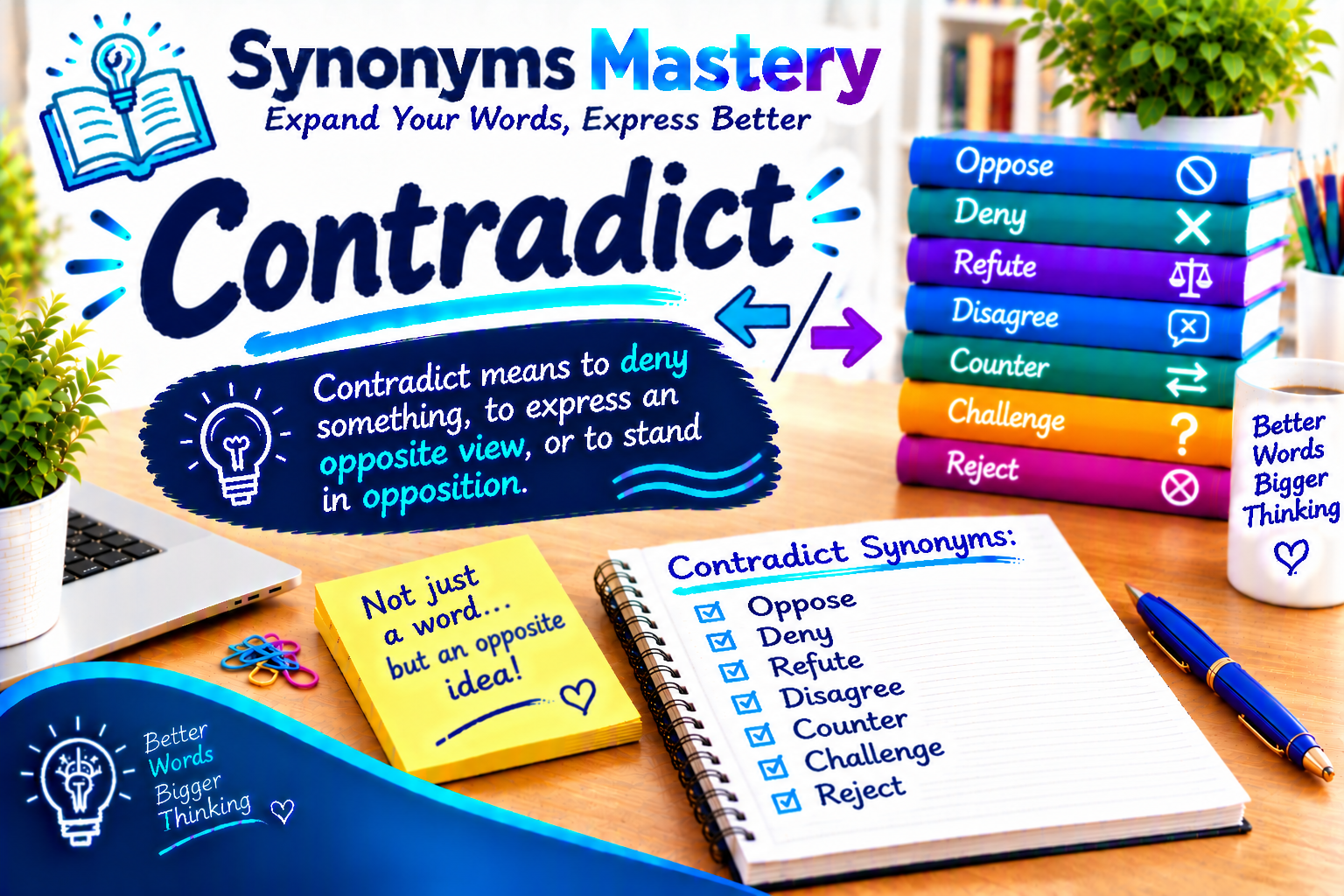
Common synonyms for contradict include dispute, deny, refute, rebut, gainsay, and controvert. Other alternatives include oppose, challenge, counter, and disagree with. The best choice depends on the context: use deny to reject a statement as untrue, refute to demonstrate that a claim is false, and rebut to answer an argument with opposing reasoning.
25+ Synonyms for Contradict
| Word | Relationship | Meaning | Strength | Best Context |
|---|---|---|---|---|
| Dispute | Direct synonym | Challenge the truth or validity of something | Similar | Claims, facts, statements |
| Deny | Contextual synonym | State that something is not true | Similar | Accusations, allegations |
| Refute | Near synonym | Prove that a statement or argument is false | Stronger | Arguments, theories |
| Rebut | Near synonym | Respond to an argument with opposing reasoning | Similar | Debates, criticism |
| Gainsay | Direct synonym | Deny or contradict something | Similar | Formal writing |
| Oppose | Contextual alternative | Express disagreement or resistance | Variable | Opinions, proposals |
| Challenge | Near synonym | Question the validity or correctness of something | Variable | Assumptions, claims |
| Contest | Near synonym | Formally challenge or dispute something | Similar | Results, decisions |
| Disprove | Near synonym | Show that something is false | Stronger | Theories, claims |
| Confute | Formal synonym | Prove a statement or argument wrong | Stronger | Formal arguments |
| Impugn | Contextual alternative | Question the honesty or validity of something | Stronger | Credibility, reputation |
| Conflict with | Contextual alternative | Be incompatible with another statement or fact | Similar | Evidence, records |
| Disagree with | Contextual synonym | Hold an opposing opinion | Similar | Conversations, opinions |
The following words are organized according to how closely they match the meaning of contradict. Some are interchangeable in particular contexts, while others express more specific types of disagreement or opposition.
Core Synonyms and Near Synonyms
Important: These alternatives are not universally interchangeable. For example, refute usually suggests successfully demonstrating that something is false, while deny simply expresses rejection. Choose the word that communicates your intended meaning.
What Does Contradict Mean?
Contradict is a verb that means to state the opposite of what someone has said, deny the truth of a statement, or be inconsistent with another fact or piece of information.
It has two particularly important uses:
- Verbal contradiction: When someone directly disagrees with another person’s statement or says the opposite.
- Factual contradiction: When two statements, facts, or pieces of evidence are inconsistent with each other.
Examples:
- The witness contradicted the defendant’s account of the incident.
- The latest research contradicts the earlier findings.
- His actions contradict his promises.
- You are contradicting yourself by giving two different explanations.
Pronunciation (US): /ˌkɑːn.trəˈdɪkt/
Pronunciation (UK): /ˌkɒn.trəˈdɪkt/
Different Ways to Say Contradict in Different Contexts
The most suitable synonym depends on what is being challenged. A word that works in an academic argument might sound unnatural in an everyday conversation.
1. Synonyms for Contradict in an Argument
When responding to someone’s argument, use words that communicate disagreement, opposition, or a counterargument.
- Rebut: Answer an argument with opposing reasoning.
- Refute: Demonstrate that an argument is incorrect.
- Dispute: Challenge the truth or validity of an argument.
- Counter: Respond with an opposing argument.
- Challenge: Question the reasoning or assumptions behind an argument.
Examples:
- She rebutted his argument with relevant evidence.
- The researcher refuted the claim using experimental results.
- He disputed the accuracy of the speaker’s explanation.
2. Synonyms for Contradict a Statement
When someone makes a statement that you believe is incorrect, these alternatives are particularly useful.
- Deny: State that the information is not true.
- Dispute: Challenge whether the statement is correct.
- Gainsay: Formally deny or contradict something.
- Challenge: Question the accuracy of a statement.
- Take issue with: Express disagreement with a particular statement.
Examples:
- The company denied the allegations.
- She disputed his account of what happened.
- The editor challenged the accuracy of the statement.
3. Synonyms for Contradict Evidence
When facts, research, or information conflict with a claim, choose words that describe the relationship between the evidence and the claim.
- Refute: Show that a claim is false through evidence.
- Disprove: Establish that a theory or statement is incorrect.
- Conflict with: Be inconsistent with other information.
- Belie: Reveal that a statement or impression is false.
- Undermine: Weaken the credibility or strength of an argument.
Examples:
- The new findings refute the original hypothesis.
- The available records contradict his explanation.
- The investigation uncovered evidence that undermined the initial claim.
4. Formal Synonyms for Contradict
For academic papers, professional documents, and formal discussions, consider:
- Controvert
- Refute
- Rebut
- Gainsay
- Confute
- Dispute
- Impugn
Examples:
- The report controverts the assumptions underlying the proposal.
- The author rebutted the criticism in a subsequent publication.
- The findings refute the previously accepted explanation.
Some of these words, particularly gainsay and confute, are considerably less common in modern everyday English. Use them selectively.
5. Everyday Alternatives to Contradict
For ordinary conversations, simpler expressions usually sound more natural.
- Disagree with
- Deny
- Dispute
- Challenge
- Object to
- Take issue with
Examples:
- I disagree with your explanation.
- She challenged his version of events.
- He denied making that statement.
- I take issue with the conclusion, not the entire argument.
Important Synonyms Explained
1. Dispute
Meaning: To question or challenge the truth, accuracy, or validity of something.
How it differs from contradict: Dispute emphasizes challenging a claim or its validity. Contradict more directly suggests stating the opposite or presenting information that conflicts with it.
Best contexts: Claims, statements, facts, decisions, and results.
Register: Neutral to formal.
Example: The researchers disputed the accuracy of the published findings.
2. Deny
Meaning: To state that something is not true or that an alleged action did not happen.
How it differs from contradict: A denial rejects a claim, but it does not necessarily provide an opposing explanation or evidence.
Best contexts: Accusations, allegations, responsibility, and statements.
Register: Neutral.
Example: The organization denied the allegations in its official response.
3. Refute
Meaning: To demonstrate that a statement, argument, or claim is false or incorrect.
How it differs from contradict: Contradicting something means expressing an opposing statement or showing an inconsistency. Refuting it goes further by providing reasoning or evidence that establishes its weakness or falsity.
Best contexts: Research, academic writing, debates, and factual arguments.
Register: Formal and academic.
Example: The scientist refuted the theory using evidence from several experiments.
4. Rebut
Meaning: To respond to an argument or criticism with an opposing argument or evidence.
How it differs from contradict: Rebut focuses on the response to an argument, whereas contradict can simply involve saying something different.
Best contexts: Debates, legal arguments, professional discussions, and criticism.
Register: Formal to neutral.
Example: The lawyer rebutted the opposing argument with additional evidence.
5. Challenge
Meaning: To question whether something is correct, acceptable, or justified.
How it differs from contradict: Challenging something does not necessarily mean stating its opposite. It may simply involve questioning its accuracy or validity.
Best contexts: Assumptions, decisions, claims, explanations, and established ideas.
Register: Neutral to formal.
Example: The new findings challenge the assumptions behind the original study.
6. Controvert
Meaning: To dispute or argue against a statement, position, or claim.
How it differs from contradict: Controvert emphasizes formal disagreement or argument. It is much less common in everyday conversation.
Best contexts: Academic discussions, formal arguments, and scholarly writing.
Register: Very formal.
Example: The article controverts several established interpretations of the historical events.
7. Oppose
Meaning: To express disagreement with or resistance to an idea, action, or proposal.
How it differs from contradict: Opposition can involve refusing to support something without directly stating that it is false.
Best contexts: Policies, proposals, decisions, opinions, and actions.
Register: Neutral to formal.
Example: Several committee members opposed the proposed changes.
8. Belie
Meaning: To show that an appearance, claim, or impression is misleading or untrue.
How it differs from contradict: Belie often describes evidence or behavior that reveals an inconsistency rather than someone verbally disagreeing.
Best contexts: Claims, appearances, expectations, and impressions.
Register: Formal.
Example: Her calm expression belied the concern she felt about the results.
Contradict vs. Similar Words: Important Differences
Understanding these distinctions prevents you from using a synonym that changes the intended meaning.
Contradict vs. Dispute
Both words express disagreement with something, but their emphasis differs.
- Contradict: State the opposite or present information that conflicts with another statement.
- Dispute: Challenge the accuracy or validity of a statement.
Examples:
- His account contradicts the official report.
- He disputes the accuracy of the official report.
Use contradict when the information directly conflicts. Use dispute when someone questions whether the information is correct.
Contradict vs. Refute
Both can be used when challenging a claim, but refute carries a stronger implication.
- Contradict: Express the opposite or show an inconsistency.
- Refute: Demonstrate that a claim or argument is false.
Examples:
- Her statement contradicts his explanation.
- The evidence refutes his explanation.
A contradictory statement does not automatically prove the other statement false.
Contradict vs. Deny
- Contradict: Say something opposite to another statement.
- Deny: State that a claim, accusation, or alleged fact is not true.
Examples:
- The witness contradicted the previous testimony.
- The witness denied the accusation.
Use deny when rejecting an allegation. Use contradict when the statements themselves conflict.
Contradict vs. Rebut
- Contradict: Express an opposing statement.
- Rebut: Respond to an argument with opposing reasoning or evidence.
Examples:
- His explanation contradicts the original statement.
- She rebutted his argument with additional information.
A rebuttal is a response; it does not automatically establish that the opposing argument is false.
Contradict vs. Oppose
- Contradict: State the opposite or demonstrate an inconsistency.
- Oppose: Resist, disagree with, or refuse to support something.
Examples:
- The figures contradict the original estimate.
- The committee opposed the proposed changes.
Use oppose for resistance to a proposal or action, rather than a direct factual contradiction.
Which Word Should You Use Instead of Contradict?
| If you want to… | Choose | Example |
|---|---|---|
| Say the opposite of someone | Contradict | He contradicted his colleague. |
| Reject an accusation | Deny | She denied the allegation. |
| Question a claim’s validity | Dispute | They disputed the results. |
| Prove an argument wrong | Refute | The evidence refuted the claim. |
| Respond to criticism | Rebut | He rebutted the criticism. |
| Express disagreement | Disagree with | I disagree with your conclusion. |
| Resist a proposal | Oppose | They opposed the decision. |
| Question an assumption | Challenge | The study challenged the assumption. |
| Show an inconsistency | Conflict with | The records conflict with his account. |
| Weaken an argument | Undermine | The new information undermined the argument. |
Common Mistakes When Using Synonyms for Contradict
1. Treating Refute and Contradict as Identical
These words overlap, but they are not interchangeable in every situation. Contradiction identifies opposition or inconsistency, whereas refutation implies demonstrating that a claim is wrong.
2. Using Deny When You Mean Disagree
Deny generally means rejecting the truth of something, not simply having a different opinion.
- Natural: She denied the accusation.
- Natural: She disagreed with his opinion.
3. Using Oppose for Every Factual Contradiction
Oppose usually describes resistance or disagreement, not necessarily conflicting facts.
- Natural: The board opposed the proposal.
- Natural: The new evidence contradicts the proposal’s central claim.
4. Confusing Rebuttal With Proof
A rebuttal is an opposing response. It may challenge an argument without conclusively proving it false.
5. Overusing Rare Formal Words
Words such as gainsay, confute, and controvert have legitimate uses, but they can sound unnecessarily complicated in everyday writing. Prefer familiar alternatives when they communicate the meaning more clearly.
Antonyms of Contradict
Antonyms of contradict express agreement, confirmation, or support rather than opposition.
| Antonym | Meaning | Example |
|---|---|---|
| Agree | Have the same opinion | I agree with your conclusion. |
| Confirm | Establish that something is true | The results confirmed the prediction. |
| Support | Provide evidence or approval | The findings support the theory. |
| Corroborate | Provide additional evidence confirming something | The documents corroborated his account. |
| Affirm | State something positively or confidently | She affirmed the original statement. |
| Verify | Check and establish accuracy | The team verified the information. |
| Substantiate | Support a claim with evidence | The records substantiated the allegation. |
| Endorse | Express approval or support | The committee endorsed the recommendation. |
Frequently Asked Questions
1. What is the closest synonym for contradict?
Dispute, deny, and gainsay are close alternatives, depending on the sentence. Dispute works when challenging a claim, deny when rejecting its truth, and gainsay when expressing formal or literary disagreement.
2. What is another word for contradict in an argument?
Rebut, refute, dispute, and counter are useful alternatives. Choose rebut when responding to an opposing argument, refute when demonstrating that it is false, and dispute when questioning its validity.
3. What is a formal word for contradict?
Controvert, gainsay, confute, and refute are formal alternatives. However, refute and rebut are generally more recognizable in modern academic and professional writing.
4. Is dispute the same as contradict?
No. Both involve disagreement, but dispute emphasizes questioning a statement’s truth or validity, while contradict emphasizes expressing the opposite or presenting information that conflicts with it.
5. What is the difference between contradict and refute?
To contradict something is to express an opposing statement or reveal an inconsistency. To refute something is to demonstrate that it is false or incorrect through reasoning or evidence.
6. What is the opposite of contradict?
Common antonyms include agree, confirm, support, corroborate, affirm, and verify. These words express agreement, confirmation, or evidence that strengthens an existing statement.
7. What does contradict yourself mean?
To contradict yourself means to make two statements that conflict with each other. For example, saying that you never use social media and later explaining that you use it every day creates a contradiction.
8. What is a professional way to say I disagree?
Professional alternatives include I respectfully disagree, I take a different view, I question that conclusion, and I would challenge that interpretation. These expressions communicate disagreement without sounding unnecessarily confrontational.
Conclusion
The best synonyms for contradict depend on the type of disagreement you want to express. Use dispute to question a claim, deny to reject an allegation, rebut to answer an argument, and refute to demonstrate that something is false. For more formal writing, controvert and gainsay offer additional alternatives. Choosing words according to their precise meanings makes your writing clearer, more natural, and more effective.

Oliver Grant is a vocabulary researcher who focuses on uncovering the subtle differences between similar words. He specializes in synonyms, antonyms, and contextual usage, helping readers choose the most accurate word in any situation. His content is designed for writers, bloggers, and students who want to elevate their language skills and write with precision.