Synonyms of Policy: 25 Better Alternatives With Examples
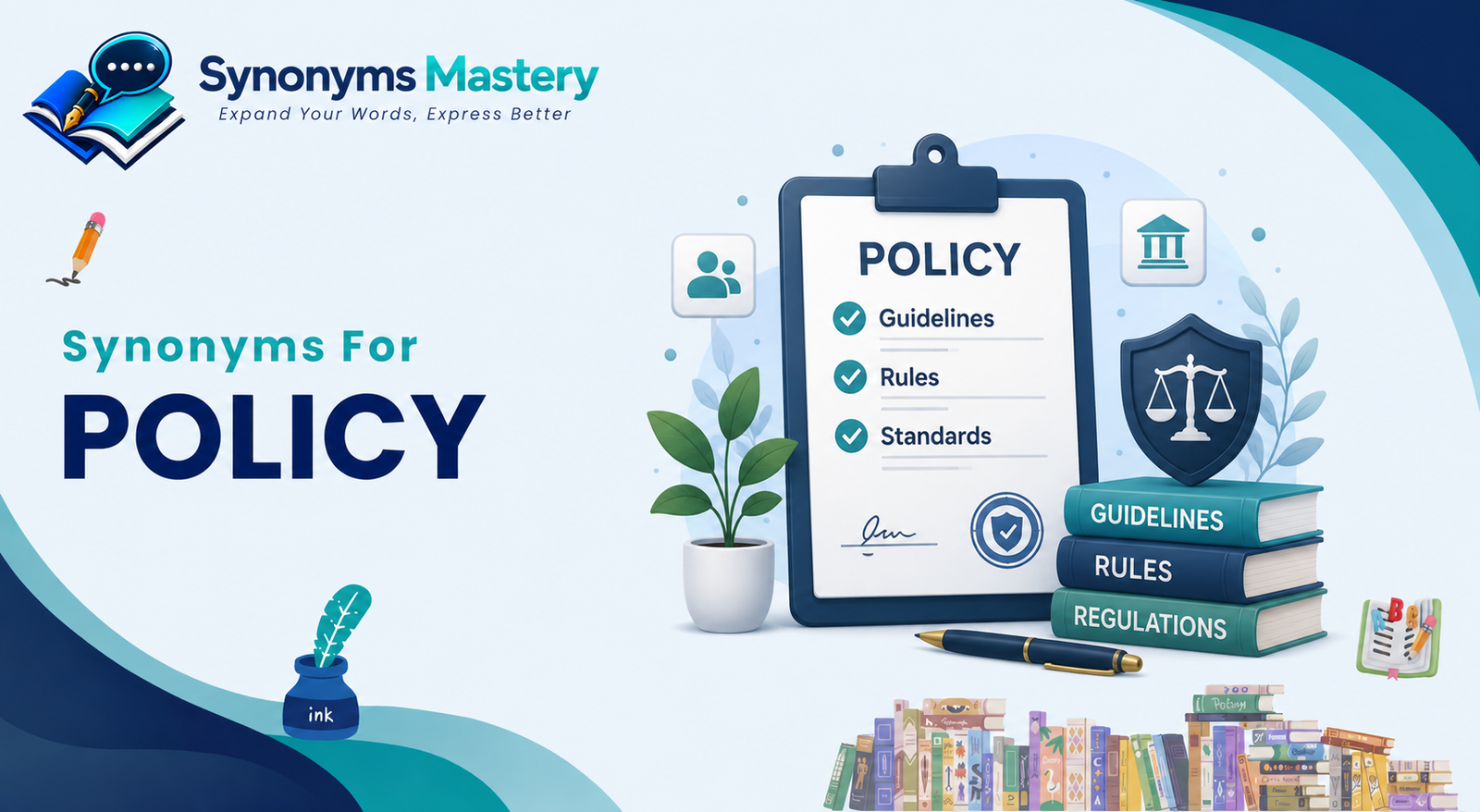
If you are looking for synonyms of policy, the best choice depends on what policy means in your sentence. Useful alternatives include plan, approach, strategy, procedure, practice, rule, guideline, code, principle, and course of action.
However, these words are not interchangeable in every context. A strategy focuses on achieving an objective, while a procedure explains how something is done, and a rule states what is required or prohibited.
Quick Answer: What Are the Best Synonyms of Policy?
The closest alternatives to policy include plan, approach, strategy, procedure, practice, rule, guideline, code, principle, program, course of action, and line. The best replacement depends on the intended meaning.
For example, approach works well for a general way of dealing with an issue, procedure emphasizes an established process, and rule emphasizes a requirement.
Major dictionaries also distinguish multiple meanings of policy. Cambridge defines it primarily as an officially agreed set of ideas or a plan for action, while Collins identifies meanings involving decision-making principles, an organization’s position or actions, and an insurance document.
Core Synonyms of Policy
| Word | Relationship | Key Difference |
|---|---|---|
| Plan | Near synonym | A proposed course of action |
| Approach | Near synonym | How an issue is handled |
| Strategy | Near synonym | Focuses on achieving a goal |
| Procedure | Contextual | Specifies how something is carried out |
| Practice | Contextual | Describes established behavior |
| Rule | Contextual | States what is required or prohibited |
| Guideline | Contextual | Provides recommended direction |
| Code | Contextual | A formal set of standards |
| Principle | Near synonym | A fundamental idea or standard |
| Course of action | Strong alternative | A chosen way forward |
| Program | Contextual | An organized set of activities |
| Method | Near synonym | Focuses on how something is done |
| Scheme | Contextual | A structured plan, sometimes negative |
| Direction | Contextual | The course an organization takes |
| Design | Contextual | Intentional arrangement or planning |
| Intention | Related | What someone intends |
| Purpose | Related | Explains why something exists |
| Methodology | Related | An organized system of methods |
| Custom | Contextual | An established way of acting |
| Action | Contextual | Focuses on what is done |
| Blueprint | Metaphorical | A detailed future plan |
| Pathway | Metaphorical | A route toward an outcome |
| Tack | Contextual | A particular way of handling a situation |
Merriam-Webster’s thesaurus includes procedure, strategy, program, methodology, method, approach, course, plan, line, scheme, intention, design, purpose, direction, blueprint, path,
pathway, and tack among similar words for one sense of policy. Collins similarly includes terms such as procedure, plan, action, program, practice, scheme, code, and line.
What Does “Policy” Mean?
Policy is a noun referring to a definite course of action, set of ideas, or officially adopted plan used to guide decisions and behavior.
For example:
- The company introduced a new remote-work policy.
- The government changed its immigration policy.
- The school has a strict attendance policy.
- It is company policy to protect customer information.
Cambridge describes policy as a set of ideas or an officially agreed plan for dealing with particular situations. Merriam-Webster similarly defines one major sense as a definite course or method of action chosen to guide present and future decisions.
The word also has a separate insurance meaning: an insurance policy is a document representing an agreement with an insurance company. In that sense, words such as plan or strategy are not suitable replacements.
The Most Useful Synonyms of Policy
1. Plan
Plan is one of the closest general alternatives when policy refers to an intended course of action.
Example:
The government announced a new plan to improve public transportation.
Difference: A plan can be specific to a particular project or objective, while a policy often provides broader principles for making repeated decisions.
2. Approach
Use approach when you mean a particular way of dealing with a problem, situation, or subject.
Example:
The company adopted a more flexible approach to employee training.
Best for: business, management, education, problem-solving, and professional writing.
3. Strategy
Strategy emphasizes deliberate action designed to achieve a goal.
Example:
The company changed its pricing strategy.
A policy can establish general boundaries for decisions, whereas a strategy usually focuses more directly on how an objective will be achieved.
4. Procedure
Procedure refers to an established way of doing something.
Example:
Employees must follow the company’s safety procedures.
This distinction is important:
Policy = what the organization requires or intends.
Procedure = how the requirement is carried out.
Calling a detailed step-by-step process a policy may therefore be less precise.
5. Practice
Practice can replace policy when you mean an established or customary way of doing something.
Example:
It is common practice for the company to review applications within five days.
Unlike policy, practice does not necessarily imply a formally adopted organizational decision.
6. Rule
Rule is appropriate when the policy is primarily a requirement that people must follow.
Example:
The company’s no-smoking rule applies to all employees.
However, rule is often narrower and more prescriptive than policy.
7. Guideline
A guideline provides advice or direction about how something should generally be handled.
Example:
The department issued guidelines for responsible use of company technology.
A guideline is often less rigid than a formal rule.
8. Code
Code works especially well when referring to a formal collection of standards for conduct.
Example:
All employees must follow the company’s code of conduct.
It is therefore a useful contextual alternative to policy, but not a universal replacement.
9. Principle
A principle is a fundamental belief, standard, or idea that guides decisions.
Example:
Transparency is a central principle of the organization’s policy.
A principle can form part of a policy without being equivalent to the entire policy.
10. Course of Action
Course of action is a useful formal alternative when referring to a selected way forward.
Example:
The committee agreed that legal action was the most appropriate course of action.
It works particularly well in formal, academic, business, and analytical writing.
Synonyms of Policy by Context
For Government Policy
When discussing government decisions, the strongest alternatives are often:
- approach
- strategy
- plan
- course of action
- direction
- line
- program
- principle
Example:
The government changed its economic policy.
The best choice depends on whether you are emphasizing the government’s general position, its intended actions, or its method for reaching an objective.
For Company Policy
For workplace and business contexts, consider:
- procedure
- rule
- guideline
- practice
- code
- approach
- standard
Example:
The company has a strict data-security policy.
Depending on the intended meaning:
These versions are related but do not mean exactly the same thing.
For Professional Writing
For formal writing, useful alternatives include:
- approach
- strategy
- course of action
- principle
- procedure
- framework
- direction
Use the word that expresses the precise relationship rather than automatically replacing policy.
Which Word Should You Use Instead of “Policy”?
Choose plan when:
You are describing intended future action.
The organization announced a five-year plan.
Choose strategy when:
You are emphasizing how an objective will be achieved.
The company developed a new marketing strategy.
Choose approach when:
You are emphasizing a general way of handling something.
The school adopted a different approach to assessment.
Choose procedure when:
You are describing the established steps for completing something.
Follow the company’s complaint-handling procedure.
Choose rule when:
You are emphasizing an obligation, restriction, or prohibition.
The school introduced a new rule against phone use.
Choose guideline when:
You are giving recommended direction rather than an absolute requirement.
The agency published guidelines for responsible AI use.
Choose principle when:
You mean a fundamental belief or standard.
Fairness is an important principle behind the policy.
Choose practice when:
You mean something an organization regularly does.
It is standard practice to review contracts annually.
Policy vs. Procedure
These two words are frequently confused.
A policy establishes a broad organizational position, requirement, or direction.
A procedure explains the process for implementing it.
Example:
Policy: Employees must protect confidential customer information.
Procedure: Employees must store customer files in the approved secure system.
In simple terms:
Policy = what/why
Procedure = how
That distinction makes procedure a useful contextual alternative but not a perfect synonym.
Policy vs. Strategy
A policy generally provides principles or a framework that guides decisions.
A strategy is a deliberate plan for achieving a particular goal.
Compare:
The company has a strict privacy policy.
This describes an organizational requirement or position.
The company developed a new privacy strategy.
This suggests a deliberate plan for achieving privacy-related objectives.
The two can overlap, but they answer different questions.
Policy vs. Rule
A rule is usually more specific and prescriptive.
The school has a policy on student attendance.
That policy might contain several rules, such as:
Students must attend at least 90% of scheduled classes.
So a rule can be part of a policy, but a policy is not necessarily just one rule.
Policy vs. Guideline
A guideline generally recommends how something should be handled.
A policy can establish a formal organizational position or requirement.
For example:
The company has a policy requiring employees to protect customer data.
versus:
The company published guidelines for protecting customer data.
The first sounds more authoritative and obligatory; the second sounds more advisory.
Common Collocations With “Policy”
Understanding common word combinations makes synonym selection easier.
Government and Politics
- government policy
- foreign policy
- economic policy
- public policy
- immigration policy
- tax policy
- social policy
- defense policy
Business
- company policy
- corporate policy
- pricing policy
- privacy policy
- employment policy
- recruitment policy
- compensation policy
- return policy
Organizations
- organizational policy
- internal policy
- official policy
- workplace policy
- safety policy
- security policy
- attendance policy
Different collocations favor different alternatives. For example, privacy policy is a highly established phrase; replacing policy with strategy or procedure may substantially change the meaning.
Common Mistakes When Choosing a Synonym for Policy
Mistake 1: Treating “procedure” as a universal synonym
A procedure describes how something is done, while a policy often describes the broader rule, position, or direction.
Mistake 2: Replacing every policy with “strategy”
A strategy normally involves achieving an objective. Not every organizational policy is strategic.
Mistake 3: Using “rule” for every policy
Policies can contain rules, but they may also contain principles, standards, objectives, and general directions.
Mistake 4: Calling a “guideline” a strict rule
Guidelines often provide recommendations rather than mandatory requirements.
Mistake 5: Ignoring the insurance meaning
In insurance policy, words such as strategy, approach, and procedure do not work as synonyms. Here, policy refers to an insurance agreement or document.
Mistake 6: Using “intention” as a direct replacement
An intention describes what someone intends to do. A policy is generally more established and structured.
Related Words That Are Not Exact Synonyms
Some words are closely associated with policy but should not automatically be presented as synonyms:
- objective — the result someone wants to achieve
- goal — a desired outcome
- standard — a level or criterion used for comparison
- framework — a structure for organizing decisions or actions
- regulation — an authoritative rule, often established by an official body
- objective — what an organization seeks to accomplish
- mission — an organization’s broader purpose
- position — a stated view or stance
- law — a legally enforceable rule
These terms can appear alongside policy, but their meanings are distinct.
Antonyms of Policy
There is no single universal antonym for policy because the word has several senses.
For the sense involving a deliberate or organized way of acting, possible contrasts include:
- inconsistency
- disorganization
- improvisation
- indecision
- lack of direction
For the older sense of policy meaning prudence or good judgment, Merriam-Webster lists antonyms and near-antonyms such as indiscretion, imprudence, carelessness, shortsightedness, and unreasonableness.
Frequently Asked Questions
What is the closest synonym for policy?
There is no single closest synonym in every context. Plan, approach, strategy, procedure, and course of action can be close alternatives depending on the sentence. For a broad organizational direction, approach or plan may work; for a detailed process, procedure is more precise.
What is another word for company policy?
Depending on the meaning, alternatives include company rule, company guideline, organizational practice, corporate standard, procedure, or code. These are not exact equivalents. A company policy may establish a broad requirement, while a procedure explains how employees implement it.
What is a formal synonym for policy?
Formal alternatives include course of action, approach, strategy, principle, framework, procedure, direction, and position, depending on context. Course of action is particularly useful in formal analytical writing when referring to a selected way forward.
Is “strategy” a synonym for policy?
Strategy can be a near-synonym, but it is not interchangeable with policy in every context. A strategy normally focuses on achieving an objective, whereas a policy establishes principles, directions, or requirements that guide decisions.
Is “procedure” another word for policy?
Not exactly. A procedure explains how an action should be performed, while a policy generally establishes the broader organizational direction, requirement, or position. A policy may therefore be implemented through one or more procedures.
Is “rule” the same as policy?
No. A rule is usually a specific requirement or prohibition. A policy can be broader and may contain several rules, principles, standards, or procedures.
What is a synonym for government policy?
Depending on context, useful alternatives include government approach, government strategy, government plan, policy direction, course of action, and government program. The appropriate term depends on whether you mean the government’s overall position, its plan, or a specific initiative.
What is a synonym for policy in business?
In business writing, possible alternatives include approach, strategy, procedure, guideline, practice, rule, standard, code, and plan. The correct choice depends on whether the original policy describes an objective, process, requirement, recommendation, or organizational position.
Conclusion
The best synonyms of policy are not interchangeable. Plan emphasizes intended action, strategy emphasizes achieving an objective, approach describes a way of handling an issue, procedure explains how something is done, rule states a specific requirement, and guideline provides recommended direction.
For accurate writing, choose the alternative that preserves the original meaning rather than simply selecting the word that looks most similar in a thesaurus. That context-first approach produces clearer, more natural English.

Chloe Mitchell is a professional content writer with expertise in building clear and engaging vocabulary resources. She focuses on creating easy-to-read synonym guides, helping users understand word meanings quickly. Her writing style is simple, user-friendly, and optimized for search engines.