
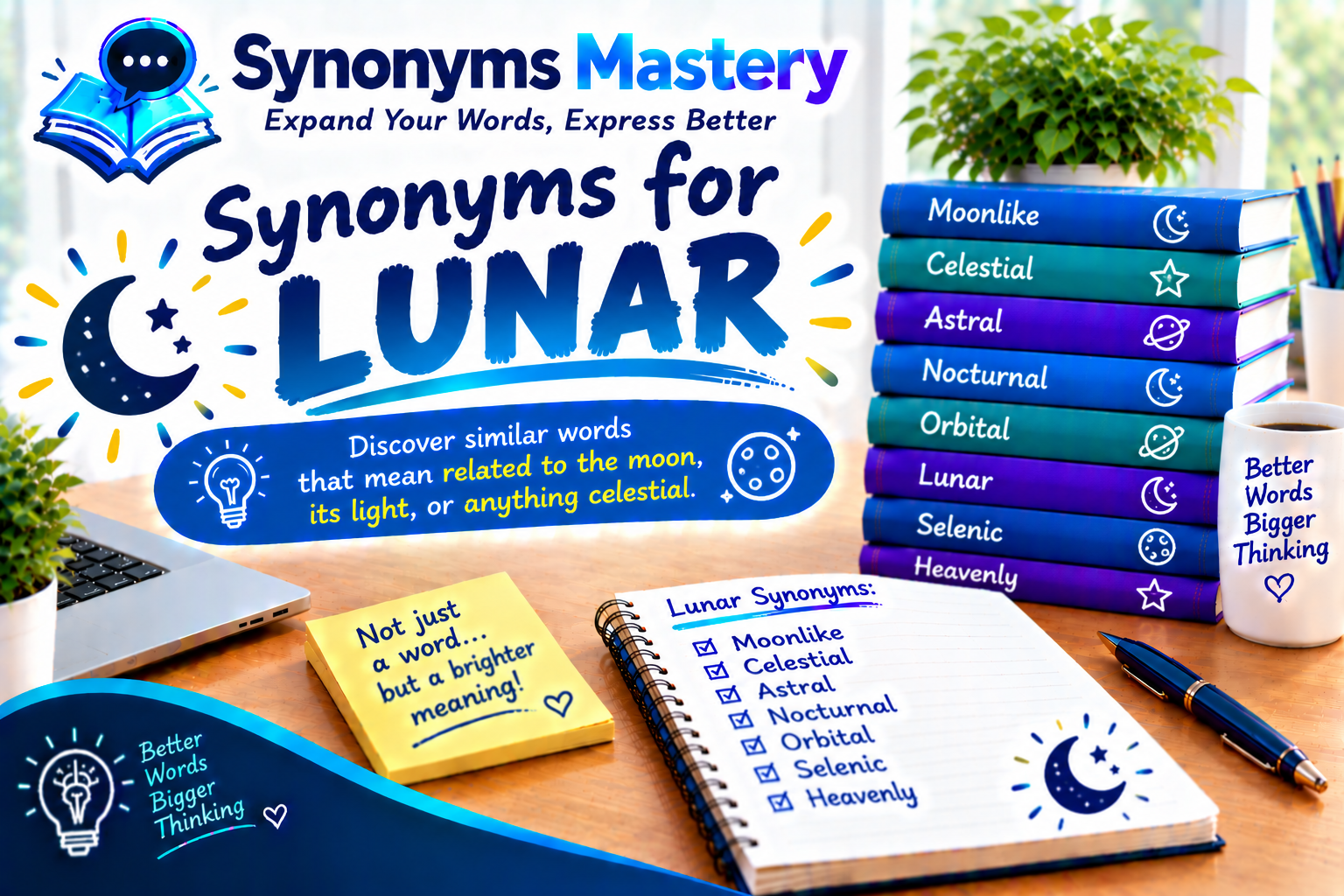
Synonyms of Lunar: Precise Alternatives With Examples
If you are looking for synonyms of lunar, the best alternative depends on what you mean by the word. Lunar is an adjective that means “of or relating to the Moon,” and it is especially common in astronomy, science, calendars, and technical writing.
Some alternatives are close in meaning, while others work only in specific contexts. For example, moon-related is a clear plain-English alternative, moonlike describes something that resembles the Moon, and selenian is a rare technical or literary adjective meaning related to the Moon.
This guide explains the most useful alternatives to lunar, shows where each one fits, and highlights words that are related to lunar but should not be treated as exact synonyms.
Quick Answer
The closest practical alternatives to lunar include moon-related, moon-based, moonlike, selenian, selenic, and lunary. However, they are not interchangeable in every sentence. Moon-related is best for plain English, moon-based works for systems or measurements based on the Moon, and moonlike is better when describing something that resembles the Moon.
What Does Lunar Mean?
Lunar is an adjective meaning of, relating to, or associated with the Moon. Cambridge and Oxford both define it in terms of a connection with the Moon, while Collins also records senses involving things occurring on the Moon, being measured by the Moon’s movements, or resembling the Moon.
Common expressions include:
- lunar eclipse
- lunar surface
- lunar cycle
- lunar calendar
- lunar crater
- lunar mission
- lunar orbit
- lunar landscape
- lunar month
- lunar year
For example:
Scientists studied the lunar surface.
This means that scientists studied the surface of the Moon.
The word can also describe something that resembles the Moon:
The volcanic landscape looked almost lunar.
Here, lunar suggests a stark or Moon-like appearance rather than a literal location on the Moon.
Synonyms and Alternatives for Lunar
Not every word below is a direct synonym. The table separates close equivalents from context-specific alternatives so you can choose the most accurate word.
| Word or Phrase | Relationship | Meaning | Best Context |
|---|---|---|---|
| Moon-related | Contextual alternative | Connected with the Moon | General writing |
| Moon-based | Contextual alternative | Based on the Moon or its cycles | Calendars, systems, measurements |
| Moonlike | Near synonym | Resembling the Moon | Appearance or atmosphere |
| Selenic | Rare/specialized synonym | Relating to the Moon | Scientific or literary writing |
| Selenian | Rare synonym | Relating to the Moon | Technical or literary contexts |
| Lunary | Obsolete/rare synonym | Relating to the Moon | Historical or literary writing |
| Moonish | Rare/contextual | Resembling or characteristic of the Moon | Literary description |
| Moonly | Rare/literary | Related to or characteristic of the Moon | Poetic writing |
| Moon-based | Context-specific | Determined by lunar cycles | Timekeeping and calendars |
| Moon-related | Plain-English paraphrase | Associated with the Moon | General audiences |
The most important point is that lunar is usually the best choice when you simply mean “related to the Moon.” Replacing it with a rarer word can make a sentence less natural rather than more sophisticated.
1. Moon-Related
Moon-related is one of the clearest plain-English alternatives to lunar. It means connected with or associated with the Moon.
It works particularly well when writing for a general audience that may find lunar less familiar.
Example:
The museum features an exhibit about moon-related discoveries.
This is understandable, but the original lunar discoveries would usually sound more concise in scientific writing.
Best for:
- General audiences
- Educational explanations
- Plain-English writing
- Informal explanations
Lunar vs. moon-related
The spacecraft collected lunar samples.
The spacecraft collected moon-related samples.
The first sentence normally suggests samples from the Moon. The second is broader and could refer to samples connected with Moon research without necessarily coming from the Moon.
2. Moon-Based
Moon-based is useful when something is based on the Moon, its cycles, or its movements.
It is especially useful when discussing calendars, timekeeping systems, or measurements.
Example:
The culture uses a moon-based calendar.
You can also say:
The culture uses a lunar calendar.
The second version is the established and more concise expression.
Best for:
- Calendars
- Timekeeping
- Systems based on lunar cycles
- Plain-English explanations
Important distinction
Moon-based should not replace lunar in every sentence.
For example:
lunar surface
cannot naturally become:
moon-based surface
The meaning changes completely.
3. Moonlike
Moonlike means resembling the Moon, especially in appearance, shape, color, or atmosphere.
It is therefore a useful alternative when lunar is being used descriptively rather than technically.
Example:
The barren landscape had a moonlike appearance.
This means the landscape looked similar to the Moon.
Compare:
The spacecraft photographed a lunar landscape.
Here, lunar means the landscape was on the Moon.
The desert had a moonlike landscape.
Here, moonlike means the desert resembled the Moon’s landscape.
Best for:
- Appearance
- Shape
- Atmosphere
- Creative writing
- Descriptive writing
Moonlike is not a universal synonym for lunar because it emphasizes resemblance rather than a direct connection to the Moon.
4. Selenic
Selenic is a rare and specialized adjective meaning relating to the Moon. It comes from Selene, the Greek goddess associated with the Moon.
This word may appear in technical, scientific, or literary contexts, but lunar is much more familiar to most English speakers.
Example:
The paper discusses selenic activity on the Moon.
Best for:
- Specialized scientific writing
- Literary contexts
- Technical vocabulary
For ordinary readers, however, this sentence is clearer as:
The paper discusses lunar activity on the Moon.
Use selenic only when its specialized register is appropriate.
5. Selenian
Selenian is another rare adjective meaning of or relating to the Moon. Collins labels it as rare and defines it as “of the moon; lunar.”
Example:
The novel describes a fictional selenian civilization.
The word can add a specialized or literary tone, but it is not normally the first choice in everyday English.
Best for:
- Literary writing
- Specialized terminology
- Science fiction
- Historical or technical contexts
For most readers, lunar remains clearer.
6. Lunary
Lunary is a rare or obsolete adjective related to the Moon. It has historical and literary value but is uncommon in modern everyday English.
Example:
The poem contains several lunary images.
Because lunary is uncommon, replacing lunar with it can make modern writing sound unnecessarily archaic.
Best for:
- Historical texts
- Literary writing
- Specialized vocabulary discussions
Modern alternative
For most modern writing, choose lunar instead.
7. Moonish
Moonish can describe something that has a quality associated with the Moon or resembles it.
It is much less common than lunar and can sound literary or unusual.
Example:
The artist used a moonish glow throughout the painting.
If the goal is simple and natural English, moonlike or lunar will usually be better choices.
Best for:
- Creative writing
- Poetic descriptions
- Unusual stylistic effects
8. Moonly
Moonly is a rare literary adjective associated with the Moon.
It can work in poetic or imaginative writing, but it is not a normal replacement for lunar in everyday or academic English.
Example:
A moonly glow covered the quiet garden.
For standard writing, a more natural option would be:
A moonlit glow covered the quiet garden.
This also shows why a word can be semantically related without being a practical synonym.
Lunar Synonyms by Context
The most useful way to choose an alternative is to consider what lunar is describing.
For Astronomy and Science
Use lunar in most scientific contexts.
Examples:
- lunar surface
- lunar orbit
- lunar crater
- lunar mission
- lunar samples
- lunar exploration
A plain-English paraphrase is often:
related to the Moon
For example:
Scientists analyzed lunar soil.
can be explained as:
Scientists analyzed soil from the Moon.
The second sentence is clearer for a general audience, while lunar soil is more concise for technical writing.
For Calendars and Time
When something is based on the Moon’s cycles, lunar and moon-based can both work.
The festival follows a lunar calendar.
The festival follows a moon-based calendar.
The first is more conventional. The second is useful when explaining the concept to readers who may not know what lunar means.
Oxford lists calendar, crater, and cycle among common nouns used with lunar.
For Appearance
When you mean that something resembles the Moon, moonlike is often more precise.
The cratered landscape looked moonlike.
This differs from:
The spacecraft photographed a lunar landscape.
The first describes resemblance. The second describes an actual connection to the Moon.
For General Audiences
Choose moon-related when clarity matters more than brevity.
For example:
The documentary explores moon-related discoveries.
This is easy for general readers to understand.
In more polished scientific writing, however:
The documentary explores lunar discoveries.
is shorter and more conventional.
Lunar vs. Moonlike vs. Moon-Related
These three alternatives are easy to confuse.
| Word | Main Meaning | Example |
|---|---|---|
| Lunar | Relating to the Moon | lunar surface |
| Moonlike | Resembling the Moon | moonlike landscape |
| Moon-related | Connected with the Moon in some way | moon-related research |
Choose lunar when:
The thing is directly associated with the Moon or occurs on the Moon.
Choose moonlike when:
You are emphasizing resemblance.
Choose moon-related when:
You want a broad, plain-English description of a connection with the Moon.
Lunar vs. Selenic vs. Selenian
All three can refer to the Moon, but their usage differs significantly.
| Word | Register | Modern Naturalness | Best Use |
|---|---|---|---|
| Lunar | Neutral/scientific | Very high | Almost all standard contexts |
| Selenic | Specialized/rare | Low | Technical or literary writing |
| Selenian | Rare | Low | Specialized or literary contexts |
For normal communication, lunar is the safest choice.
The rarer alternatives are useful mainly when a specialized vocabulary choice is intentional.
Which Word Should You Use?
Which Word Should You Use?
“Lunar” is the standard choice when you need an adjective meaning related to the Moon.
For a general audience, “moon-related” provides a simple and immediately understandable alternative.
When something depends on the Moon or its cycles, particularly calendars and systems, “moon-based” can be appropriate.
If the emphasis is on resemblance to the Moon in appearance, shape, or atmosphere, “moonlike” is more precise.
In specialized or literary writing, “selenic” or “selenian” may fit when a rarer term is appropriate.
For historical or literary contexts, “lunary” can work, although it is uncommon in modern English.
Common Collocations With Lunar
Some combinations with lunar are much more natural than others.
Common scientific collocations
- lunar surface
- lunar orbit
- lunar mission
- lunar module
- lunar crater
- lunar samples
- lunar exploration
- lunar landing
- lunar rocks
- lunar soil
Time-related collocations
- lunar calendar
- lunar cycle
- lunar month
- lunar year
- lunar phase
Oxford specifically identifies common combinations such as lunar calendar, lunar crater, and lunar cycle.
These established collocations are one reason lunar is usually preferable to an unusual synonym.
Common Mistakes With Lunar Synonyms
1. Treating “celestial” as an exact synonym
Celestial means relating to the sky, heavens, or outer space. It is broader than lunar.
lunar eclipse
is specific to the Moon.
celestial event
could involve the Moon, Sun, planets, stars, or other astronomical objects.
So celestial is a related word, not a direct synonym.
2. Using “moonlike” for every meaning of lunar
Moonlike focuses on resemblance.
The landscape looked moonlike.
does not mean the landscape was actually on the Moon.
3. Using “moon-based” with physical objects
A lunar crater is not a “moon-based crater.”
Moon-based works better for systems, measurements, calendars, or activities that depend on the Moon.
4. Choosing rare words simply to sound sophisticated
Words such as selenic, selenian, and lunary are legitimate vocabulary, but they are not automatically better than lunar.
Clear, familiar language is usually preferable when the specialized term adds no useful distinction.
5. Assuming every Moon-related word is interchangeable
A word can share part of the meaning without working in the same sentence. Always consider whether you mean connected with the Moon, based on the Moon, or resembling the Moon.
Is Lunar the Same as Moon?
No. Lunar is primarily an adjective, while Moon is a noun.
Compare:
The lunar surface is heavily cratered.
The surface of the Moon is heavily cratered.
Both are natural, but they use different grammatical structures.
The adjective lunar lets you describe a noun more concisely:
lunar landscape
lunar mission
lunar orbit
Is Moonlike a Synonym for Lunar?
Sometimes, but not generally.
Moonlike means resembling the Moon, while lunar usually means relating to or associated with the Moon. Collins also records a sense of lunar involving resemblance to the Moon, but that is only one part of the word’s broader meaning.
For example:
The desert looked moonlike.
means the desert resembled the Moon.
By contrast:
The spacecraft entered lunar orbit.
means the spacecraft entered an orbit around the Moon.
The two words cannot be freely substituted.
Antonyms and Contrasting Terms
Because lunar describes a relationship with the Moon, it does not have one simple everyday antonym.
Depending on context, useful contrasts include:
- terrestrial — relating to Earth
- earthly — relating to Earth or human life
- solar — relating to the Sun
- nonlunar — not related to the Moon
For example:
lunar environment
can contrast with:
terrestrial environment
In astronomy, solar and lunar are also frequently contrasted because they refer to the Sun and Moon respectively.
Pronunciation and Word Origin
The American pronunciation of lunar is approximately /ˈluːnər/. Cambridge gives the US pronunciation as /ˈluː.nɚ/.
The word comes from Latin lūnāris, meaning “of or pertaining to the Moon,” from lūna, meaning “moon.” Oxford and Collins both trace the word to Latin.
FAQ
What is the closest synonym for lunar?
The closest practical synonym is often moon-related, especially in plain English. In specialized vocabulary, selenic and selenian can also mean relating to the Moon, but they are rare. For most modern writing, lunar remains the clearest and most natural choice.
What is another word for lunar?
Depending on context, another word for lunar can be moon-related, moon-based, moonlike, selenic, or selenian. These words are not interchangeable, though. Moon-related describes a general connection, while moonlike emphasizes resemblance.
What is the opposite of lunar?
There is no single universal opposite of lunar. Depending on the context, terrestrial can provide a useful contrast because it refers to Earth. Solar is another common contrast when discussing the Moon and Sun.
Is “moonlike” the same as “lunar”?
No. Moonlike means resembling the Moon, while lunar usually means relating to or associated with the Moon. A landscape can be moonlike without being located on the Moon.
What is a formal synonym for lunar?
Selenic and selenian are specialized alternatives, but they are not necessarily better formal choices. In professional, scientific, and academic writing, lunar is usually the clearest standard term.
Can “celestial” replace lunar?
Usually not. Celestial has a much broader meaning and can refer to anything related to the sky or outer space. Lunar specifically identifies a connection with the Moon. Therefore, celestial is better treated as a related word rather than an exact synonym.
What is the synonym for lunar calendar?
A plain-English alternative is moon-based calendar or calendar based on the Moon’s cycles. However, lunar calendar is the standard and most concise expression.
What is a synonym for lunar landscape?
If you mean a landscape located on the Moon, Moon landscape or landscape on the Moon can explain the phrase in plain English. If you mean a landscape that resembles the Moon, moonlike landscape is more accurate.
Conclusion
The best synonyms of lunar depend on the exact meaning you want to express. Moon-related is the clearest plain-English alternative, while moon-based works for systems connected to the Moon’s cycles. When you mean resemblance rather than a direct connection, moonlike is usually more precise.
Rare terms such as selenic, selenian, and lunary have legitimate uses, but they are not better choices for ordinary writing. In most scientific, academic, and professional contexts, lunar remains the most natural and precise word. The key is to distinguish between something that is related to the Moon, based on the Moon, or merely resembles it.

Ethan Walker is a language tutor who helps learners improve their English through practical examples and real-life usage. He specializes in teaching synonyms, sentence formation, and writing clarity. His goal is to make complex vocabulary simple and usable for everyday communication.