Synonyms of Situations: 25 Better Words for Different Contexts
Finding the right synonym for situations is not always as simple as replacing one word with another. Situations can refer to circumstances, conditions, events, scenarios, positions, or even locations, depending on the sentence. That means the best alternative changes with context.
This guide explains the most useful synonyms of situations, separates true synonyms from context-specific alternatives, and shows you when to use words such as circumstances, conditions, scenarios, cases, circumstances, predicaments, states of affairs, and contexts.
Quick Answer: Synonyms of Situations
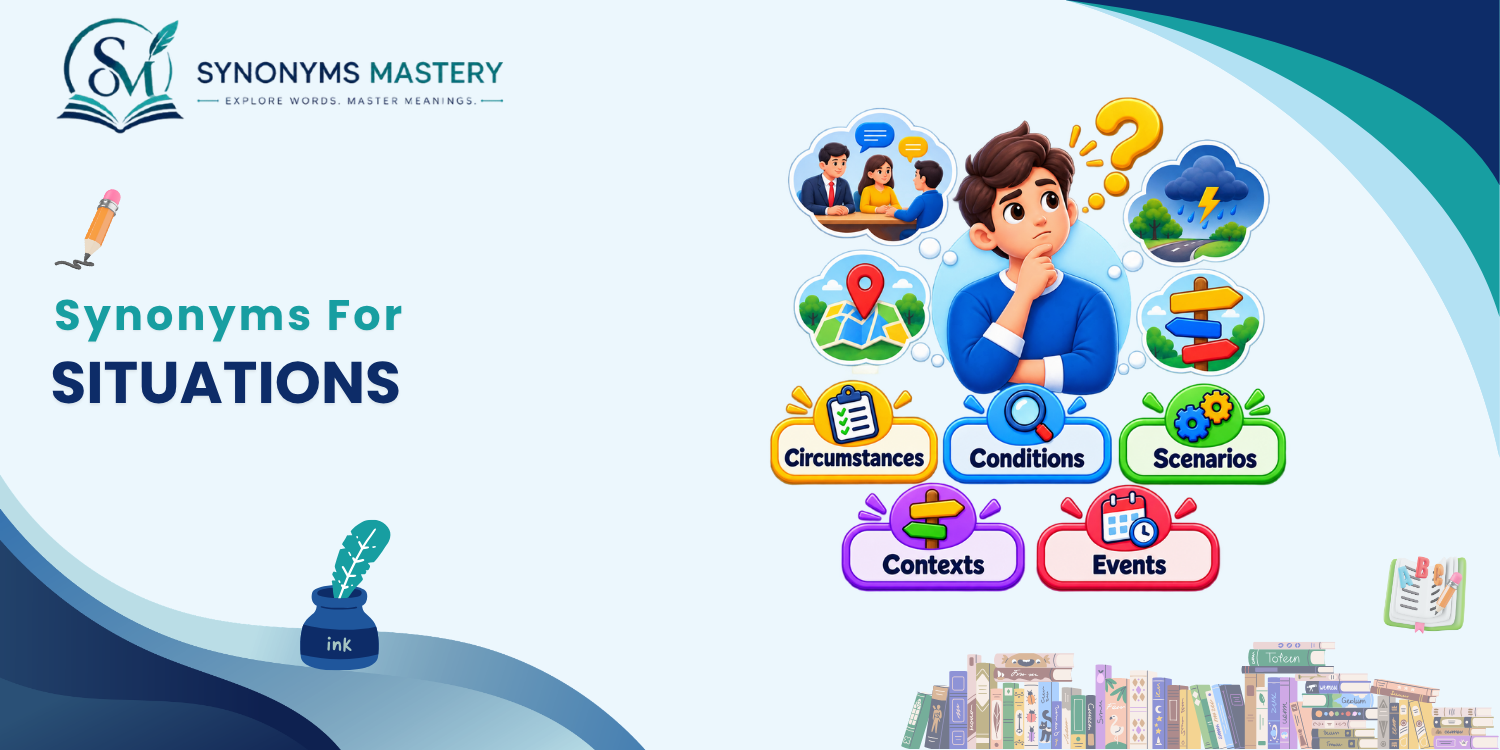
Some of the most useful synonyms of situations are:
- Circumstances — conditions surrounding an event or person
- Conditions — the particular factors or state affecting something
- States of affairs — the overall condition of things
- Scenarios — possible or imagined situations
- Cases — particular examples or instances
- Predicaments — difficult or unpleasant situations
- Contexts — surrounding circumstances that give something meaning
- States — particular conditions or situations
- Positions — circumstances in which someone finds themselves
- Events — things that happen, when the meaning involves occurrences
The closest choice depends on what situations means in your sentence.
What Does “Situations” Mean?
Situations is the plural form of the noun situation. In its most common modern sense, a situation is the combination of things happening and conditions existing at a particular time and place. Cambridge gives this as the central meaning and also identifies older uses connected with a job or position.
For example:
We need to understand the different situations people may face.
Here, situations means the different sets of circumstances or conditions people may encounter.
The word can also have other senses. Depending on context, situation can refer to a location, position, social status, employment, or a difficult state of affairs. Collins and Merriam-Webster both distinguish these different meanings.
That is why not every word listed in a thesaurus is a suitable replacement in every sentence.
Best Synonyms of Situations at a Glance
| Word | Relationship | Best Meaning | Formality | Best Context |
|---|---|---|---|---|
| Circumstances | Direct/near synonym | Conditions surrounding something | Neutral | Personal, professional |
| Conditions | Near synonym | Factors or state affecting something | Neutral | Social, economic, technical |
| States of affairs | Near synonym | Overall condition of things | Formal | Academic, professional |
| Scenarios | Contextual alternative | Possible or imagined situations | Neutral | Planning, analysis |
| Cases | Contextual alternative | Particular instances | Neutral | Academic, legal, professional |
| Predicaments | Contextual alternative | Difficult situations | Neutral | Problems, difficulties |
| Contexts | Near synonym | Surrounding circumstances | Formal/neutral | Academic, writing |
| States | Near synonym | Conditions or circumstances | Neutral | General, formal |
| Positions | Contextual alternative | Circumstances or status | Neutral | Personal, professional |
| Events | Related/contextual | Things that happen | Neutral | Occurrences |
| Occurrences | Related/contextual | Things that happen | Formal | Reports, academic writing |
| Incidents | Contextual alternative | Individual notable events | Neutral | Problems, accidents |
| Experiences | Related/contextual | Things personally encountered | Neutral | Personal situations |
| Predicaments | Contextual alternative | Difficult circumstances | Neutral | Problems |
| Plights | Contextual alternative | Difficult circumstances affecting someone | Formal/literary | Serious hardship |
1. Circumstances
Circumstances is one of the closest alternatives to situations when you mean the conditions surrounding a person, event, or decision.
Situation:
We need to consider the situation carefully.
Circumstances:
We need to consider the circumstances carefully.
The two words often overlap, but circumstances places greater emphasis on the surrounding factors that influence what is happening.
Best for: personal circumstances, financial circumstances, unusual circumstances, difficult circumstances.
2. Conditions
Conditions works when you want to emphasize the factors or state that exist at a particular time.
The economic situation is improving.
can become:
Economic conditions are improving.
This substitution is especially natural in economic, social, environmental, and technical writing.
Best for: economic conditions, working conditions, market conditions, living conditions.
3. States of Affairs
State of affairs means the overall condition or state of things. The plural form is states of affairs.
The current situation is worrying.
More formally:
The current state of affairs is worrying.
This expression is particularly useful in formal, academic, analytical, and professional writing.
4. Scenarios
Scenarios are possible, imagined, or projected situations.
We prepared for several possible situations.
can become:
We prepared for several possible scenarios.
The words are not interchangeable in every context. Scenario often implies a particular version of what might happen.
Best for: business planning, risk analysis, emergency planning, forecasting, storytelling.
5. Cases
Cases refers to particular examples or instances.
In some situations, employees may work remotely.
can become:
In some cases, employees may work remotely.
Here, cases is highly natural because the sentence refers to particular circumstances or instances.
However, case does not mean situation in every context.
6. Predicaments
Predicaments refers specifically to difficult, unpleasant, or complicated situations.
They found themselves in difficult situations.
A stronger alternative is:
They found themselves in difficult predicaments.
Because predicament already suggests difficulty, it is unnecessary to add words such as bad in most contexts.
Best for: awkward predicaments, difficult predicaments, financial predicaments.
7. Contexts
Contexts refers to the surrounding circumstances or information that helps explain something.
The word can have different meanings in different situations.
In academic or linguistic writing, you could say:
The word can have different meanings in different contexts.
This is more precise when you are discussing language, interpretation, communication, or meaning.
8. States
States can replace situations when the intended meaning is a particular condition or state.
The machine can operate in several situations.
If you mean different operating conditions, a better sentence may be:
The machine can operate in several states.
This use is especially common in science, computing, engineering, and formal descriptions.
9. Positions
Positions can mean the circumstances or place in which someone finds themselves.
I understand the difficult situation you are in.
Depending on the meaning, you might say:
I understand the difficult position you are in.
Position can also mean rank, viewpoint, physical placement, or employment, so context matters.
10. Events
Events are things that happen. They are related to situations, but they are not universal synonyms.
Several unexpected situations occurred.
If you are talking about things that happened, events may be more precise:
Several unexpected events occurred.
Use events when the focus is on occurrences rather than the surrounding circumstances.
11. Occurrences
Occurrences is a more formal word for things that happen.
The report documents unusual situations.
If the emphasis is on things that happened:
The report documents unusual occurrences.
This word is particularly suitable for formal reports, academic writing, and technical descriptions.
12. Incidents
Incidents usually refers to individual events, especially unusual, problematic, or noteworthy ones.
The company reviewed several workplace situations.
If those situations involved specific problems or events:
The company reviewed several workplace incidents.
An incident is therefore more event-focused than situation.
13. Experiences
Experiences refers to things a person personally encounters or goes through.
Children may face difficult situations at school.
could become:
Children may have difficult experiences at school.
The meaning changes slightly: situation focuses on circumstances, while experience focuses more on what the person goes through.
14. Plights
Plights refers to difficult or unfortunate circumstances affecting a person or group.
The organization helps people in difficult situations.
A more literary or formal alternative is:
The organization helps people in difficult plights.
However, plight is less common in everyday conversation, so situation or circumstances will usually sound more natural.
Which Synonym Should You Use?
The easiest way to choose the right word is to identify what you mean by situations.
Use “circumstances” when:
You mean the surrounding facts or conditions.
Under these circumstances, we should wait.
Use “conditions” when:
You are emphasizing factors or an existing state.
Economic conditions remain challenging.
Use “scenarios” when:
You mean possible or imagined situations.
We considered three possible scenarios.
Use “cases” when:
You mean individual examples or instances.
In some cases, the policy does not apply.
Use “predicaments” when:
You specifically mean difficult situations.
She found herself in an uncomfortable predicament.
Use “contexts” when:
You mean the surrounding information that affects meaning or interpretation.
The phrase has different meanings in different contexts.
Use “states of affairs” when:
You want a formal expression for the overall condition of things.
The current state of affairs requires immediate attention.
Situations vs. Circumstances
These words overlap considerably, but they are not identical.
Situation usually refers to what is happening or the overall set of conditions at a particular time and place.
Circumstances emphasizes the surrounding factors that contribute to or influence that situation.
Compare:
We need to understand the situation.
We need to understand the circumstances.
The first focuses on the overall state of affairs. The second asks you to consider the surrounding facts and conditions.
Situations vs. Scenarios
Situation normally describes something that exists or is happening.
Scenario often describes a possible, imagined, or planned version of events.
We are dealing with a difficult situation.
We prepared for several possible scenarios.
A scenario is therefore especially useful in planning and forecasting.
Situations vs. Conditions
Situation is broader.
Conditions emphasizes the factors or state that exist.
Compare:
The political situation is unstable.
Political conditions are unstable.
The second sentence sounds more analytical and focuses on the underlying conditions.
Situations vs. Circumstances vs. Scenarios
| Word | Main Focus | Example |
|---|---|---|
| Situation | What is happening | The situation is becoming serious. |
| Circumstances | Surrounding factors | Under these circumstances, we should leave. |
| Scenario | Possible version of events | The worst-case scenario is unlikely. |
This distinction is particularly useful in professional and academic writing.
Situations for Different Contexts
For difficult situations
Use:
- predicaments
- plights
- problems
- difficulties
- challenging circumstances
Example:
She handled several difficult situations calmly.
More specific:
She handled several challenging circumstances calmly.
For professional situations
Use:
- circumstances
- conditions
- cases
- scenarios
- contexts
- states of affairs
Example:
Managers must know how to respond to different situations.
More specific:
Managers must know how to respond to different workplace scenarios.
For academic writing
Prefer:
- circumstances
- conditions
- contexts
- cases
- states of affairs
Example:
The results may vary in different situations.
More academic:
The results may vary under different conditions.
For possible situations
Use:
- scenarios
- possibilities
- eventualities
- cases
Example:
We need to prepare for different situations.
More precise:
We need to prepare for different possible scenarios.
Common Mistakes When Using Synonyms of “Situations”
1. Treating every related word as an exact synonym
Words such as events, incidents, and experiences are related to situations but do not have exactly the same meaning.
2. Using “scenario” for every situation
A scenario often suggests something possible, imagined, projected, or planned.
3. Using “predicament” for neutral situations
A predicament normally involves difficulty or an awkward circumstance.
4. Using “context” when you mean an event
Context means the surrounding information or circumstances that help explain something. It does not simply mean an event.
5. Using unnecessary phrases such as “crisis situation”
In formal editing, crisis is often enough. Collins specifically notes that situation can become redundant in expressions such as “crisis situation.”
Instead of:
The company is facing a crisis situation.
prefer:
The company is facing a crisis.
This makes the sentence shorter and more precise.
Common Collocations With “Situation”
Some natural combinations include:
- difficult situation
- difficult situations
- challenging situation
- stressful situation
- dangerous situation
- awkward situation
- complicated situation
- unusual situation
- serious situation
- current situation
- present situation
- political situation
- economic situation
- financial situation
- family situation
- work situation
- emergency situation
- understand the situation
- assess the situation
- handle the situation
- deal with the situation
- improve the situation
- control the situation
- avoid the situation
- situation arises
Collins also identifies common combinations such as assess the situation, avoid a situation, and calm the situation.
Antonyms of “Situations”
There is no single perfect antonym for situations because the word has several meanings.
Depending on context, contrasting concepts may include:
- certainty
- stability
- normality
- resolution
- simplicity
- order
- clarity
For example:
The situation remains uncertain.
could contrast with:
The issue has reached a resolution.
The best opposite depends on which aspect of situation you are contrasting.
Frequently Asked Questions
What is the best synonym for situations?
Circumstances is one of the closest general alternatives when situations means the conditions surrounding a person or event. However, conditions, scenarios, cases, and contexts may be more precise in specific sentences.
What is a formal synonym for situations?
Useful formal alternatives include circumstances, conditions, states of affairs, and contexts. The appropriate choice depends on the intended meaning.
What is another word for difficult situations?
Good alternatives include predicaments, difficult circumstances, difficulties, plights, and challenging conditions. Predicament is especially useful when the situation is complicated or unpleasant.
Are “situations” and “circumstances” synonyms?
They are often near-synonyms, but they are not identical. Situation usually describes what is happening or the overall state of affairs, while circumstances emphasizes the surrounding conditions and factors.
Are “situations” and “scenarios” the same?
Not always. A situation generally exists or is happening, while a scenario often describes a possible, imagined, or projected set of events.
What is a professional synonym for situations?
Depending on the context, circumstances, conditions, scenarios, cases, and states of affairs can work well in professional writing.
What is another word for situations in academic writing?
Contexts, circumstances, conditions, cases, and states of affairs are useful academic alternatives. Choose the word that matches the precise meaning rather than replacing situations automatically.
What is the difference between situations and circumstances?
A situation is the overall set of conditions or events existing at a particular time and place. Circumstances are the surrounding facts and conditions that affect that situation.
Conclusion
The best synonym of situations depends on the meaning you want to communicate. Circumstances is a strong general alternative when you mean surrounding conditions; conditions works well for states or factors; scenarios is better for possible situations; cases works for particular instances; and predicaments is appropriate for difficult situations.
Instead of replacing situations mechanically, choose the word that expresses the exact idea you mean. That approach produces clearer, more natural, and more precise English.

Ethan Walker is a language tutor who helps learners improve their English through practical examples and real-life usage. He specializes in teaching synonyms, sentence formation, and writing clarity. His goal is to make complex vocabulary simple and usable for everyday communication.