Synonyms of Internalize: 20 Better Alternatives
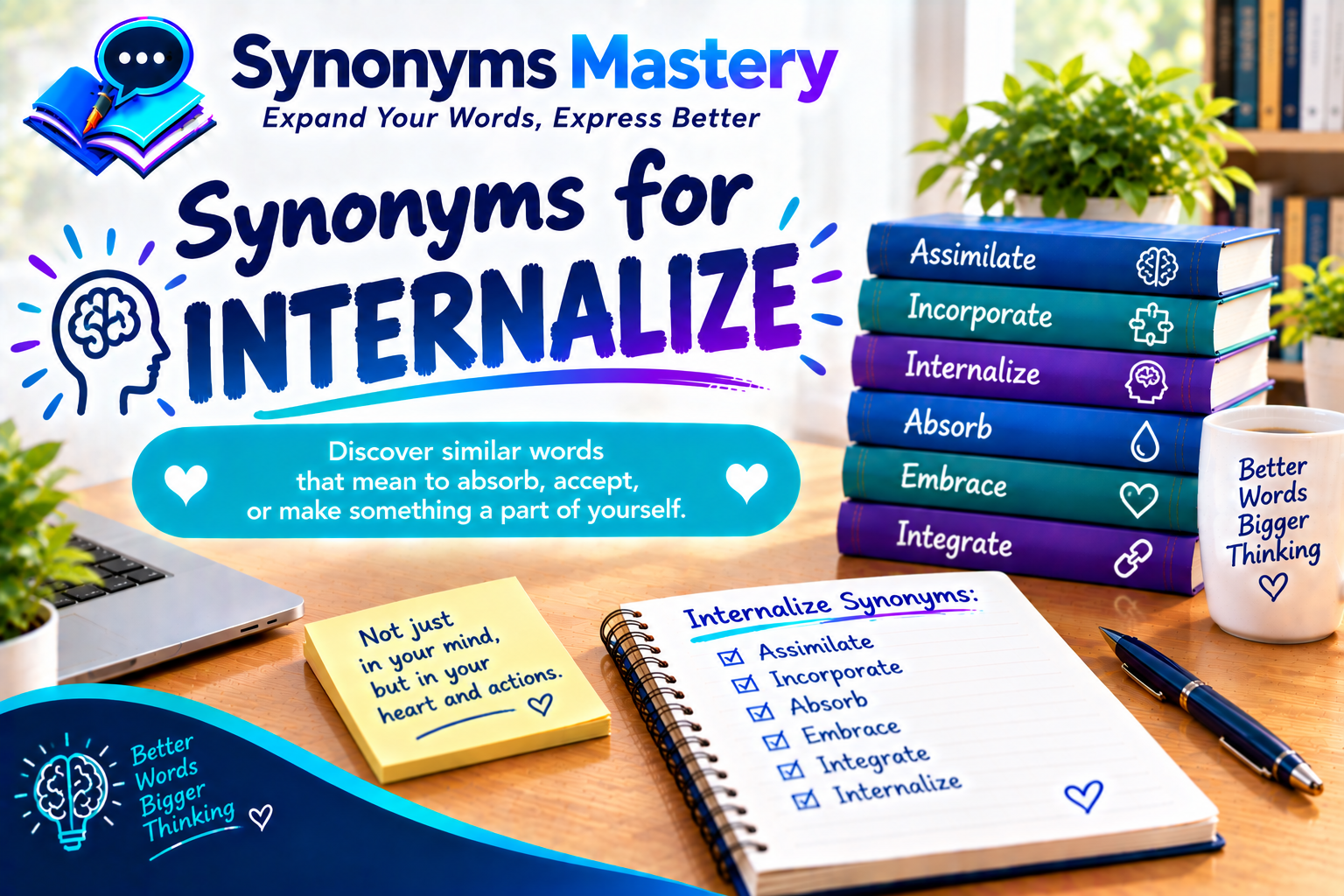
If you need synonyms of internalize, the best choice depends on what you are internalizing. When you accept an idea or belief and make it part of your thinking, absorb, assimilate, incorporate, embrace, or adopt may work. When you mean keeping emotions inside rather than expressing them, suppress, bottle up, contain, or hold in can be more appropriate. The word also has a specialized economic meaning, so context matters.
Quick Answer: What Are the Best Synonyms of Internalize?
The closest alternatives to internalize include absorb, assimilate, incorporate, integrate, take in, digest, learn, adopt, embrace, accept, embody, and process when referring to ideas, knowledge, beliefs, or values. For emotions, alternatives such as suppress, bottle up, contain, and hold in may fit better. The exact choice depends on the meaning and context.
Synonyms of Internalize at a Glance
| Word | Relationship | Meaning | Strength | Best Context |
| Absorb | Near synonym | Take in information, ideas, or knowledge | Similar | Learning and information |
| Assimilate | Near synonym | Take in and understand something fully | Similar | Knowledge and ideas |
| Incorporate | Near synonym | Make something part of a larger whole | Similar | Ideas, practices, values |
| Integrate | Near synonym | Combine something into an existing system | Similar | Knowledge and ideas |
| Take in | Contextual synonym | Receive and understand information | Similar | Everyday learning |
| Digest | Contextual synonym | Think through and understand information | Similar | Complex information |
| Learn | Broader synonym | Gain knowledge or understanding | Broader | Education |
| Adopt | Contextual synonym | Accept an idea, belief, or practice | Similar | Beliefs and approaches |
| Embrace | Contextual synonym | Accept something willingly or enthusiastically | Stronger | Ideas, values, change |
| Accept | Near synonym | Agree with or recognize something | Broader | Ideas and beliefs |
| Embody | Contextual synonym | Express a quality or idea through behavior | Different | Values and principles |
| Process | Near synonym | Think through and understand information or experiences | Similar | Information and experiences |
| Comprehend | Related alternative | Understand something | Different | Knowledge and ideas |
| Grasp | Related alternative | Understand something clearly | Different | Concepts and information |
| Digest mentally | Contextual alternative | Consider and understand difficult information | Similar | Complex ideas |
| Imbibe | Literary near synonym | Absorb ideas, beliefs, or knowledge | Similar | Formal/literary writing |
| Suppress | Contextual alternative | Prevent feelings from being expressed | Different | Emotions |
| Bottle up | Contextual alternative | Keep emotions hidden inside | Different | Informal emotional contexts |
| Contain | Contextual alternative | Control or restrain emotional expression | Different | Emotions |
| Hold in | Contextual alternative | Prevent an emotion from being expressed | Different | Everyday speech |
Cambridge’s definition centers on accepting or absorbing an idea, opinion, or belief so that it becomes part of one’s character. It separately identifies the psychological use involving emotions and a specialized business/economic meaning.
What Does Internalize Mean?
Internalize is a verb meaning to accept or absorb an idea, belief, attitude, or value so deeply that it becomes part of your thinking or character.
For example:
- She internalized the lessons from her mentor.
- He internalized the belief that hard work matters.
- The students gradually internalized the new approach.
The word can also refer to emotions. In this sense, someone internalizes an emotion when they keep it inside instead of expressing it openly.
A third, specialized meaning appears in economics and business, where internalize can mean including a cost in the calculation of producing a product or activity.
1. Absorb
Absorb is one of the closest everyday alternatives to internalize when talking about information, ideas, or knowledge.
The emphasis is on taking information in and mentally receiving it.
Example:
She quickly absorbed the new information.
Best for: Knowledge, information, lessons, and ideas.
Cambridge lists absorb among the words related to mentally assimilating information.
2. Assimilate
Assimilate means to take in and understand something so that it becomes part of your existing knowledge or thinking.
It often suggests a deeper process than simply hearing or receiving information.
Example:
Students need time to assimilate complex concepts.
Best for: Knowledge, information, concepts, and ideas.
Cambridge’s thesaurus specifically connects assimilate with absorb, take in, digest, incorporate, and integrate.
3. Incorporate
Incorporate means to make something part of a larger whole.
It is useful when an idea, practice, value, or lesson becomes part of someone’s existing approach.
Example:
The manager incorporated the feedback into her leadership style.
Best for: Ideas, feedback, practices, values, and methods.
Unlike internalize, incorporate does not necessarily imply a change in someone’s inner beliefs or character.
4. Integrate
Integrate emphasizes combining something with what already exists.
It can describe knowledge, ideas, experiences, or practices becoming part of an established system of thought.
Example:
He integrated the new information into his understanding of the subject.
Best for: Knowledge, ideas, experiences, and systems.
5. Take In
Take in is a natural, conversational alternative to absorb or internalize when talking about information.
Example:
It took her several days to take in everything she had learned.
Best for: Everyday speech, information, lessons, and experiences.
It is less formal than internalize and usually emphasizes receiving or understanding information rather than making it part of one’s character.
6. Digest
Digest can be used figuratively for thinking about and understanding difficult information.
Example:
The team needed time to digest the new policy.
Best for: Complex information, ideas, arguments, and news.
It is especially natural when someone needs time to process something before fully understanding it.
7. Learn
Learn is broader than internalize. It simply means gaining knowledge or a skill.
Example:
She learned the principles of effective communication.
You can say someone learned something without implying that they deeply accepted or incorporated it into their beliefs.
Best for: Education, skills, facts, and general knowledge.
8. Adopt
Adopt works well when internalize refers to accepting an idea, belief, practice, attitude, or approach.
Example:
The team adopted a more collaborative approach.
The key difference is that adopt emphasizes choosing or accepting something, while internalize emphasizes its becoming part of one’s thinking or character.
9. Embrace
Embrace suggests accepting something willingly, often with enthusiasm.
Example:
The organization embraced the new values.
It is stronger and more positive than internalize in many contexts.
Best for: Values, ideas, change, opportunities, and beliefs.
10. Accept
Accept is a broad alternative that works when someone comes to recognize or agree with an idea or belief.
Example:
He eventually accepted the idea that mistakes are part of learning.
However, acceptance does not necessarily mean that the idea has become deeply rooted in someone’s character.
11. Embody
Embody is useful when an internalized belief or value becomes visible through someone’s behavior.
Example:
She embodies the values she teaches.
This is not a direct synonym for internalize. Someone can internalize a value without visibly embodying it.
Best for: Values, principles, qualities, and ideals.
12. Process
Process means mentally working through information, feelings, or experiences.
Example:
He needed time to process the criticism.
It overlaps with internalize when the focus is on mentally dealing with an experience, but it does not necessarily mean that the experience becomes part of someone’s character.
13. Comprehend
Comprehend means understand something fully or clearly.
Example:
The students struggled to comprehend the complex theory.
It is a useful related word, but it should not be treated as an exact synonym. Understanding something does not necessarily mean internalizing it.
14. Grasp
Grasp is another alternative for understanding an idea or concept.
Example:
Once she grasped the principle, she could apply it confidently.
Like comprehend, it emphasizes understanding rather than the deeper process implied by internalize.
15. Digest Mentally
Digest can describe mentally taking in and working through difficult material.
Example:
Give the students some time to digest the information.
This expression works especially well when the material is complex or requires reflection.
16. Imbibe
Imbibe can mean to absorb ideas, beliefs, or knowledge. It is more literary or formal than absorb.
Example:
He imbibed the traditions of his community from an early age.
Best for: Formal, literary, and historical writing.
Collins includes imbibe among alternatives associated with absorbing ideas or information.
Suppress becomes relevant when internalize refers to emotions rather than ideas.
17. Suppress
To suppress an emotion means to prevent it from being expressed or openly shown.
Example:
She suppressed her frustration during the meeting.
This is not an exact synonym of internalize. Internalizing an emotion can involve keeping it inside, whereas suppression specifically emphasizes actively holding it back.
Cambridge distinguishes the emotional use of internalize from its meaning involving ideas and beliefs.
18. Bottle Up
Bottle up is an informal expression for keeping emotions or feelings inside.
Example:
He tends to bottle up his anger instead of talking about it.
It is much more conversational than internalize.
Best for: Everyday conversations about emotions.
19. Contain
Contain can describe controlling or restraining emotional expression.
Example:
She struggled to contain her frustration.
It focuses on controlling outward expression rather than necessarily making the emotion part of one’s inner character.
20. Hold In
Hold in is an informal alternative when someone deliberately prevents an emotion from being expressed.
Example:
He tried to hold in his disappointment.
It is natural in everyday speech but less suitable for formal writing.
Which Word Should You Use?
The right alternative depends on what happens after someone encounters an idea, emotion, or experience.
Choose “absorb” when:
The focus is on taking in information or knowledge.
Choose “assimilate” when:
The information becomes integrated with what someone already knows.
Choose “incorporate” when:
Something becomes part of an existing system, approach, or practice.
Choose “adopt” when:
Someone accepts an idea, belief, method, or approach as their own.
Choose “embrace” when:
The acceptance is willing, positive, or enthusiastic.
Choose “process” when:
Someone is mentally working through information, feelings, or experiences.
Choose “suppress” when:
The focus is specifically on preventing an emotion from being expressed.
Internalize vs. Absorb
Internalize and absorb overlap when discussing information and ideas.
The difference is mainly depth and result. Absorb emphasizes taking information in, while internalize suggests that an idea, belief, or value becomes part of someone’s thinking or character.
- She absorbed the information during the lecture.
- She internalized the lesson and changed her approach.
Internalize vs. Assimilate
Both words can describe taking in knowledge or ideas.
Assimilate emphasizes understanding and integrating new information with existing knowledge. Internalize emphasizes making an idea, belief, or value part of one’s own thinking or character.
- The students assimilated the new material.
- The students internalized the importance of careful research.
Internalize vs. Incorporate
Incorporate means adding something to an existing whole. Internalize suggests a deeper mental or personal change.
Compare:
- The company incorporated the feedback into its policy.
- The employee internalized the lesson from the feedback.
The first describes a change to a system or practice. The second describes a change within a person.
Internalize vs. Adopt
Adopt emphasizes acceptance or choice.
Internalize emphasizes the point at which an idea or belief becomes part of someone’s thinking.
- She adopted a new approach to teaching.
- She internalized the principle behind the approach.
Internalize vs. Suppress
These words should not be treated as exact synonyms.
Internalize can describe keeping emotions inside, while suppress specifically means preventing feelings from being expressed.
For example:
- He internalized his anxiety.
- He suppressed his anger during the discussion.
The second sentence focuses more directly on controlling outward expression.
Common Collocations With Internalize
Some common patterns include:
- internalize a belief
- internalize an idea
- internalize a value
- internalize a lesson
- internalize knowledge
- internalize information
- internalize expectations
- internalize social norms
- internalize criticism
- internalize emotions
- internalize feelings
- internalize anger
- internalize anxiety
- internalize costs
The appropriate synonym changes with the noun.
For example, absorb knowledge, adopt a belief, incorporate feedback, and suppress anger are usually more natural than using one substitute for every occurrence of internalize.
Common Mistakes With Internalize Synonyms
1. Treating “understand” as an exact synonym
Understanding something does not necessarily mean that it has become part of your beliefs or character.
2. Using “suppress” for ideas
Suppress is mainly appropriate when something is being restrained or prevented from being expressed. It does not normally replace internalize when discussing knowledge.
3. Assuming “absorb” always means internalize
You can absorb information without deeply accepting or incorporating it.
4. Using “adopt” for every context
Adopt suggests acceptance or choice. It does not necessarily imply deep psychological integration.
5. Confusing “incorporate” with personal change
A company can incorporate a policy without a person internalizing the values behind it.
6. Treating “embrace” as neutral
Embrace often suggests willing or enthusiastic acceptance, giving it a stronger positive tone than internalize.
Antonyms of Internalize
The opposite depends on the sense.
For ideas or beliefs, possible contrasts include:
- reject
- dismiss
- disregard
- refuse to accept
- externalize
For emotions, contrasting expressions may include:
- express
- voice
- communicate
- let out
- share
Cambridge’s related-word information also identifies contrasts such as reject and keep out for the mental-absorption sense.
Frequently Asked Questions
What is the closest synonym for internalize?
For ideas, beliefs, or knowledge, absorb and assimilate are among the closest alternatives. Incorporate and integrate work when something becomes part of an existing system of thought or practice. The best choice depends on whether the sentence emphasizes receiving, understanding, accepting, or deeply adopting something.
What is another word for internalize an idea?
Depending on the context, you can say absorb, assimilate, adopt, embrace, accept, incorporate, or integrate an idea. Adopt emphasizes acceptance, while assimilate emphasizes understanding and integration. Internalize is especially useful when the idea becomes part of someone’s own thinking or beliefs.
What is a synonym for internalize knowledge?
Useful alternatives include absorb, assimilate, learn, take in, digest, incorporate, and understand. Absorb is natural for taking in information, while assimilate suggests integrating new knowledge with what you already know.
What is another word for internalize feelings?
For the emotional sense, alternatives include suppress, bottle up, contain, hold in, and keep inside. These are not perfect synonyms. Suppress emphasizes preventing expression, while bottle up is informal and suggests keeping emotions hidden rather than openly dealing with them.
Is absorb the same as internalize?
Not always. Absorb usually means taking in information, knowledge, or ideas. Internalize goes further by suggesting that an idea, belief, or value becomes part of someone’s thinking or character. You can absorb information without necessarily internalizing it.
Is assimilate a synonym for internalize?
Assimilate can be a close synonym when the subject is knowledge, information, or ideas. It emphasizes taking something in and integrating it with existing knowledge. Internalize has a stronger focus on something becoming part of a person’s thinking, beliefs, or character.
What is the difference between internalize and incorporate?
Incorporate means to make something part of a larger whole, system, or approach. Internalize usually refers to something becoming part of a person’s thinking, beliefs, values, or character. A company can incorporate feedback, while an employee can internalize the lesson behind that feedback.
Is internalize a formal word?
Yes. Internalize is generally a formal or neutral-formal word, especially when discussing beliefs, values, psychology, education, or social behavior. In everyday conversation, simpler alternatives such as take in, absorb, accept, or learn may sound more natural depending on the context. Cambridge labels the word as formal.
Conclusion
The best synonyms of internalize depend on what is being taken inward. Use absorb or assimilate for knowledge, adopt or embrace for ideas and beliefs, and incorporate or integrate when something becomes part of an existing system. For emotions, words such as suppress or bottle up may fit, but they carry different meanings. Choosing the right alternative requires matching the synonym to the specific context.

Ethan Walker is a language tutor who helps learners improve their English through practical examples and real-life usage. He specializes in teaching synonyms, sentence formation, and writing clarity. His goal is to make complex vocabulary simple and usable for everyday communication.