Synonyms for Truce: 15 Better Alternatives With Examples
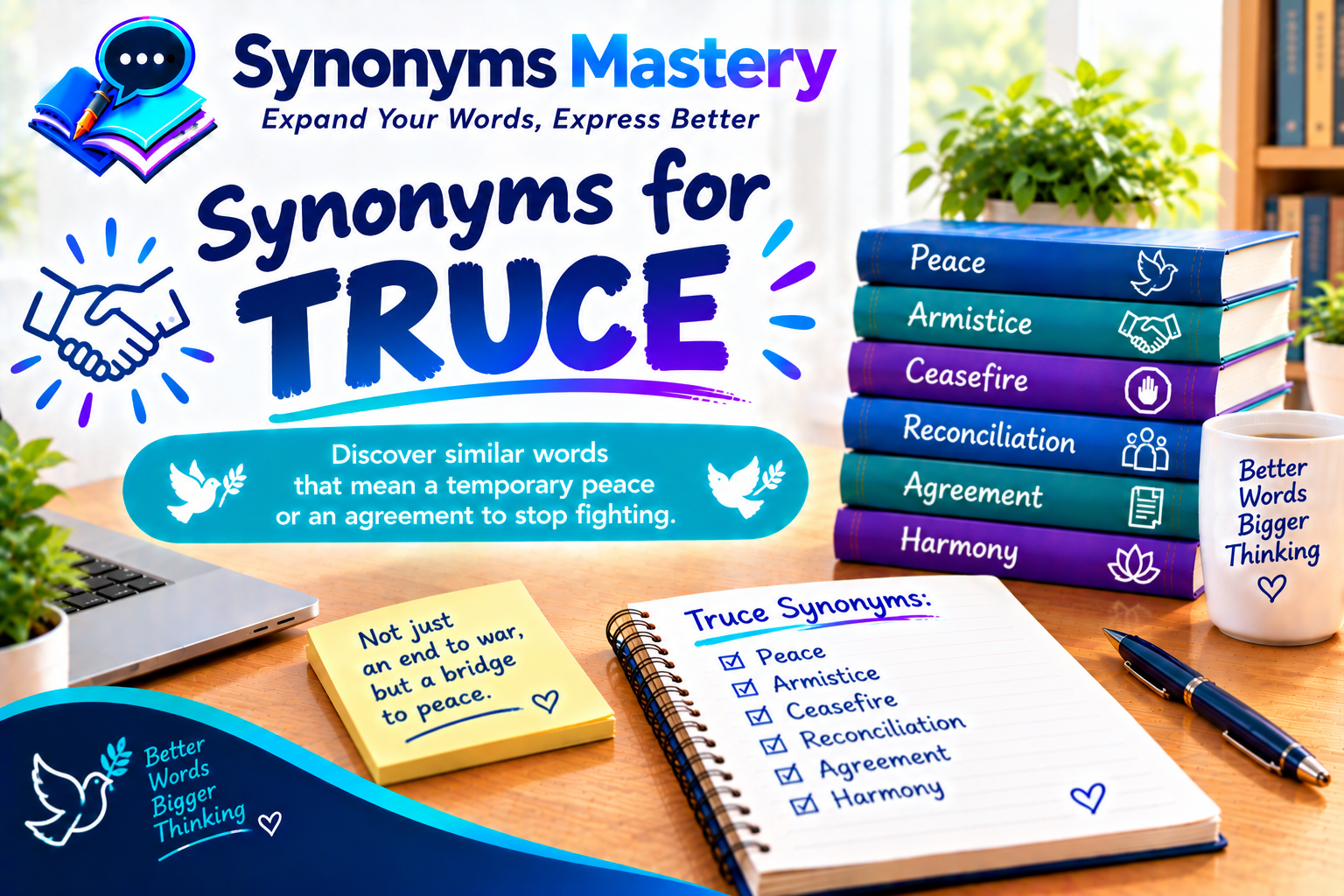
Finding the right synonym for truce depends on what kind of conflict you are describing. Ceasefire and armistice are the closest alternatives when opposing sides agree to stop fighting. In less formal situations, words such as pause, break, respite, or lull may work when you mean a temporary interruption rather than a formal agreement. Other words, including peace, treaty, and moratorium, are related but have different meanings. This guide explains the differences so you can choose a natural alternative for military conflicts, personal disagreements, formal writing, and everyday situations.
Quick Answer
The closest synonyms for truce are ceasefire and armistice. Both describe an agreement to stop fighting temporarily. Depending on context, cessation, suspension of hostilities, pause, respite, lull, break, and moratorium can also work. However, peace and treaty are related rather than exact synonyms because they can describe broader or more lasting arrangements.
15 Synonyms for Truce
| Word | Relationship | Meaning | Formality | Best Context |
| Ceasefire | Direct | Agreement to stop fighting | Neutral/Formal | War, armed conflict |
| Armistice | Direct/Near | Formal agreement to suspend hostilities | Formal | Wars, military history |
| Cessation | Near | An ending or stopping | Formal | Hostilities, conflict |
| Suspension of hostilities | Near | Temporary stopping of fighting | Very formal | Military/diplomatic writing |
| Peace | Contextual | Absence or ending of conflict | Neutral/Formal | International or personal conflict |
| Pause | Contextual | Temporary interruption | Neutral | Arguments, activities |
| Respite | Contextual | Temporary relief or break | Neutral/Formal | Conflict, difficulty |
| Lull | Contextual | Period of reduced activity or conflict | Neutral | Fighting, tension |
| Break | Contextual | Temporary interruption | Neutral | Arguments, negotiations |
| Stay | Contextual | Temporary halt or postponement | Formal | Legal/formal contexts |
| Moratorium | Contextual | Temporary suspension of an activity | Formal | Policies, actions, disputes |
| Intermission | Related | Break between parts of an activity | Neutral | Events, discussions |
| Recess | Related | Temporary break or suspension | Neutral/Formal | Meetings, proceedings |
| Let-up | Contextual | Reduction in intensity | Informal | Pressure, conflict |
| Rest | Contextual | Period of stopping or relief | Neutral | General conflict or activity |
The distinction matters because dictionaries do not treat every word in this table as interchangeable with truce. Collins, for example, lists ceasefire and armistice alongside contextual words such as break, stay, rest, and lull.
What Does Truce Mean?
Truce is a noun meaning an agreement between opposing people or groups to stop fighting or arguing for a period of time. It can describe military conflict, political or social conflict, or a less serious disagreement between individuals. Cambridge defines it as a temporary agreement or interruption involving fighting or arguing.
Oxford similarly defines truce as an agreement between enemies or opponents to stop fighting for an agreed period, and lists common expressions such as call a truce and break a truce.
Example:
The two rival groups agreed to a temporary truce.
The word can also be used informally:
After arguing all morning, the siblings finally called a truce.
The Closest Synonyms for Truce
1. Ceasefire
Ceasefire is one of the closest synonyms for truce. It refers to an agreed stopping of fighting, especially during a war or armed conflict.
Oxford directly identifies truce as a synonym of ceasefire and defines a ceasefire as a period when enemies agree to stop fighting, often while efforts are made to end the conflict permanently.
Example:
The two sides agreed to a temporary ceasefire.
Best choice: Use ceasefire when the focus is specifically on stopping armed fighting.
2. Armistice
Armistice is another very close synonym, but it usually sounds more formal and is strongly associated with wars and opposing military forces.
Cambridge defines an armistice as a formal agreement between countries or groups at war to stop fighting for a particular period, especially while discussing possible peace.
Example:
The opposing armies signed an armistice.
Best choice: Use armistice for formal military, historical, or diplomatic contexts.
3. Cessation
Cessation means a stopping or ending of something. It can replace truce in formal phrases such as cessation of hostilities, but it does not necessarily imply a mutual agreement.
Example:
The negotiators called for an immediate cessation of hostilities.
Best choice: Use cessation when formal writing emphasizes that an activity or conflict has stopped.
4. Suspension of Hostilities
Suspension of hostilities is a formal phrase meaning that fighting has been temporarily stopped.
It is particularly suitable for diplomatic, military, historical, or legal writing.
Example:
The agreement called for a temporary suspension of hostilities.
Best choice: Use this phrase when you need precise formal language for armed conflict.
Contextual Alternatives to Truce
Not every useful alternative means exactly the same thing. These words work when the surrounding context matches their particular meaning.
5. Peace
Peace is broader than truce. A truce usually means a temporary halt in conflict, whereas peace can refer to a more lasting condition in which conflict or war has ended.
Example:
The truce gave both sides an opportunity to discuss a lasting peace.
This sentence shows why the two words should not always be substituted for one another.
Use: Choose peace when the focus is on ending conflict more broadly.
6. Pause
Pause means a temporary interruption. It can describe an argument, discussion, activity, or conflict, but it does not necessarily imply a negotiated agreement.
Example:
The two friends took a pause from their argument.
Use: Choose pause for everyday or less formal situations.
7. Respite
Respite means a temporary period of relief or a break from something difficult or unpleasant.
Example:
The brief truce provided a respite from the fighting.
Here, respite describes the relief created by the truce rather than the agreement itself.
Use: Choose respite when emphasizing temporary relief.
8. Lull
A lull is a temporary period when activity becomes quieter or less intense.
Example:
There was a brief lull in the fighting.
Unlike truce, lull does not necessarily mean that both sides formally agreed to stop fighting.
Use: Choose lull when describing reduced activity rather than an agreement.
9. Break
Break can mean a temporary interruption or pause.
Example:
The two sides agreed to a break in the negotiations.
It can sometimes work in informal descriptions of conflict, but it is much broader than truce.
Use: Choose break when the context already makes the type of interruption clear.
10. Stay
Stay can mean a temporary halt or postponement, especially in formal or legal language.
Example:
The court ordered a stay of the proceedings.
It is not normally a direct replacement for truce in ordinary conversation.
Use: Reserve stay for contexts involving a formal suspension or postponement.
11. Moratorium
A moratorium is a temporary suspension of an activity, practice, or action.
Example:
The governments agreed to a moratorium on military testing.
It can overlap with truce when an activity is temporarily suspended, but it does not specifically mean that opposing sides stop fighting.
Use: Choose moratorium for formal policy, legal, economic, or regulatory contexts.
12. Intermission
An intermission is a break between parts of an event, performance, or activity.
Example:
The negotiations entered an intermission before the next session.
It is generally not a synonym for truce in military writing.
Use: Choose intermission when describing a scheduled break.
13. Recess
A recess is a temporary break or suspension, especially in a meeting, court, legislative session, or formal proceeding.
Example:
The committee took a short recess before continuing the discussion.
It is better for formal proceedings than for armed conflict.
14. Let-Up
Let-up means a reduction in intensity, pressure, or activity.
Example:
There was no let-up in the fighting.
Because it is informal, it should not normally replace truce in formal diplomatic writing.
Use: Choose let-up when emphasizing that something has become less intense.
15. Rest
Rest can refer to a period without activity, effort, or conflict.
Example:
The fighters used the brief rest to regroup.
It is a broad contextual alternative rather than a direct synonym for truce.
Which Word Should You Use?
Choose “ceasefire” when:
You mean an agreed stop to fighting, especially in an armed conflict.
Example:
The two sides announced a ceasefire.
Choose “armistice” when:
You are describing a formal military agreement to suspend hostilities.
Example:
The countries signed an armistice.
Choose “pause” when:
You mean a temporary interruption in an argument or activity.
Example:
They agreed to pause the dispute for the evening.
Choose “lull” when:
The conflict becomes quieter without necessarily involving a formal agreement.
Example:
The fighting entered a brief lull.
Choose “respite” when:
You want to emphasize temporary relief from something difficult.
Example:
The truce offered civilians a short respite from the violence.
Choose “peace” when:
You mean a broader or potentially lasting end to conflict.
Example:
The negotiations focused on establishing lasting peace.
Truce vs. Ceasefire
These two words are extremely close.
| Truce | Ceasefire |
| Can describe war or personal disagreements | Primarily associated with fighting |
| Often emphasizes an agreement | Emphasizes stopping armed fighting |
| Can be used informally | More common in military or political reporting |
| The siblings called a truce. | The armies agreed to a ceasefire. |
Bottom line: In a military context, truce and ceasefire can often be used interchangeably. For personal arguments, truce is much more natural.
Truce vs. Armistice
An armistice is generally more formal and specifically connected with organized armed conflict.
| Truce | Armistice |
| Broadly applies to opponents or enemies | Usually applies to opposing forces at war |
| Can be informal | Formal or diplomatic |
| Works for personal disagreements | Primarily military |
| They called a truce. | The armies signed an armistice. |
An armistice can therefore be considered a particular formal type of truce. Cambridge specifically describes an armistice as a formal agreement between groups at war.
Truce vs. Peace
Truce and peace are related but should not be treated as exact synonyms.
A truce normally represents a temporary stop in conflict. Peace can describe the broader condition in which war or conflict has ended.
Example:
The two countries agreed to a truce while negotiating a peace treaty.
Using both words in the same sentence makes the distinction clear.
Truce vs. Treaty
A treaty is a formal agreement between countries or other parties. It may establish peace, settle disputes, regulate conduct, or address other matters.
A truce specifically concerns stopping fighting or arguing for a period.
Example:
The countries signed a truce before negotiating a permanent treaty.
Therefore, treaty is a related word, not a direct synonym for truce.
Common Collocations With Truce
Some combinations are especially natural in American English:
- call a truce
- declare a truce
- agree to a truce
- negotiate a truce
- broker a truce
- reach a truce
- sign a truce
- break a truce
- temporary truce
- fragile truce
- uneasy truce
- lasting truce
- truce between two sides
- truce between rival groups
Oxford specifically lists combinations such as call a truce, break a truce, declare a ceasefire, and negotiate a truce among its war-and-peace collocations.
Common Mistakes When Using Truce Synonyms
1. Treating peace as an exact synonym
A truce usually describes a temporary halt. Peace can describe a broader or lasting condition.
2. Using armistice for every disagreement
You would not normally say that two friends signed an armistice after an argument. Truce is much more natural.
3. Confusing a lull with an agreement
A lull means reduced activity. It does not necessarily mean that the opposing sides agreed to stop fighting.
4. Using treaty when you mean a temporary stop
A treaty is a formal agreement that can cover many subjects. A truce specifically concerns stopping conflict temporarily.
5. Using moratorium in casual conversation
Moratorium has a formal tone and is commonly used for policies, laws, activities, or official decisions. It is not the normal word for two friends stopping an argument.
Antonyms of Truce
The opposite of a truce depends on the context. In military situations, useful opposites include:
- conflict
- fighting
- combat
- warfare
- hostilities
- battle
For a personal disagreement, argument, conflict, or dispute may express the opposite situation.
The key contrast is between suspending conflict and continuing conflict.
Frequently Asked Questions
What is the closest synonym for truce?
Ceasefire is one of the closest synonyms for truce, particularly when discussing armed conflict. Armistice is also very close but tends to sound more formal and specifically refers to an agreement between opposing forces to suspend hostilities. In personal disagreements, however, truce is usually more natural than either term.
Is ceasefire the same as truce?
In many military contexts, ceasefire and truce can mean essentially the same thing: an agreement or arrangement to stop fighting temporarily. The main difference is usage. Ceasefire is strongly associated with armed conflict, while truce can also describe an agreement between people or groups to stop arguing.
What is a formal word for truce?
Armistice is a formal alternative to truce, particularly in military and historical contexts. Cessation of hostilities is another highly formal phrase. Armistice specifically refers to an agreement to suspend fighting between opposing forces.
What is another word for a temporary truce?
Depending on the sentence, alternatives include ceasefire, armistice, pause, lull, respite, and suspension of hostilities. The first two are closest when an agreement has been reached to stop fighting. Lull is better when fighting has simply become less intense without implying a formal agreement.
Can truce be used for an argument?
Yes. Truce can describe a temporary agreement between people to stop arguing or quarreling. For example, “We were tired of arguing, so we called a truce.” Cambridge specifically includes arguments as a context in which truce can be used.
Is peace a synonym for truce?
Peace is a related word but is not always an exact synonym. A truce usually refers to a temporary halt in conflict, while peace can refer to the broader absence or ending of war and violence. For example, people may agree to a truce while continuing negotiations for permanent peace.
What is the difference between truce and armistice?
A truce can apply to military conflict or ordinary disagreements, whereas an armistice is generally a formal agreement between opposing forces to suspend hostilities. This makes armistice more specialized and formal than truce.
What is the opposite of truce?
The opposite of truce depends on the situation. In warfare, fighting, combat, hostilities, or war can express the opposite. In a personal disagreement, argument, conflict, or dispute may be more appropriate. The basic contrast is between a temporary suspension of conflict and the continuation of conflict.
Conclusion
The best synonym for truce depends on the context. Ceasefire is the closest everyday alternative for stopping armed fighting, while armistice is more formal and military. For broader or less formal situations, pause, lull, respite, or break may work better. When you mean a lasting end to conflict, peace is more appropriate than truce. Choosing the word that matches the type, duration, and formality of the situation makes your writing more precise.

Oliver Grant is a vocabulary researcher who focuses on uncovering the subtle differences between similar words. He specializes in synonyms, antonyms, and contextual usage, helping readers choose the most accurate word in any situation. His content is designed for writers, bloggers, and students who want to elevate their language skills and write with precision.